What's new

C&C Please, Waterfall

H4X1MA

No longer a newbie, moving up!
Joined
Aug 10, 2011
Messages
327
Reaction score
59
Location
Vermont
Can others edit my Photos
Photos OK to edit
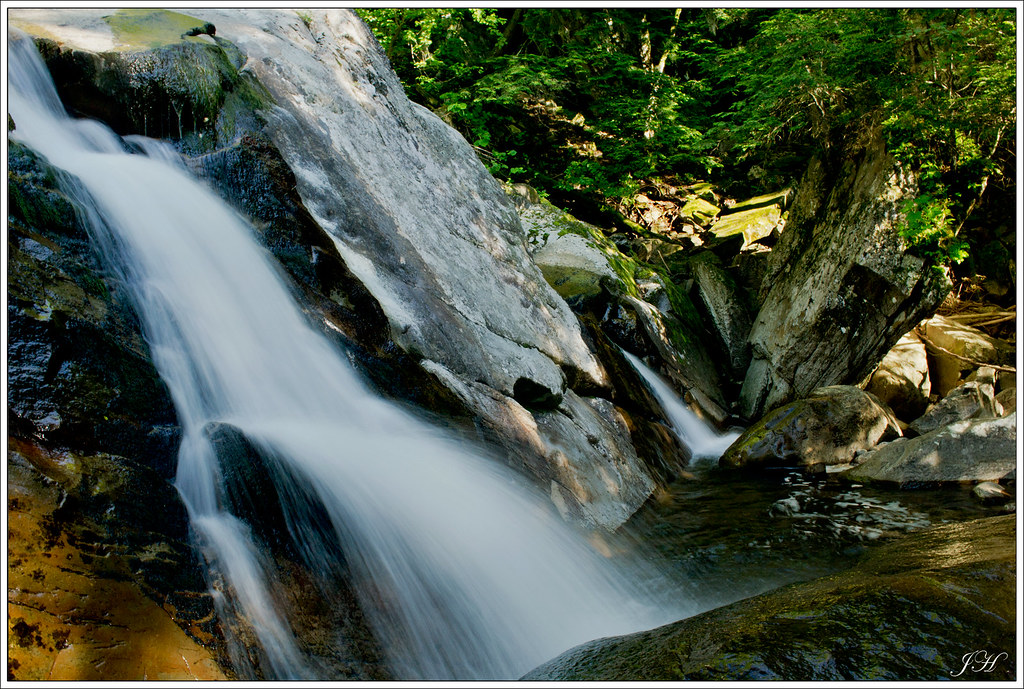
Handheld waterfall shot I took about a month ago. Just got around to editing it. I tried out using the #777 grey, threshhold, levels method that KmH recommended in another thread I started. Also tried a #777 grey overlay with black and white 20% opacity brushes to lighten and darken area's (better fake exposure I guess).

My thoughts:

1) It is rather green, but that's kind of how Vermont always is. So sick of the same old green green green VT landscapes. Really hoping to be alot better before fall comes.
2) I can't tell if my focus was off, if the image is just really noisy, or if I was having a seizure. It's probably blur from doing slower shutter handheld.

btw, I like to border and initial my shots. I don't do this for a living in the least and don't plan to. 100% hobby. I just think the border adds a little class I guess.
 
What waterfall is this? Didn't know there was another Vermonter on here!
 
Ok it's the falls of Lana right? It looks good to me but I'm on an iPhone so I can't see very well!
 
Your self criticism is great! Use a tripod and it will look a lot better. Although I must say for being handheld it could look a lot worse.

The reason the color is off is because all the areas around the waterfall are in direct sun. The waterfall is in the shade which is why it's so blue. Looks like your white balance was set for daylight not shade.

IMO the whole right side of the image is pretty blah, it's more of a distraction than a background. I would crop it vertically, getting rid of the right side and then try to photoshop that splotch of sunlight in the bottom left corner which also distracts me.
 
Nice shutter control. I am also learning. Did you use any filter?
I would like to see the water fall taken from different angle and in vertical orentation if possible. so that I can see more flow/curve.
 
I feel like this image is underexposed, and is begging for you to go back with a tripod and reshoot it.
 
MT, it is Lana which I have been to a few times. It's only ~30 mins away and since it's supposed to be one of the best falls in New England I'll probably keep going until I get it right!

Bekah, good catch with the sunlight thing. These are the things I need to learn to look for, when I'm actually in the field I never stop to think. Still in the point and shoot phase I guess. I'll try a recrop and see if I can't get a better result. I like to keep my images wider than taller though, I use them all as backgrounds. Wonderful Windows 7 (sarcasm), at least they came up with the rotating background idea!

Richards, I have a bad habit of always leaving my Polorizer on, so there was a polarizing filter.

D-B-J, I do have an explanation for that one. Until last week I realized that the Gamma on my monitor was set brighter than normal, so when I brought images up from a shoot they would all come out overexposed. To compensate for this I would just take images that seemed dark on my LCD. I know I still need a lot of exposure practice, but if you were to flip through my flickr account you will find that 90% of my images are all over exposed. :( I also like an overly sharp, high contrast photo, so that doesn't help when i am going for realistic images >.<
 
Last edited:
I have to comment and say that if you're going to do a watermark, your image is a perfect example of how to do it. I hate trying to look past/through watermarks to get the feel of an image.
 
I feel like this image is underexposed...

I agree. Waterfall photography is best done on either A) overcast days, or B) early morning or dusk. When you shoot waterfalls in broad daylight (e.g. any time after early morning when strong, direct beams of sunlight are hitting the ground), you run into all sorts of exposure problems.

The most common waterfall exposure problem experienced when shooting at inconducive times or under inconducive weather conditions is usually the occurrence of "sun burn". The sunlight directly strikes the whitewater of a waterfall and causes ugly, blown-out patches on the water every time you attempt to produce a balanced exposure. Even though it would appear that conditions were not favorable to waterfall photography at the time you took this shot, you managed to avoid this common problem by virtue of the fact that you found a waterfall which was shrouded in shade.

But other problems have nonetheless popped up here, almost all of which can be attributed to the simple fact that the conditions just weren't right for waterfall photography.

For starters, the bright light on the forest in the right-hand side of the photograph has done considerable damage to the overall exposure of the frame. Preventing those patches of direct sunlight from blowing out meant severely under-exposing the rest of the shaded areas of the shot... namely on your subject... the waterfall. The result is that the waterfall looks flat and washed-out, lacks sufficient contrast, and ends up losing its power in the frame.

Notice, also, that the further you look to the right-hand side of the frame, the more unrecognizable everything becomes. Because the background of the shot is being pelted with bright sunlight, which in turn casts pitch black shadows, all of the natural contours of the trees and rocks get lost in the powerful contrast between light and dark. You probably hear people talking about certain photos as having "great contrast"... but great contrast generally accentuates or enhances natural forms found within the frame. "Bad contrast", on the other hand, works against these natural contours... it is "imposed" on the scene (in this case by sunlight) in a way that is arguably destructive to the shapes that are present.

So, right off the bat, you can drastically improve your waterfall shots simply by not shooting at times when there is direct sunlight. Shooting around sunrise or sunset works well, though even under these circumstances you still need to be conscious of disparities in light within the scene. Some truly phenomenal waterfall shots can be had on overcast days. The reason I stress overcast days is because A) there is NO direct sunlight to cause serious exposure problems, B) light levels are relatively low so slow shutter speeds can be had with little more than a polarizer, and C) the scene surrounding the waterfall will retain its natural contours and look considerably more appealing.

Hope I could be of help.

Oh, and I also agree that you ought to...

...go back with a tripod and reshoot it.
 

Create an account or login to comment

You must be a member in order to leave a comment

Create account

Create an account on our community. It's easy!

Log in

Already have an account? Log in here.

New Topics

Back
Top Bottom