What's new

CMOS Sensors - Blue Channel - Boosting

Caps

TPF Noob!
Joined
Jul 10, 2012
Messages
47
Reaction score
3
Location
Wash. Dc
Can others edit my Photos
Photos OK to edit
hello all,

I ran across an interesting video about the value of using glass filters (either screw-in or square) in the digital age. The claim was that certain affects cannot be duplicated in PP or shouldn't be tried due to IQ degradation. In short, there is still value to old-school glass filters (brought to you by Tiffen, BW etc)."Drink milk - brought to you by the dairy council":lol:

Anyway, in the video they talked very briefly about blue filters (80 filters) and recommended them for boosting the "weak and noisy" blue channel. The moderator said that weak blue channels are inherent in all silicone based chips and that an 80c filter would help with this problem.
I have no reason to doubt a man giving a lecture in front of Schnider, BW, Tiffen and high level people of the industry.

How does the glass filter aid the chip? Does custom white balancing shift something to cause the blue channel to become noisy? How would you deploy this in the field?

Of course the 80 filters are designed to WB yellow light but I just don't know how he is recommending their use.
 
Last edited:
When was the article written, and what generation of detector were they using?

Detector chemistry was altered years ago to introduce materials such as "Indium Tin Oxide" to boost blue response. The "Quantum Efficiency" of the blue channel is quite good. Sensors in the early 1990s: different story. Looking at the spectral response of the CMOS sensor used in the full-frame Kodak DCS14 over 10 years ago, the response curve is about the same as film.

White balance built into the camera is more effective than using color correction filters.

Color filters are useful for the new Leica M Monochrom camera. Both color-correction filters and selective color filters are useful because the camera's sensor does not record color information. Color filters are used on the Monochrom camera the same as with film.

If interested- comparison shots here:

http://www.dpreview.com/galleries/876628771/albums/m9-and-monochrom-comparisons

Red filter on the Monochrom versus Leica M9 "red-filter" simulated in Silver-Efex 2.
 
Last edited:
just a follow-up- If the lighting conditions are Way-Out-There: like heavy Tungsten lighting that needs to be cut with an 80a and deeper, the auto-white balance of the camera would cut the red channel in "about half" to correct the color after the image was taken. If you used an actual filter, for the same exposure- the red channel would be cut in about half as it is being taken. If pixels in the Red channel had "saturated", or blown out: you would have been better off using the color correction filter to preserve highlights.

If lighting was heavy in the blue channel, or green channel- a color-correction filter would help in the situations where the highlights were being blown-out.
 
Bear in mind that the standards expected of professional motion pictures are often significantly higher that those required for general still photography, and the efforts to achieve those standards are often prodigious.

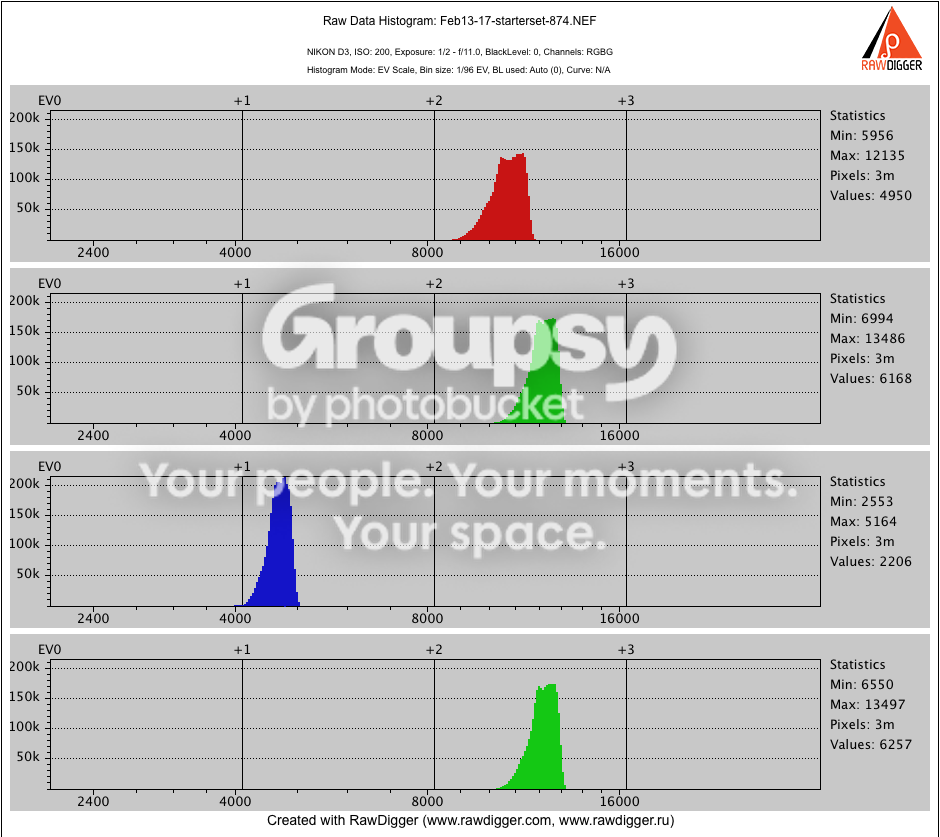
If you want to investigate the response of your camera in different types of light, try using rawdigger on an image of a grey scale, or just black and white, or just any neutral card at different exposures. Notice where the peaks occur in the four channels (RGGB). This exercise should give you a good feel of the relative amounts of change necessary to achieve equal R, G and B values.

The overwhelming evidence is, of course, that it is perfectly possible to take great pictures without a light balancing filter in front of the sensor (either in front of or behind the lens) and that one shouldn't worry about it, especially if you expose for the highlights. If you start to run into problems, then it may be a useful piece of information. Or not.
 
This is an example of the raw histogram of an image of a neutral white in 2850 K incandescent lighting, shot with a Nikon D3. You can see that the green channels have the highest values, closely folowed by the red channel. The blue channel is the equivalent of over a stop down from the green. If you really wanted to balance these you would need more of a true light blue filter than an 80 in this case - because an 80 would have too much negative influence on the red.

houseincanD3_zpscb3f8e91.png
 
Helen B...

Thanks for going the extra mile !!! It appears you've got the answer, blue filters are not needed.

I'm glad I asked the question though....thanks again.
 
He may be right about the poor response and high noise in a typical blue channel. But let me show you why this doesn't matter.

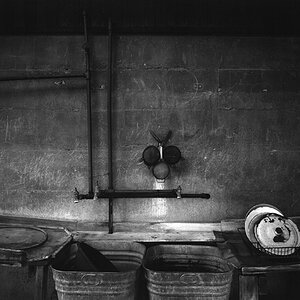
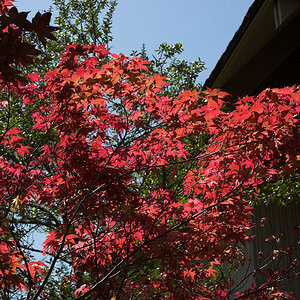
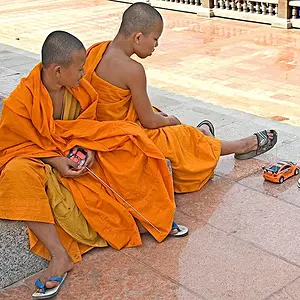
Below we have an identical image 3 times. The top one is the original file. The first one down is the original image, scaled down to the size you see, with a 3px gaussian blur, and then a 25% uniform noise distribution applied to the pixels of the image. This second image has the settings applied to the blue channel only. The bottom image is the exact same thing again, however this time it's applied to the green channel only. Notice how the blue doesn't look too bad compared to the original, yet the green one is completely screwed? Our eye sensitivity makes the blue channel almost redundant, we just need it to fill in a bit of colour information. This is also leveraged by a lot of lossy compression algorithms which start by completely butchering the blue channel.
Original:
DSC_4184-Orig_zpsd417fdb4.jpg


Blue butchered:
DSC_4184-blue_zps9c94009c.jpg


Green butchered:
DSC_4184-Green_zpse9201a2b.jpg
 
KAC-12040 - Surveillance - Markets - Products - CMOS

Looking at data sheets from modern sensors, the "QE", Quantum Efficiency, of BLUE channels is on par with green and red. From the new CMOS sensor from Truesense,
"
40%, 45%, 43% (470, 540, 620 nm)
"

The first generation of sensors, it was very low and was noisy. If you need details at this level, try to get the data sheets from the sensor and check out the spectral response curves.
 
Does it give numbers for full well-charge, darkcurrent, spectral response, etc?

Much of this information is in the manufacturer's data sheets. For sensors used in the scientific/technical market, they are available. Kodak and now Truesense made them available for their products. Some others do as well, but Sony and the manufacturers that produce sensors for commercial cameras keep much of it proprietary. Some manufacturers encrypted some of the fields in their raw files.

Leica published the spectral response of the M Monochrom, and I have it for the M9 and M8.

Too add: the original question concerned excessive noise in the blue channel of silicon based detectors. Noise is a function of dark current (the "background" current generated in the absence of light) and being more noticeable in one channel versus the other two means the Quantum Efficiency for that channel is low. This was true of the blue channel in first generation detectors. Kodak improved sensor chemistry to extend blue response around 1995, probably ahead of other manufacturers. The sensor used in the Nikon D100 seemed to have poor blue response, remembering forum discussions on it and the Epson RD-1. If the QE is relatively even across the channels in the sensors, and it is in the data sheets that I've seen lately, there should be no reason to expect one to be any noisier than the others under normal lighting conditions. Use a darkroom red light for lighting, Blue and Green channels will be noisy.
 
Last edited:
I've never used Rawdigger- just looked it up. It gives a good analysis of the data stored in the raw file, but this is not the same information as given in sensor data sheets. Data sheets give the performance specifications of the detector, down to electrical and spectral characteristics.

What Rawdigger does now, I used to do in FORTRAN many years ago. I dug out some software written in the 80s to look at the DNG files from the M9 and M Monochrom. Hard to believe that processing files from the Monochrom are a problem for any vendor.
 
The raw file tells you all you need to know in this case; the sensor data alone is neither sufficient nor necessary.

Although the improved quantum efficiency for blue wavelengths helps, it is not the whole answer to this issue (an issue that we all agree is usually unimportant, of course).

What you seem to forget, and what the RawDigger histograms I posted show, is that there are plenty of common light sources that result in a lower blue sensel response in practice, and hence less signal/noise.
 
Like I stated, if you use a red light for illumination -you will not get much response in the blue or green. They will be noisy. Most lighting sources are not so far off from the norm, color correction filters that cut 50% of one portion of the spectrum versus another are usually all that is required.

If your histogram was of a sunlit scene, I would guess that the blue response of the sensor is much less efficient than green and red. This is where knowing the spectral response comes in handy. Basically, it would let you optimize selection of a color correction filter before taking the shot to minimize noise. You might choose a color filter that is stronger or weaker, more like what was done for film balanced for a different lighting sources. In the case of the early silicon detectors, it was more like orthochromatic film.

If I were going to use color-correction filters to get better signal/noise, it would make life a lot easier knowing the spectral response of the sensor, the color correction filter, and the lighting source to get a correct white balance. The raw histogram data is a convolution of the three along with the colors in the image.
 
Last edited:
Helen, I don't fully understand your charts.

The light source you're using is quite light on blue spectral content, isn't it? So with a perfect sensor you'd expect the blue to be quite low. Is that what you're saying with the charts?

I'm having a little trouble distinguishing issues about the actual spectrum (light falling on the subject) from issues about sensor efficiency. Your charts seem to be about both, since they're describing what was measured by the sensor?
 

Create an account or login to comment

You must be a member in order to leave a comment

Create account

Create an account on our community. It's easy!

Log in

Already have an account? Log in here.

New Topics

Back
Top Bottom