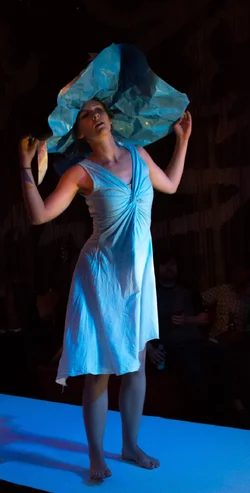
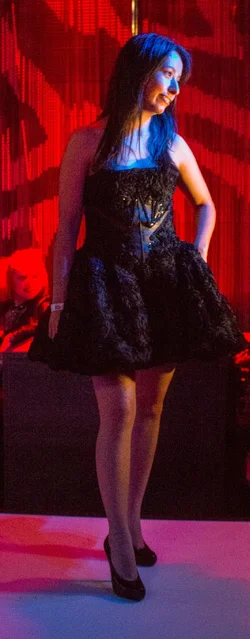
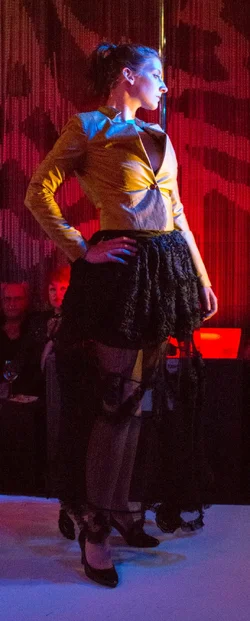
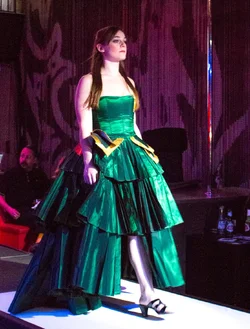
Spot lighting of that type produces very extreme scene dynamic range between the highlights on the face and skin, and the darker areas, like the stocking and shoes, and the areas thrown into shade by the costuming, skirts, hats, or whatnot. You need to shoot in RAW mode, 14-bit if your camera offers 14-bit, because you might very well be doing some **extreme** data adjustment in post.
One of the single biggest problems is light metering; a spot-lighted face is often placed in front of a large not-lighted dark curtain, and so the metering system will tend to over-expose the face by as much as 4 f/stops. I encountered the same issues at a recent theatrical stage play, and at my son';s graduation. Spot lighting, against a dark,dark red velvet draping, or a plain, dark, not-lighted background.
I used a 135mm f/2 and 85mm f/1.8 lens, center-weighted metering, set to Minus 1.7 to Minus 2.3 EV. On wide-angle shots, I went to Spot metering and Minus 1.7 to Minus 2.7 EV; I used spot metering because with a wide-angle lens, even the smallest center-weighted metering covered far too great an area.
I think you will find that in situations like this, spot-lighting on people seen against not-lighted backdrops, that Av mode and a Minus Exposure Compensation of Negative 2.0 to Negative 2.7 EV AND CENTER-Weighted metering with telephoto lens length is the easiest for run-n-gun shooting. You really want to avoid blowing out and terribly over-exposing the spot-lighted faces! Get the faces right, let the clothes go darker in-camera, then "lift" the shadows up later, in post processing, using digital fill light.




![[No title]](/data/xfmg/thumbnail/36/36135-6594fe1d58af0053c3e939665e543ce4.jpg?1734168245)
![[No title]](/data/xfmg/thumbnail/30/30876-d35f95603398bf3423b26c68d344f018.jpg?1734158870)
![[No title]](/data/xfmg/thumbnail/30/30875-d76f1fa085aee4334cb6b0cd62bb5e2d.jpg?1734158867)
![[No title]](/data/xfmg/thumbnail/36/36132-5bd4fa365c199003273e0ff128bf42f4.jpg?1734168228)