No offense, but from your post I can tell that you're not particularly up to speed with camera terminology or function. I highly suggest taking a merry old jaunt through the instruction manual and taking notes on some of the basics. There's no "cranking up" of your aperture. The larger the number it's "cranked" to, the smaller the lens opening. If anything, you're cranking it down. On top of that, such a small lens opening can cause softness in the photo due to the way the light diffracts through the optics.
Don't get me wrong, it's not always best to shoot at the widest aperture available, but it's definitely not always best to shoot at the smallest.
Got it. Thank you so much for the information...

So the key is once you are inside the house is to lower the ISO for better image quality, "lower the aperture, thus larger lens opening to catch more details", use a tripod and Buy a wider lens.....
Probably next times, I'm going to screw around strictly with the M mode for a solid hour once inside the house until I start getting what I'm looking for.
You can tell for example in this slideshow that he is using the criteria above:
Europe House of the Day - London Penthouse - Photos - WSJ.com
actually, pretty much the opposite of what you said.
you don't even need to shoot in full manual, you just need to know more about what you are doing.
you want to shoot in the lowest iso possible at all times, if you're using a tripod then your iso should be as low as it goes.
aperture: smaller hole (like f22) = greater depth of field = more in focus. bigger hole (smaller number, like f1.8) = smaller depth of field = less in focus. If you want to take a picture of something close and blur out the background you'd use a BIG aperture size (which is identified by a small f-number)
set those two things, and then just set your shutter speed to get the correct exposure. you can even shoot in aperture priority mode, and just get the aperture where you want it.
remember that as you move the aperture size one way, your shutter speed has to move in the opposite direction to compensate the exposure. if you want more in focus, which is a smaller aperture size (bigger f-number like 16 or 22), the hole is smaller and letting in less light so you either need to slow your shutter speed down to let enough light in.
For example, if you don't want to get a tripod:
- Make sure your lines are straight. Vertical lines in real life need to be vertical in the picture
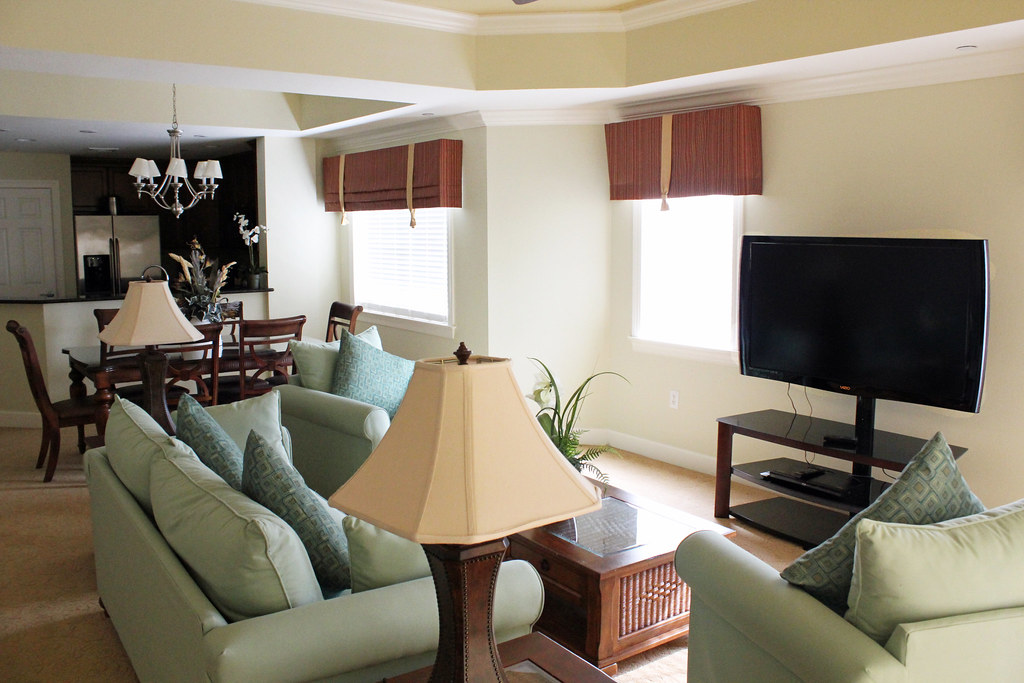
- If you're doing a picture of a room, for example, start around f/8 (that's "normal" or in the middle) and iso 100 or 200, whichever is your camera's lowest (without being called "Lo")
- Adjust your shutter speed so that you get a correct exposure.
- If the shutter speed is too slow, so you get a blurry image, you can:
(a) get a tripod; (b) increase the iso and increase the shutter speed until you get an acceptable speed (like 1/30th or 1/60th of a second or so); (c) increase your aperture size (smaller f-number) and increase your shutter speed until it is acceptable, but remember that the depth of field will be shallower (less in focus)
There's the condensed version of exposing a picture lol