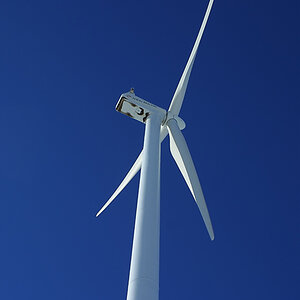
It is a Monochromatic image; a monochromatic image is a full range on any single color from the lightest value to the darkest value of that color - B&W. Other than a straight, high contrast image - all black and all white, there is no such thing as a B&W print, perse.
This really only to do with chromatic range. There is a 100% black value and a 100% white value and depending on your scaling device, about 256 values of "grays" between the two. The grays can be a tint of the original color, thus the darkest value achievable with that color would be the 100%. Since we do not look at paper on the net it is not the true issue. However, using some pretty sophisticated densitometers, Jon Cone (http://www.inkjet-mall.com) has produced as white a paper as I've ever seen and that include Hahnemuhle's.
There is a 100% black value and a 100% white value and depending on your scaling device, about 256 values of "grays" between the two. The grays can be a tint of the original color,
You are getting me wrong with this explanation (sorry), I print on silver-gelatine paper so just 256 values of gray don't apply to me. My question was about the paper as the white depends on that. The black we can get using this or that method, the white is somewhat beyond our control. Is this the cause that B&W image cannot exist ?
For this, I'd have to know what paper you are using. IMO, the best B&W paper I ever used was Agfa as far as the pureness of white, but I think there isn't a piece of Agfa left in the world. I am going to assume if you are a hard core film guy you're not using much polycontrast paper. It's not terrible but I don't think it can ever replace graded papers. Foma makes a pretty good white as did Ilford and Kodak made a paper called Portra which was a damn good white with a beautiful gray range between.
The problem as you pointed out earlier, is what defines white? Thus, it is probably correct to say there cannot be a true B&W print based on any criteria...And I guess that's why they make so many papers.
What format are you shooting (as a general rule) and what enlarger are you using?
Too bad you live so far away, I have a C23 and a C45 cold head sitting in my garage looking for a new home....but the shipping costs would be prohibitive. I've promised them to a photo teacher in Miami, but if he doesn't take claim by the end of the month, they're up for grabs...along with a Zone 6 washer, tons of paper, some chems, trays, etc.
The only chemical work I do anymore is in alternative and I use digital negatives for that.
There is a 100% black value and a 100% white value and depending on your scaling device, about 256 values of "grays" between the two. The grays can be a tint of the original color,
You are getting me wrong with this explanation (sorry), I print on silver-gelatine paper so just 256 values of gray don't apply to me. My question was about the paper as the white depends on that. The black we can get using this or that method, the white is somewhat beyond our control. Is this the cause that B&W image cannot exist ?
There is a 100% black value and a 100% white value and depending on your scaling device, about 256 values of "grays" between the two. The grays can be a tint of the original color,
You are getting me wrong with this explanation (sorry), I print on silver-gelatine paper so just 256 values of gray don't apply to me. My question was about the paper as the white depends on that. The black we can get using this or that method, the white is somewhat beyond our control. Is this the cause that B&W image cannot exist ?
Too bad you live so far away, I have a C23 and a C45 cold head sitting in my garage looking for a new home....but the shipping costs would be prohibitive. I've promised them to a photo teacher in Miami, but if he doesn't take claim by the end of the month, they're up for grabs...along with a Zone 6 washer, tons of paper, some chems, trays, etc.






![[No title]](/data/xfmg/thumbnail/37/37606-3c9ffb5906173fa2aa489341967e1468.jpg?1734170733)

![[No title]](/data/xfmg/thumbnail/37/37604-7ad625e983f92f880eb65a264eeef5e4.jpg?1734170732)