As mentioned, you can use (understand) the inverse square law, which says that light falls off at a rate that is inversely proportional to the square of the distance. So if the first person is 5 feet away (from the light) and the 2nd person is 10 feet away (twice as far), they second person will only reflect 1/4 as much light. If the second person is 15 feet away (3 times as far) they will only reflect 1/9 as much light. And so on.
Now, it should be noted that this law really only applies (in that way) to diffuse reflection. So if you had a white piece of paper, this rule would work out as expected. But when it comes to direct reflection, brightness of the reflection isn't affected by the distance (only size). For example, if you have a mirror reflecting your light source, it will be just as bright at 10 feet, as it is a 5 feet.
I could go on...but hopefully that is enough to move on. Now, human skin (like most things) has properties of both direct and diffuse reflection. But the darker the skin, the less diffuse reflection it has...and the more oily or sweaty it is, the more direct reflection it will have. So when lighting darker skin, you have to realize that it may take a lot more light, to get enough diffuse reflection...and diffuse reflection is what shows us the color etc. But at the same time, you need to realize that because there is less diffuse reflection in dark skin, the direct reflection (glare) will show up even more. So it's pretty typical that your lights will cause glare or hotspots in darker skin, more than it will in lighter skin. One technique is to use a very soft light for darker skin tones (a large light that is close to the subject).
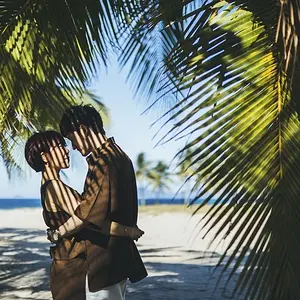
On top of all that, you need to realize the limitations of your camera and your lighting. As you have seen, if you expose for the lighter skin tones, the darker ones are too dark....and if you expose for the darker tones, the lighter ones are too bright. That is what happens if they are both in the same light. So what you can do, is create a situation where they are not in even lighting. If you have an on camera flash, that may be very hard to do, but if you have off-camera lighting it's something you could probably achieve. Also, you may be able to find natural lighting situations where you can place your subject so that one gets more light than the other...so be on the look out for that.