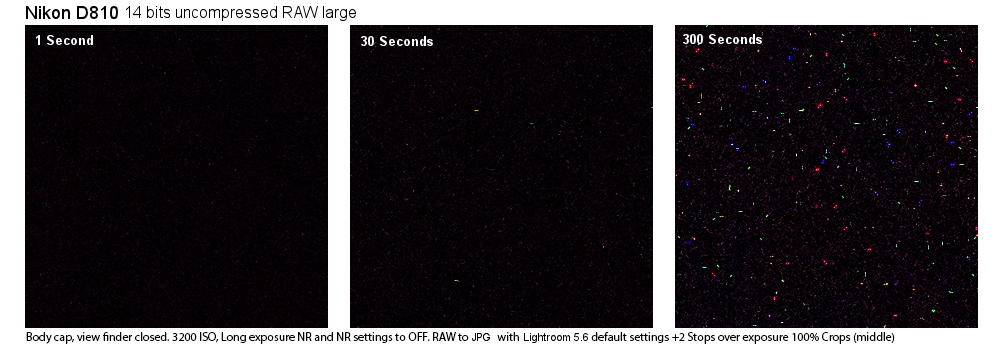
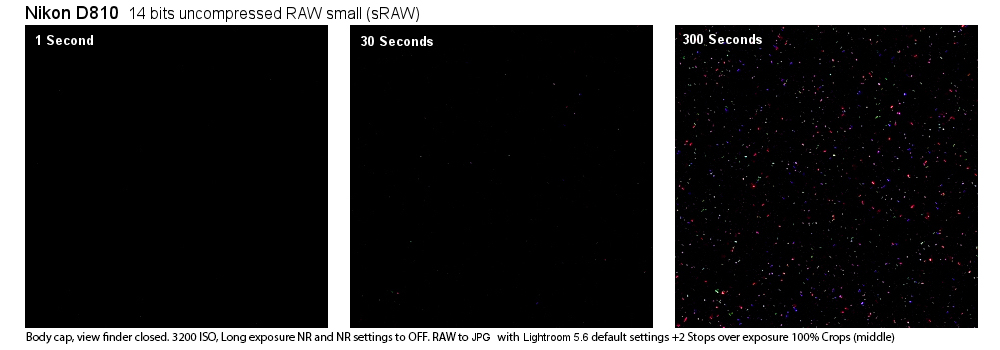
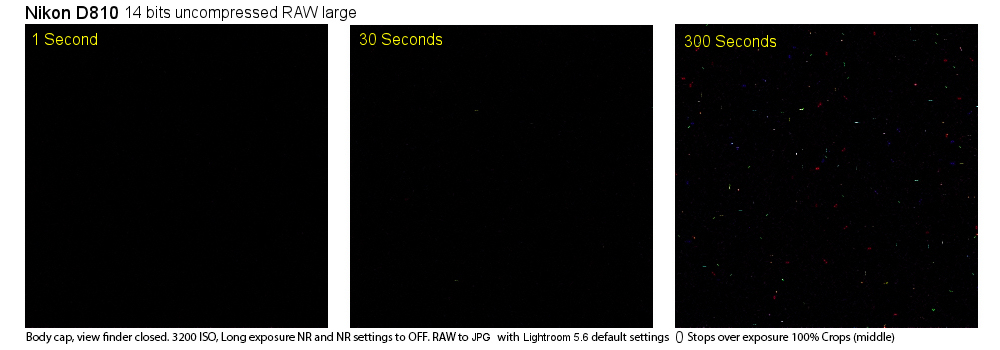
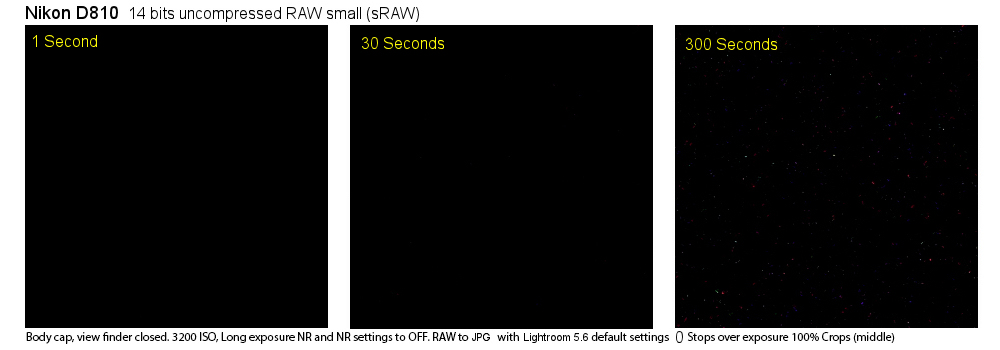
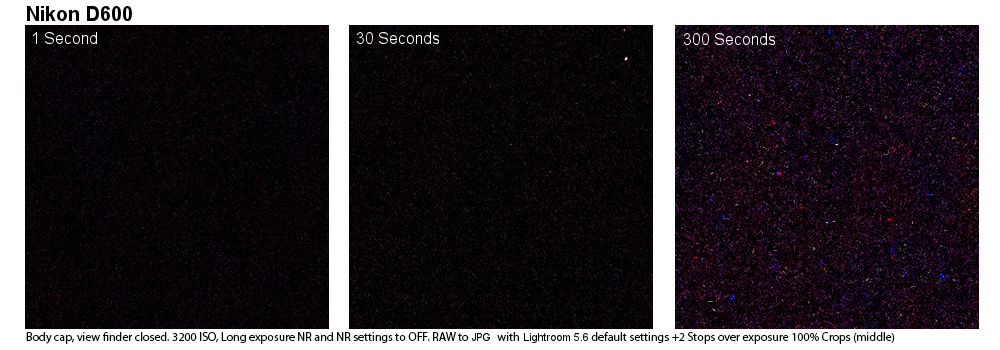
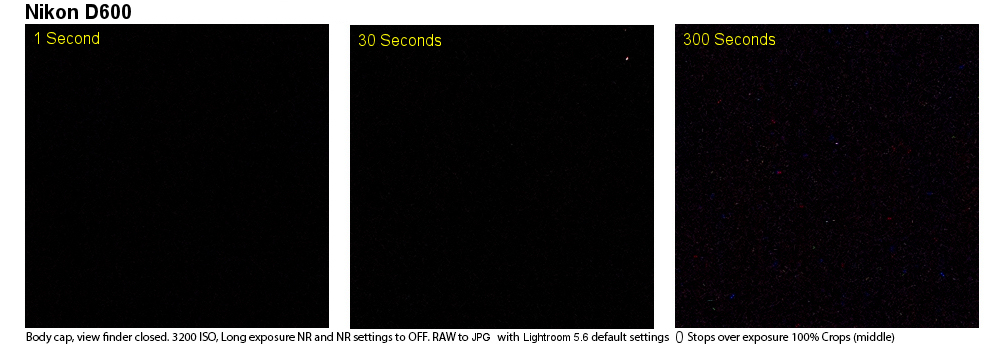
Physical camera temperature (how hot was it outside and how long had the camera been in use before doing the test) will impact these results as well. You can MASSIVELY decrease noise by physically lowering the temperature of the camera sensor. In frigid cold nights here in the north, it's much less of a problem.
However, the image registration and integration software can do wonders for this if you tell the auto-guider to dither when you're capturing your "light" frames.
The idea is that although the guider is keeping the scope tracking during image acquisition, you'll get both random noise and pattern noise in the frame in addition to the real data (e.g. stars, etc.) and at some point you wonder when something is "noise" vs. a very very faint background star. So you take multiple "light" images and "stack" them together using image processing software (I use PixInsight).
The noise can be knocked back by a factor of the square root of the number of frames you took. So if you take 9 "light" frames, you can reduce the noise by a factor of 3. Take 16 and you can reduce the noise by a factor of 4. This is because as long as the mount and scope are solid and tracking nicely then everything representing "real" data will appear in every frame and will occupy the same pixels, but anything appearing randomly (e.g. noise) will land on random pixels and the computer should be able to determine (via the stacking algorithm and you get to control which algorithms are used.) when it's "noise" vs. "data."
Sounds good, right? Well not quite.
Turns out you also get "pattern noise" where the same pixels tend to get lit up in each frame (given the same conditions when the image was taken and that includes physical temperature). That means the computer will think the pattern noise is real data.
But this is where the "dithering" comes in.
If you are using guiding software that integrates with your image acquisition software (e.g. I use PHD guiding and BackYard EOS for camera control and image frame acquisition when I'm at the observatory) then once the shutter closes, the image acquisition software will tell the guiding software to randomly move the scope by a few pixels. Once the auto-guider finishes moving the scope (it doesn't move far) it tells the image acquisition software that it's ready for the next "light" frame to be captured. You end up with a stack of "lights" which are each randomly offset just a tiny bit. But NOW your "data" will appear to be slightly shifted (each star will have moved a tiny bit) in each frame... meanwhile the "pattern" noise will not have moved. The "registration" component of the image acquisition software aligns each frames based on the stars and this causes the "pattern noise" to now appear in somewhat random spots. The result is that the computer can now, finally, figure out that this is, in fact, just "noise" and can safely be removed from the final integrated image. It's a beautiful thing when it all comes together like that.
BTW, for this to work it's better to use a stacking algorithm like sigma-clipping vs, say, "averaging". When you "average" frames the bad data just gets dimmer but isn't completely eliminated. But sigma clipping works a bit more like a winner-take-all "vote" for each pixel's value. E.g. suppose you've shot 16 "lights" of an object, but in just ONE of them... a satellite or aircraft went flying through the frame (something that happens more often then we'd like.) With 'averaging' that streak from the satellite or aircraft will get dim. But with sigma-clipping it's a bit different. The computer checks to see what color that same pixel was in frame 1 (black) vs. frame 2 (black) vs. frame (3) black, and so on... but then let's say in frame 16 it was lit up brilliantly due to the aircraft lights. Since the computer effectively has 15 frames that "vote for black" and 1 frame that "votes for white" then black wins. The computer discards the "white" value from that one frame that disagrees with the rest ... it's an outlier... and the result is a nice image. Averaging works best when you just have a few frames. Sigma clipping is better when you have lots of frames.
As for Back Yard EOS... that uses the Canon SDK to control the camera so it won't work on a Nikon camera but I hear they're developing a Back Yard NIK. I haven't heard anything on that in quite some time so I have no idea how it's progressing.







![[No title]](/data/xfmg/thumbnail/33/33362-84aacb865117bf8cba89104b89e9b36c.jpg?1734163304)