Pictorial Photography in America 1920
Pictorial Photography in America 1921
Pictorial Photography in America 1922
Well, is it?
Have we become so technology crazed, and lust so much for perfection, that we forget the beauty that came before us, with much less? I do realize this was all cutting edge at the time. But I think when we talk about image quality, we are always going towards perfection, rather than discussing image qualities which could be quite soft but still be an exceptional image.
In these books, there are ads for lenses, most of which are selling their softness, or quality of diffusion. There are a few that advertise sharpness, though.
In these books, there're many, many, amazing, outstanding images. Look how soft they are. I am really intrigued by this history. Would any one, or all of these images be better if they were sharp as today's standards? There's only a few that in would say yes to.
Derrel, how would one go about duplicating this sort of softness using todays technology?
Could something be done to a screw on filter to mimic this style with current lens selection?
Could something be done to the lens element, creating dedicated soft lenses?
Is it more than just the lens, and includes paper choices, film choices, etc?
There were some pretty clever optical designs in terms of lenses that produced wonderfully soft focus, or ghosty, flare-prone images. The famous Rodenstock Imagon lens used a diaphragm mechanism that had a BUNCH of small holes, which were selectable by the photographer, based upon the softness of the image. Here's a modern video showing an Imagon 200mm lens, used on a GH1 digital camera.
Screw-on filters work pretty well to create dreamy images. I have a collection of various softening and diffusing filters. Window screening material works wonderfully well with longer focal length lenses...in the early 1980's, I did a series of images which were shot through the Visqueen (storm windows) of the house where my father and I lived. That gave a very soft, impressionistic quality to the images. Plain UV or clear filters, sprayed with hairspray, clear lacquer, or smeared with Vaseline petroleum jelly--all three of those methods are pretty well-known. "Hairspray filters" give one type of effect. "Black netting diffusers" give another type of effect, a lot like window screen. Using two, or even three cross-star filters can work also. Fog filters work pretty well. Hell, for that matter, shooting in REAL FOG is a fun way to get pictorial-type images without any special techniques!!! (real foggy conditions--imagine that!!)
There ARE dedicated soft focus lenses. Nikon's 105mm f/2 and 135mm f/2 AF-D series lenses have Defocus Control, and allow you to defocus the image and create a misty, soft look that is very repeatable. THe effect looks a lot like a good-quality Zeiss Softon filter. Canon makes a very affordable, 135mm f/2.8 Soft Focus lens that has a sharp setting, and then two separate settings for softer, and then really soft-focus images. Minolta used to make a very impressive soft focus lens with some radical lens design that created impeccably smooth bokeh. The Lensbaby line is also
a line of soft focus + tilt lenses...I own some Lensbaby stuff...I actually prefer their ORIGINAL, with the bad single-element design, with loads of CA, over the 2.0 model that has a multi-element lens and which is much sharper.
The old-time pictorialists had some pretty involved print-making and negative-handling methods. Retouching on the negatives was common, as were operations like reducing and intensifying, hand-accelerated development, fogging of paper, pre-fogging of sheets of film, "knocking" the camera once or twice during longer exposures, shooting toward bright lights, and of course, finding lenses that delivered the Kind of images that were appropriate to the artistic intent. Pictorialism was big wayyyy before lens coating was invented, so multi-element lenses and "fast" lenses were much more prone to light loss due to internal reflection than later, coated lenses would be. The lenses of that time were, for the most part, more prone to flare and veiling (overall) glare at their wider aperture settings, so if a person shot with the lens at a weaker-performing aperture, its imaging characteristics would reflect that.
It is a mistake to think that ALL lenses of that era were junky: I saw an old folding Kodak camera's lens, made circa 1915, whose lens had been removed from the camera, and rigged up to shoot on a Sony d-slr. The image quality of the lens was pretty damned good, by modern standards. But there were also quite a few lenses that were designed to produce softer, less-aggressive contrast and less-aggressive sharpness, and those lenses were highly sought-after by people who wanted to create the more-dreamy "pictorialist" type images.
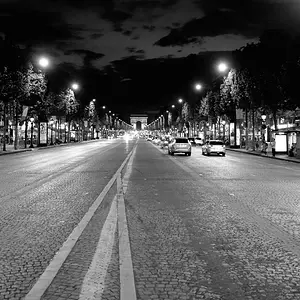
Sharpness IS OVERRATED in my opinion. Some of the greatest photographs ever made have some unsharpness due to subject blur, or camera shake, or bad focus, etc. Millions of wonderful snapshots and family pictures have flaws in them. Some great sports, news, and action shots are "flawed". If a photo lacks that certain something, it does not matter how sharp it is, it's not much of a photo. If a photo happens to HAVE that certain something, then it's a good photo. Maybe even a great photo. People who think that "only" sharp, clear, frozen images are valid are usually uneducated in the fine arts and are visually quite, how can I say this....they're visually quite plebian... They are the kind of people who rejected impressionist painting because, "it's all blurry and I can't tell what it's supposed to be about."



![[No title]](/data/xfmg/thumbnail/32/32162-dd2cfb373402c59de9c6f13cee73b0fb.jpg?1734161046)



![[No title]](/data/xfmg/thumbnail/33/33495-c9bffdaa44506a6169a2faff5c7e086e.jpg?1734163607)
![[No title]](/data/xfmg/thumbnail/41/41797-ed370d68dae70f5b0a7252ec2d525912.jpg?1734176109)
![[No title]](/data/xfmg/thumbnail/41/41800-9fad93555f178073cae2f303c5ef4e23.jpg?1734176111)