What's new

Sports photographer's opinion on long telephoto

I'm thinking about purchasing the newly announced AF-S NIKKOR 300mm f/4E PF ED VR to use on my Nikon D610, but I'm wondering how I will deal with its fixed focal length. I'm currently using the Nikkor 70-200mm f/4 for the soccer games of my son's team and the zoom is very useful. Since I can stand on the exterior lines of the field, I need the full range of the zoom. Some of the action happens 10' away from me, but most of the exciting action happens near the goal, and the 200mm is not enough reach, so I need to crop more than half of the picture. It's OK for watching on the screen, but it gets more complicated if I want a high resolution print of it. This is getting important because I've been selling a lot of photos last summer, and intend to provide a higher quality for larger prints next summer.

For those of you who have been using a fixed lenght telephoto for sports photography, how do you deal with this inconvenience? Am I exaggerating this problem?

My other option would be to purchase a new camera body, such as this upcoming D7200 that is rumored at the moment. On an APS-C camera, my 70-200mm zoom would become the equivalent of a 105-300mm. Also, the D7200 is rumored to have a decent buffer size, and hopefully has a higher capacity than 6 i/s. If so, then I'm sure it would be a less expensive option than buying this 300mm lens (2000$). I'm quite sure the D7200 with a grip would sell for less than that, since the D7100 goes for 1000$ here in Canada, and I would have a second body which is never a bad thing.

Sorry, a 1.4x or 2x converter is not an option for me...

What would you do?

for sports I have found a good 100-400 super to be the most valuable lens in the bag. I shoot Canon and use the venerable 100-400mm L f4 lens. heres an example taken from the balcony above 1st base of the LEFT fielder making a catch. These are hand-held.
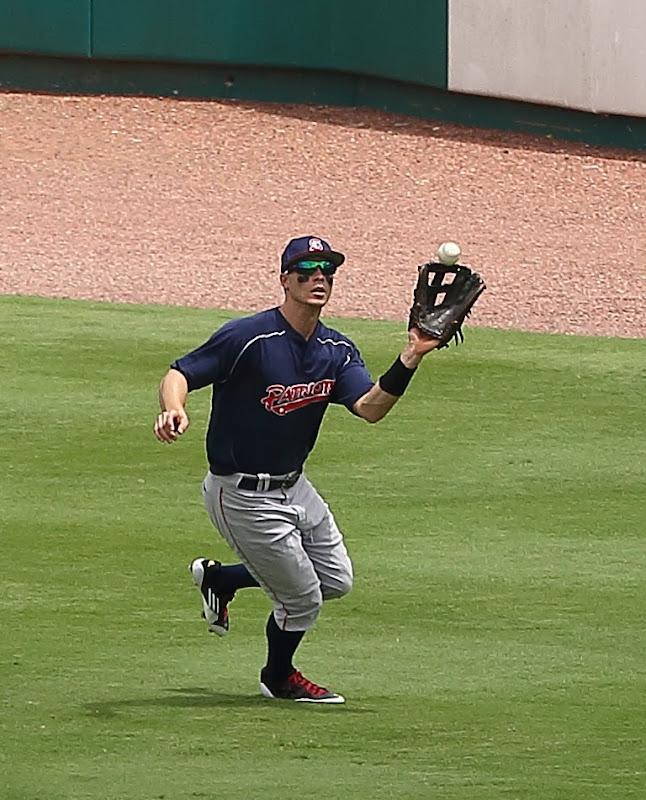
IMG_2759%2520v4.JPG


and another of home plate action
IMG_2617.JPG
 
Last edited:
Few thoughts:

1) Fixed focal length can be more tricky to work with in some ways because you can't zoom back; however at times this is not always a case of missing shots, but adapting how you work and where you're sited. A change of location might yield more keeper shots.

2) Many times Sports and other journalists will have two cameras with them to let them quickly change between wide range of focal lengths.

3) Understanding over the game and how it plays out in general will improve your chances with options 1 and 2 because when you can predict you can change to suit - or move to anticipate the direction of the ball and game.

4) Sigma makes a very nice 120-300mm f2.8 OS lens that might suit your desires. Giving you a zoom, but also a longer reach. The only downside is weight - its heavy and heavier than most 300mm f2.8 primes, (though not in a vast way


"""
Notes
Due to the characteristics of a PF (Phase Fresnel) lens that utilizes the photo diffraction phenomenon, when there is a strong light source within the frame or when light enters the lens from outside of the frame, ring-shaped colored flare may occur according to shooting conditions. This phenomenon can be minimized with "PF Flare Control" included in Capture NX-D. See the comparison images below: original image (above), PF Flare Control applied (below). Refer to the software manual for more information. Capture NX-D is available from our website. Please download and use the latest version."""

I found that interesting. This new technology that allows Nikon to produce a smaller, lighter lens, with less elements (I read cheaper) has a tradeoff.
 
didnt the new lens just double the amount of elements?
 
Pro shooters are often restricted to where they can shoot from.

For shooting local kid and adult soccer I generally set up on an end line near one of the corners of the pitch and stayed put.
I stayed low on a knee and with my butt on a Walkstool Portable Folding Chair.
My goal was to get shots of each player on each team.

I used 3 cameras and 3 lenses - a 24-85mm for action close to me, an 80-200 mm for action around mid-field, and a 200-400 (or 150-500) for action at the far end of the field.
 
Thanks for your all responses so far. Looks like my first idea is probably the best; getting an APS-C body and outfit it with my 70-200mm f/4, and maybe have my D610 as a backup with a shorter lens for wider shots happening close to me. Now the big question is should I wait for the rumored D7200 with better buffer size and hopefully higher i/s, or I should settle for a D7100? I don't have to make a decision before the end of April, and hopefully the D7100 (or D300) successor will be announced shortly. I can get a D7100 + grip for 1200$ here in Canada, most likely much less if I shop around, so this is by far the cheapest route for me.
 
Best solution If I was getting paid I'd definitely use a 2nd body/lens.

one lens I thought of, though slow, was the sigma 50-500. 50 being about 75FOV
500 being .. well .. quite a bit of reach. :)
So a crop body with that lens might be all that is needed in bright days. I'm not sure how that lens is though. For FX they had the 150-500 which wasn't short enough.
 
my GF is a sports photographer. She typically has 2 or 3 cameras going. Often a 300 f/2.8 on one, 70-200 on the other...and the 24-70 on a remote mounted to some railing so that when she takes a shot, the 24-70 takes the shot simultaneously from another angle.
 

Create an account or login to comment

You must be a member in order to leave a comment

Create account

Create an account on our community. It's easy!

Log in

Already have an account? Log in here.

Back
Top Bottom