What's new

why would DOF for a lens changes depending on sensor size ?

raywzou

TPF Noob!
Joined
May 4, 2013
Messages
2
Reaction score
0
Location
New York City
Can others edit my Photos
Photos NOT OK to edit
Hi,


I always though a (lens + f-stop + object distance) would define the DOF, and lens by itself would define the hyperfocal.

I recently came across this interesting link (Online Depth of Field Calculator), which says that the sensor size would affect the DOF and hyperfocal values. It is easy to understand that Crop sensor just takes a smaller part of the frame of the FF sensor from the same lens output, but why would it cause the lens DOF and hyperfocal to change ?
 
Umm... How do I go explaining this...

The whole discussion is actually pretty funny and the statement that a larger sensor always has less DOF than a smaller sensor is sort of true but not as simple as that.
DOF is dependant on a whole lot of variables and to be able to understand how it works you'd first need to understand its definition:

Wikipedia said:
In optics, particularly as it relates to film and photography, depth of field (DOF) is the distance between the nearest and farthest objects in a scene that appear acceptably sharp in an image. Although a lens can precisely focus at only one distance at a time, the decrease in sharpness is gradual on each side of the focused distance, so that within the DOF, the unsharpness is imperceptible under normal viewing conditions.

This definition means several things.
DOF is of course dependent on the lens length, aperture and focus distance. However, it is also dependent on something like a crop and magnification.

Technically speaking, given the same lens length, aperture, focus distance and magnification a crop sensor will indeed have the same DOF as a full frame sensor.

39081304.jpg


However, this is not taking any actual image sizes into account.
Say we have a full frame sensor of 8MP and a crop frame sensor of 8MP, this will give a different magnification. The magnification of the crop sensor in this case is larger as you will be more zoomed in on an image of the same size. This results in less DOF than on the full frame sensor! (Yes, you read correctly.)

42699107.jpg


Now to get to the reason why people say the DOF on a crop sensor is larger.
What happens if we want to take the same image on both 8MP sensors? Well, there's 2 ways to achieve this.
First you could use different lenses, a longer lens on the full frame sensor and a shorter lens on the crop frame sensor. This would result in the same field of view, but because the full frame sensor uses a longer lens its DOF will be less than the crop frame sensor with the longer lens.
The other solution is to use different subject distances by walking way back with the crop frame sensor. This would also result in the same field of view, but because the focus distance with the full frame sensor is shorter the DOF will be less than the crop frame sensor with the longer focus distance.


(Unfortunately I don't have any good ruler images to show you the exact differences. Neither do I have a full frame camera to do a good comparison with. However, I think the general idea is pretty clear now.)


What is interesting by the way is that the first example (with the same magnification) can be compared to a simple crop in Photoshop and the second one (with the same MP count) to a resize in Photoshop (yes, it's cropped too but that's not really the point here).
Basically this means that by resizing an image in Photoshop you will alter the DOF. Making an image larger will make the DOF smaller while making the image smaller will make the DOF larger.

 
Not to call you out but this statement "Technically speaking, given the same lens length, aperture, focus distance and magnification a crop sensor will indeed have the same DOF as a full frame sensor." is not true.
Sensor size actually does plays a role in the DOF calculation, sensor size relates to the circle of confusion. APS-C sized sensors number is 0.019948 and full frame 0.02501
I won't get into the actual calculations but if you're interested they can be found here:
http://www.dofmaster.com/equations.html
 
Not to call you out but this statement "Technically speaking, given the same lens length, aperture, focus distance and magnification a crop sensor will indeed have the same DOF as a full frame sensor." is not true.
Sensor size actually does plays a role in the DOF calculation, sensor size relates to the circle of confusion. APS-C sized sensors number is 0.019948 and full frame 0.02501
I won't get into the actual calculations but if you're interested they can be found here:
http://www.dofmaster.com/equations.html

Doesn't Judobreaker go on to explain this very well, after showing the conditions under which the original statement is true? I suspect that J understands this very well, and has certainly put some effort into the answer.

The statement is correct, by the way. Nothing to be called out on. 'Same magnification' is the key part to understand.

edit: Remember that the maximum acceptable circle of confusion is not an absolute value that applies to a given sensor size. As Judobreaker says, it depends on the final magnification from the sensor size to the viewed size (among other things). It should not be quoted to four or five significant figures, because it just isn't that precise a value. Two sig figs is closer to the true precision, but even two may be overstating it.
 
Last edited:
Not to call you out but this statement "Technically speaking, given the same lens length, aperture, focus distance and magnification a crop sensor will indeed have the same DOF as a full frame sensor." is not true.
Sensor size actually does plays a role in the DOF calculation, sensor size relates to the circle of confusion. APS-C sized sensors number is 0.019948 and full frame 0.02501
I won't get into the actual calculations but if you're interested they can be found here:
http://www.dofmaster.com/equations.html

First you're going to have to explain how a smaller sensor picking up the exact same light as a larger sensor would, given the same pixel density, yield different results besides of course the crop frame being a crop of the full frame. If we assume the sensor does nothing more than collect the light coming in through the lens and displaying it in an image it is physically impossible to get different DOFs in this scenario.
Then you'll have to explain to me how a crop sensor with a higher pixel density will give the exact same DOF as one with a lower pixel density. The higher pixel density (more MP) will have a larger magnification which will result in something appearing out of focus much faster than the lower pixel density.

As far as I see this is all 'simple physics'. Unless I am seriously missing something or am misinformed of the way sensors work my statement is very true.
Please, do correct me if I'm wrong but with detailed explanations if you can. ;)
 
It just does. Don't worry about it.

Interesting point... I never looked at it from that perspective.
That really helps me understand things!


[/sarcasm]

Sure I was being flippant but it is an approach, you have your lens/sensor combination, you have a DOF calculator.

You don't need to know how internal combustion engine works to be a good driver.
 
Of course it is an approach, and one that works fairly well for a lot of people. ^^
However, if one is interested in the inner workings just for the sake of knowledge (which would be the case for me usually) it's not really a satisfying approach. :P

Besides, DOF calculators usually don't take pixel resolutions into account so they're more of a guideline then a precise calculator.
 
It just does. Don't worry about it.

Interesting point... I never looked at it from that perspective.
That really helps me understand things!


[/sarcasm]

Sure I was being flippant but it is an approach, you have your lens/sensor combination, you have a DOF calculator.

You don't need to know how internal combustion engine works to be a good driver.

Well, the OP did ask the question. If you asked a question about why something was the way it was, would you prefer an explanation or would you prefer to be told you don't need an answer so don't worry abou it? (Who is worrying, anyway?)

The answer to this question does help the photographer to understand when a DoF calculator will give an inappropriate result. It may help in some circumstances, it may not help in others. There's no disadvantage in trying to understand what is going on.
 
Say you want to take a portrait. Someone's face, basically, from maybe 7-8 away for good proportions.

- On a full frame sensor, you're looking at maybe an 80mm lens. The magnification might be 20:1 or thereabouts.

- On a camera with a GIANT SENSOR, say 8x10 sheet film, you're looking at 700-800mm lens. Very roughly. The magnification is more like 2:1 here.

Magnifications might be 1:20 and 1:2 respectively. I have never sorted out which side goes where.

Remember how a lens works, roughly:

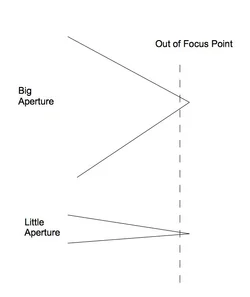
A point on the subject reflects light. That light bounces all over the place, but some of it hits the lens, goes through the lens and bangs into the sensor. The rays of light from the SUBJECT to the LENS form a cone, with the point on the point of the subject, and the base of the cone on the lens. You can think of the aperture-opening of the lens as the base of the cone.

At the same aperture, the hole in the bigger lens is 10x wider than the hole in the small lens. Visualize the cone of light from the SUBJECT to the sensor. You're the same distance from the subject in both cases, but the base of the cone is 10x wider.

So for one single point on the subject, you have a long skinny cone with the little sensor, and a massively fat cone for the big sensor.

Now what happens if the point isn't quite in focus? The cone is skewed back and forth a little. If it's a skinny cone, you're still near the top so maybe it's not a POINT but it's pretty small. If you have an enormously fat cone, and you skew back and forth the same about, you get a much much fatter blob.


$DoF.webp


Note that the key point here is that we're hold a LOT of stuff fixed. The distance to the subject and the aperture, for instance. If you stop down to the same physically sized aperture on the big lens as the small one, you'll get the same DoF.

If you move the subject proportionally farther away from the lens, and leave the aperture alone, you'll get the same DoF.

Exercise to the reader: estimate how much more open the aperture needs to be on a crop sensor versus a full frame to get the same DoF.
 
Another helpful way to look at this question is to simplify the originally DOF equation as quoted (lens + f-stop + object distance) -- remember grade school pre-algebra?

DOF = f/stop + focal length + object distance.
focal length + object distance = magnification.
DOF = f/stop + magnification.

To take the same photo with a crop sensor camera versus a full frame sensor camera you must capture the subject at a reduced magnification and vice versa. This explains WHY we assign different circle of confusion values to different size recording media.

Joe
 
The whole point here is that the DOF technically isn't different but when you want to make the exact same picture the DOF will be different because you're changing factors.
 

Create an account or login to comment

You must be a member in order to leave a comment

Create account

Create an account on our community. It's easy!

Log in

Already have an account? Log in here.

New Topics

Back
Top Bottom