What's new

Astro photo question

Turnerea

TPF Noob!
Joined
Aug 28, 2008
Messages
212
Reaction score
0
Location
SoCal
Can others edit my Photos
Photos OK to edit
I've seen many pictures of this style:

http://parkerlab.bio.uci.edu/pictur...new for web/big thumbs/tn_IMG_3177_tweak2.jpg

(not shown in the post because I didn't take it)

What techniques would you guess are at play here?? In my head its got to be one of two ways:

*very high ISO to capture all that detail in the stars before trails can be formed. I'm thinking you'd have to have a full frame sensor to keep the noise down for high ISO for this option, and shoot at wide angles to allow the longest time possible.

*a stack effect to get all the stars (with or without a moving mount?), then digitally combined to place the arch in front

Obviously people won't know what really happened to make this picture, but maybe some people with experience with these types of shots can shed some light on how they accomplished them?

Thanks,
Erik
 
Camera Make: Canon
Camera Model: Canon EOS DIGITAL REBEL XTi
Image Date: 2009:01:17 20:23:15
Flash Used: No
Focal Length: 10.0mm
CCD Width: 14.85mm
Exposure Time: 137.000 s
Aperture: f/3.5
Focus Distance: 0m
ISO equiv: 1600
Exposure: Manual
Photographer: unknown

I am going to assume that is the exposure for the foreground. No way those stars were taken with a 137s exposure.

So I would say it is a composite photo....with some photoshopped enhancements to more than a couple of the stars. But then I have only photographed the night sky a few times.
 
I would also guess composite. And I would guess some PP effect on the brightest stars as that does not look like an effect you would get from a cross-screen filter nor a custom-made diffraction spider.

It's possible that it's a single shot at 137 seconds and just the foreground was processed separately from the sky and then put together after. I say this given the high amount of noise (red dots) near the center of the field.
 
It’s possible to get a nice shot and merge them all in Photoshop as a smart object but it’s no piece of cake you are going to end up manually adjusting alignments of photos and all of them for the most effect will be all raw lot’s of raw images

Look read this below it will tell you what this guy did. * He used a tracking tripod which is $$$*
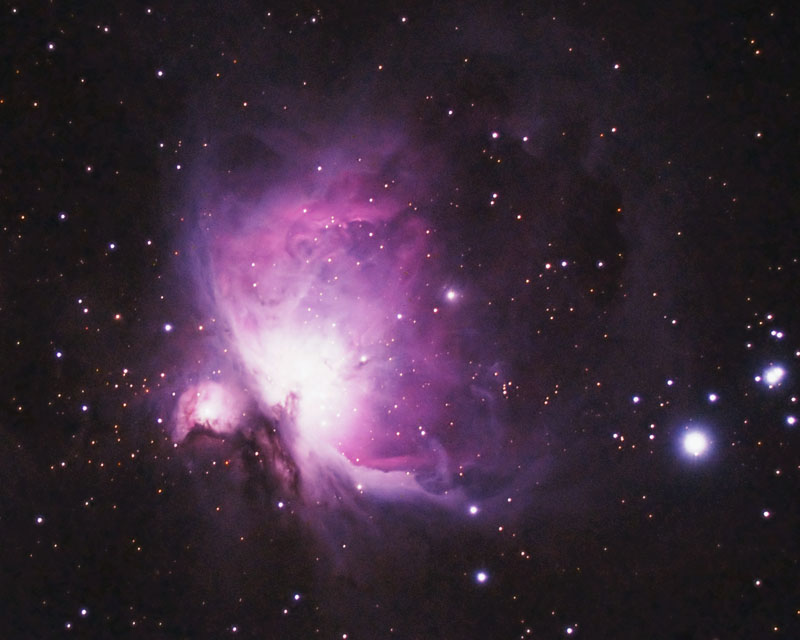
B33, The Horsehead Nebula this was taken in my homestate NJ where according to Dark Sky Finder map says there is null chance for a shot like this one below.

16bwv2e.jpg


Exposure Data
  • Lens: Astro-Physics 130EDT f/8 Triplet Apochromatic Refractor
  • F/stop: f/6 with 0.75x matched Telecompressor
  • Exposure: 4.5 hours total exposure:
    • RGB: 18 x 600 seconds
    • Ha: 9 x 600 seconds
  • Mount: Polar-aligned tracking equatorial mount, auto-guided
  • Camera: Canon EOS 20Da DSLR
  • Mode: RAW
  • ISO: RGB: 800, Ha: 1600
  • White Balance: Custom
  • In-Camera Noise Reduction: Off
  • Filter: RGB:IDAS LPS, Ha: Lumicon Hydrogen-alpha cut filter
  • Temp: RGB: 40F, Ha: 33F
  • Date October 22, Oct 26, Nov 25 2006
  • Location: Belleplain, NJ
 
Last edited:
Just FYI, Astro-Physics telescopes are ridiculously expensive.
 
Just FYI, Astro-Physics telescopes are ridiculously expensive.

But who mentioned a telescope?

Uh .... you did. The sucker's over $4700 (and discontinued). Its replacement, the f/7.5, starts at $5675.

Astro-Physics 130EDT f/8 Triplet Apochromatic Refractor

:lmao: Ok my mistake he hooked up the camera to the telescope yes
but not everyone does this. You do need to track the same area so a telescope mount is a must but regular dslr and good lens mounted on a motorized equatorial tripod would be on a budget and give good results

This one cost $700 from b&h photo

CG-5 Motorized Equatorial Telescope Mount with Tripod
 

Create an account or login to comment

You must be a member in order to leave a comment

Create account

Create an account on our community. It's easy!

Log in

Already have an account? Log in here.

New Topics

Back
Top Bottom