What's new

Astrophotography... Frustrated.

elementgs

No longer a newbie, moving up!
Joined
Sep 1, 2013
Messages
136
Reaction score
26
Location
California!
Can others edit my Photos
Photos OK to edit
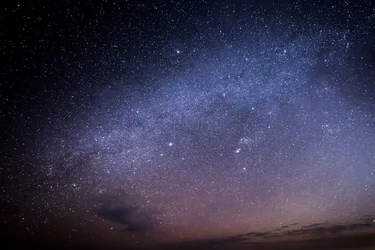
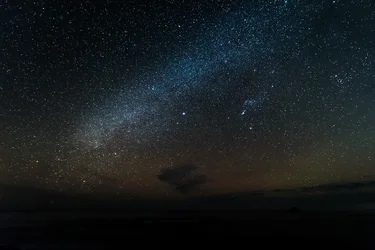
I was out on Friday just south of Big Sur doing my best to take some photos of the stars. My goal wasn't to do anything special, just to try and capture the stars and make them look good.

I followed a few guides which said to shoot wide open at f2.8 with a 10-30 second shutter speed and ISO in the neighborhood of 800-1600.

So I did that... The shot below is 14mm, f2.8, 15s at 1600ISO. I experimented quite a bit, up and down the spectrum and sure enough, as the guide mentioned, this was the best result from the night which kinda makes me sad.

One of my problems is that I'm still getting star trails... they're subtle at 15s but they are there. I have to shorten the shutter speed to 8-10s and increase the ISO in order to eliminate them and of course that causes the noise to come into play pretty hardcore, or it's too dark to recover..

I'm using a Nikon D810 with a Nikon 14-24mm f2.8 for this shot... What am I missing here?
_DSC9404-1.webp
 
Nope, you're about right. Star trails show up after about 6 seconds and if you really want to pixel peep I think after about 1.6th of a second if you really dive into it especially with a fixed telescope. I think those are the numbers I came up with last summer in pixel peeping for star movement when I started using my d600. It's world's better than my d7000.

Remember, you're just a marble floating and spinning in a bigger chunk of spinning and moving galaxy.

Use your DR Shadow Recovery in post ... it helps alot.

The skys were clear here this morning. So I pulled out my tripod, put my 50/1.4 on for testing on the d600. Got outside and ... CLOUDS rolled in !!

Gotta love it.
Glad I didn't lug out my 100 lb telescope.
 
Last edited:
another tip .. in LR I push the blacks more towards black. This also helps eliminate noise.
And I push the whites more white.

Also, there's this nicely made german mount that will keep your camera moving in the proper plane for longer photos .. I'm trying to find a link as soon as I figure out the brand.


hey .. the clouds are gone .. gotta run outside now.
 
I would shoot much higher than 1600, especially if you're using a d810. I start at 3200 and adjust from there, typically shooting between 2500-6400. While I do notice slight trailing in almost every photo if I get SUPER picky, I shoot exposures of 20-25 seconds at 16mm. You should have no issue doing 25-30 seconds at 14mm, are you sure you were accurately focused? It's not as easy as it sounds...I still have to be super careful getting my focus right and I've been shooting astro for a while now. Any deviation from proper focus at infinity will make your stars appear to trail a bit.

Don't be scared to crank up that iso. I barely ever go down below iso1000 and thats on nights with a lot of moonlight. I'd rather have a properly exposed photo with some noise, than to bring up the shadows a ton in post and end up with a lot of noise
 
Sooner or later, if you wish to pursue astrophotography, a motor-driven mount will be needed. There are many available, usually as a part of a telescope.
 
All the best results I've seen use stacking. Combining multiple shots to reduce noise ('Deep sky stacker' is a free package for this).

I've yet to get round to trying it myself, as the skies round here have loads of light pollution, frequent clouds... & I'm just too lazy/disorganized/busy to grab everything when we do get a clear night.

The time before star trails become noticeable in a finished image is highly dependent on the magnification. There is a guide calculation based on the focal length of your lens (IIRC its 500/EFL in seconds), but I'm not sure what size final image it relates to. Distance from the pole star is a significant factor too.

The suitable ISO range will depend a lot on your camera. 1600 tends to be rather noisy on all of mine, but at narrower FOV I can at least open the aperture to 1.4 though this starts to make focusing more critical...
 
Thank you all so much for your advice and guidance.

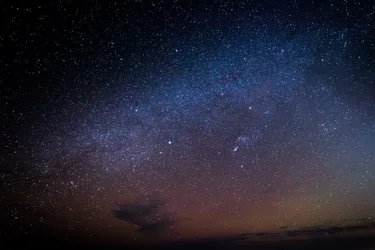
Here is the same scene at 2500 and 12,800 ISO. I just cranked it to test the scene. Can you tell which one is which? :)

I'm not entirely sure how to properly focus btw but what I did was zoom in on one star and reduce the halo around it as much as possible. Not sure how else to focus sadly.

_DSC9411-2.webp

_DSC9408.webp
 
There is usually a LOT of postprocessing done to create the images that we so admire.

The easiest way to get a good signal-to-noise ratio is to use a motorized equatorial drive (as @Torus34 noted) which compensates for the motion of the earth. Ioptron (iOptron) makes a like of tracking devices ranging from the Skytracker, to much more expensive (and capable) mounts. There are other companies as well, and the quality of the resulting mount usually correlates with the price.

If you cannot use a tracking mount, then stacking a bunch of short exposures also improves the signal to noise ratio. If I remember correctly, the noise reduction is the inverse square of the number of images used. As @petrochemist noted, using a stacking program will help in this regard.

Furthermore, there are all kinds of processing steps that tease out the fine detail, in each image prior to stacking.

You have a very good camera that will allow you to do excellent astrophotography. Next, you'll also need to find the darkest skies that you can reach, to reduce the noise of the background light. As well, if photographing the galaxy, the best views are in summer, when we are looking at the center of the galaxy.
 
Here's what I was looking for ==> Losmandy StarLapse System
or this ==> iOptron

I don't have one .. as I can just stick my camera on top of my scope, or attach it directly to my scope with the scope as the lens.

other than that ... as mentioend above .. you can stack photos too. There's free stacking software out there such as ==> DeepSkyStacker - Free
 
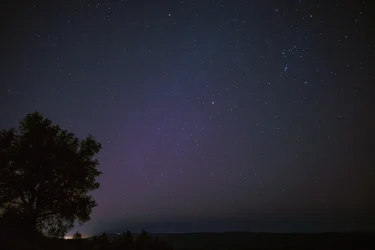
I'm no expert, but I've had success with much lower ISO's. This last time I went out I was experimenting and the best shots I got were all at 100 ISO. I shot it with a 12 mm lens on my NEX-7 so an 18 mm equivalent on your D810. Most were between 20-30 second exposures, but the trails seemed minimal at that focal length. I did have a fair amount of CA the further away from center that I got, but that was taken care of in post. I suppose if I had shot at 2.8 instead of 2.0, I probably would have eliminated the CA and I would have still only been at 400 ISO.

astro-6.webp

I always used to think that I was going to need a full frame camera to get that extra couple of stops over my crop sensor, but I'm not convinced of that anymore.

Oh, by the way, this was shot using my cheap $20 amazon basics tripod.
 
For focusing, switch to Live View and zoom in max. You don't have to focus on a star if you have some kind of light source at a great distance. With optics this size, a few miles equals infinity.

My first night out I was very frustrated, thinking my focusing was still failing somehow, when I realized I was getting star trails. Banged one off at max ISO (which on my D7000 is actually useless) just to see, and sure enough, sharp stars.

I've shot with an 8mm fisheye, and you have to really blow it up to find trails at that focal length!
 
For landscape astrophotography, you don't really need a tracking mount at all. They can help, but I've never needed one to get great images in dark skies, and I can only think of one or two photographers I know who use one. If you're trying to do deep space type photos, you will need a tracker.

It always baffles me how many people comment and give advice in astrophotography threads that have no idea what they are talking about. There are some VERY knowledgeable people in here that do have experience with astro work, and I respect their input, but there is more bad advice being tossed around here. Iso100 for landscape astrophotography? Best of luck with that!
 
For landscape astrophotography, you don't really need a tracking mount at all. They can help, but I've never needed one to get great images in dark skies, and I can only think of one or two photographers I know who use one. If you're trying to do deep space type photos, you will need a tracker.

It always baffles me how many people comment and give advice in astrophotography threads that have no idea what they are talking about. There are some VERY knowledgeable people in here that do have experience with astro work, and I respect their input, but there is more bad advice being tossed around here. Iso100 for landscape astrophotography? Best of luck with that!
Was my picture bad? Could it have been better shot at 1600 or 3200 ISO?
 

Create an account or login to comment

You must be a member in order to leave a comment

Create account

Create an account on our community. It's easy!

Log in

Already have an account? Log in here.

Back
Top Bottom