What's new

Bokeh with f/3.5

lelavadee

TPF Noob!
Joined
Feb 7, 2014
Messages
12
Reaction score
0
Location
Bangkok
Can others edit my Photos
Photos NOT OK to edit
Hello everyone!

I am very new to photography and have a question about bokeh.
I have a Nikkor 24 - 120 mm f/3.5 lens and a Sigma 70 - 300 mm f/4 lens.
I am just trying a lot of things and would like to know how to create bokeh like this (Pictures by Nirrimi):
wingboned lover. | Flickr - Photo Sharing!
Flickr: nirrimi's Photostream

Here I found that she uses a lens with max f/3.5:
i'm funny looking. | Flickr - Photo Sharing!

The maximum bokeh that I can get is this, which obviously is very blurry compared to hers.
http://goo.gl/79S5go

How to get such sharp bokeh where you can actually see circles in the background? I know that people normally say you should buy a f/1.8 lens or something, but I was wondering how to do it with other lenses.

Thank you!!
 
Bokeh differs from Lens to lens. You get less depth of field at larger apertures (smaller ap numbers). The focal length you use and the distance your subject is from the background all contribute to your depth of field perception, but some lenses render the out of focus area nicer, so give a nicer looking bokeh
 
Thank you!

I tried a lot of different things. Putting the object far away from or close to the background, zooming in, etc. but my bokeh just stays very blurry.
Doest this mean that with my lens I can't get this effect?
And if so, I'd like to know why, since she has a 18-55 f/3.5 and I have a 24 - 120 mm f/3.5 lens and I don't yet understand why one does give that type of bokeh and the other one doesn't.
 
Try them now at smaller apertures ( bigger numbers) say f6.3, the backgrounds will render clearer. Try different settings for different looks
 
Hi, thank you thank you!
I think my explanation wasn't right.
I want to get bokeh, but not the blurry type. So normally people use lenses with f/1.8 for the kind of pictures I want, but the girl from the pictures that I showed has a f/3.5. So correct me if I am wrong, but I think I should use the maximum aperture right?

I want to go from this:
https://www.flickr.com/photos/bearseye/7837275402/

To this:
https://www.flickr.com/photos/johnpetrick/4478576584/

So their should be bokeh, but the bokeh should be clear circles, just like hers.
 
That is dependent on the background and if there are light sources from different points. Bubbles have reflections and throw light points around. Try spraying some droplets on grass and shoot them with the sun behind and see do you get the effect you desire
 
As Jaomul and others have noted above, bokeh is dependent on the lens, the focal length, the distance between the subject and background (or foreground!), and to some degree, the camera sensor size. Note, however, that whether bokeh is ‘good’ or ‘not so good’ is completely subjective and it’s unlikely that 2 people will always agree.In general, the wider the aperture (lower f-stop number), the better the bokeh that will result. So, an f1.8 lens (a 50mm f1.8 nifty-fifty comes to mind) will consistently produce better bokeh than, say, an f4.0 lens can. That’s the common opinion. I’m sure there are some out there that would prefer, say, 6-sided bokeh over smooth circular bokeh, or over mushy bokeh, or whatever.

It’s also safe to say that a short to medium telephoto lens will produce better bokeh than a wide angle or normal lens. This is the result of the thinner depth of field produced by a telephoto than a wide angle for the same distance to the subject. Compare the bokeh produced from a nifty-fifty with that of a 135mm f2 lens, both wide open. The 135 wins hands down.

In most cases, too, the more expensive lenses will produce better bokeh than low-priced, entry-level lenses. This is due to better quality of all the elements, coatings, and even the number of aperture blades in the higher priced lenses.Although some may disagree, I also suspect that full frame sensor bodies give better bokeh results than crop sensor camera bodies. At least, that’s what I’ve observed in my own pictures.

It’s my belief that a point and shoot camera can almost never produce anything other than blurry, out-of-focus elements outside the DOF due to their small sensor sizes.I’m also thinking that your Nikkor 24-120mm f3.5 lens is really the 24-120 f3.5-5.6 AF-S VR lens. If so, it’s only f3.5 from 24mm focal length to perhaps 30mm. From there to 120mm focal length, the maximum aperture decreases quickly to f5.6. As mentioned above, the wider apertures not only produce better bokeh, but in my experience, expecting any kind of bokeh other than a soft-blur above f3.5 or so is a near impossibility. And with the f3.5 at wide angles only, the DOF will generally be quite large unless the subject is perhaps not more than 5 feet away at f3.5.

I’ve never done so, but I’m sure than some photographers (fauxtographers?) have ‘manufactured’ bokeh during post processing either by using various blur functions available or simply cutting and pasting a sharp, focused subject into a blurred/bokeh background-only photo. The key there is that the shot with and without the subjects are taken moments apart with the same gear. Anything else would cause lighting and perspective issues to be dealt with during the cut/paste operation.

Lastly, I feel that you’re ‘focus’ on creating pleasing bokeh is not the way to learn photography. It seems like you’re trying to get your putting mastered before you can consistently go from the tee to the green in 1-3 swings. For what it’s worth, in the 54 years or so I’ve been taking photographs, I’ve never once thought "what kind of bokeh will I get?" when taking a photograph. I get what I get. My priority has always been get the exposure right, get the composition right, and will I be satisfied with the results. I’m my harshest critic.

Perhaps you have taken up photography to specifically achieve some kind of specific art objectives or sales materials, or some specific situation where bokeh might be a factor in photograph quality. But in my opinion, you should master the exposure triangle and your camera before trying to control a generally non-controllable photographic item.​

Also, be sure to do a search on this web site for 'bokeh'. Here's my results, limited to the past 12 months. http://www.thephotoforum.com/forum/s...archid=3367798
 
Thank you so much, you helped me a lot!

@bratkinson Thank you!!
You are right about my lens, it is a 24-120 f3.5-5.6 AF-S VR. My dad has a 50mm f1.8 that I could probably use. Are you saying that with my D80 I still wouldn't get the bokeh I am looking for?
 
leveladee; the term "bokeh" refers to the "smoothness" of the blur. This is an inherent quality of the particular lens. Do not confuse "blur" with "bokeh".

To maximize blur, in say, a background, keep the subject well in front of the background so there is adequate space between them. A wider aperture will yield more blur than a smaller opening. Your lens will open to only f3.5 and the maximum, so you might not get the blur you want.

If you find a lens that actually produces smooth, creamy blur, then you have found a lens that has "bokeh". Look at examples of blur, and you will see some blur that is "jittery", "jagged", or otherwise not smooth. Do not confuse blur with bokeh.

You should try the 50mm at a wide aperture with some spots of brightness in the background that you have made to blur by focusing on a subject that is well in front of the background and evaluate the blur for smoothness.
 
Last edited:
A blurred background is not bokeh.
A blurred background results for using a shot set up that results in a depth-of-field (DoF) with a far sharp focus range limit that is in front of the background.
DoF is adjustable. Understanding Depth of Field in Photography

Bokeh is not adjustable. It is an inherent property of each lens make/model.
The quality of the optics, the shape of the lens aperture blades, the edge contour of the aperture blades, and the number of aperture blades contribute to the quality, ot lack of quality, of the bokeh a lens produces.

An example of a DSLR lens that delivers low quality bokeh because it has only 5, straight, sharp edged aperture blades is the inexpensive, low build quality, Canon EF 50mm f/1.8 II Camera Lens.

An example of a DSLR lens that delivers high quality bokeh because it has 9, curved, round edged aperture blades is the Nikon 85mm f/1.4D AF Nikkor Lens
 
When you want to create "bokeh balls", like those seen in this photo you linked to https://www.flickr.com/photos/nirrimi/2770998246/ the need is for point light sources, seen against a dark field. So...in this image, what is happening is that the model in in an area of open shade, lighted by "sky-light" and not sun-light. The sun is BEHIND the subject, and is shining in in very small patches and bits, through fairly dense foliage and trees, which allows very small pin-points of light to be seen, out of focus, as what I and many otherc call "bokeh balls".

Tall hedges, like photinia, allow light to come through, and when seen against a predominantly dark background behind a person, create bokeh balls.

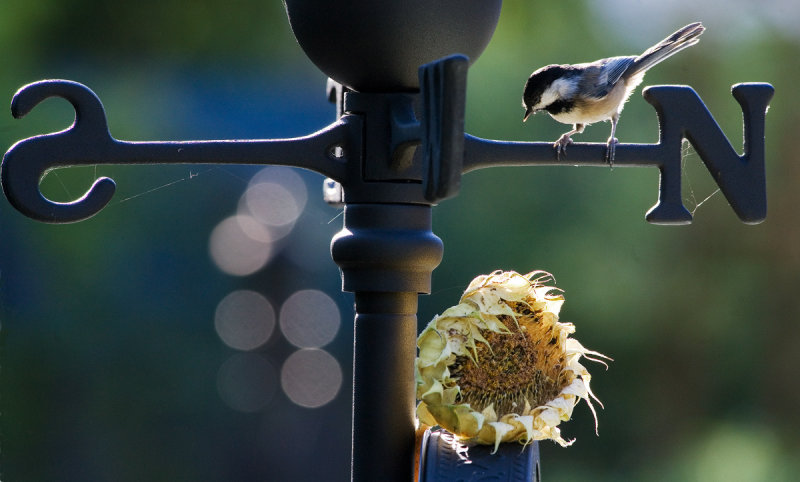
Here is a photo I took about seven years ago. You can see light, coming in through a photinia hedge about six feet behind the bird. The photo was shot with a 300mm lens + a 1.4x converter, so it's a 420mm effective focal length with an aperture of f/4.0, and the lens is wide-open, so the bokeh balls are round. As you can see, where there is NO SUNLIGHT coming through, the bokeh is just smooth, way out of focus blur..but where the sun is peeking through, there are "bokeh balls".
155012786.jpg


[larger Black Capped Chickadee_bokeh.JPG photo - Derrel photos at pbase.com ]
 
The circles are small light source.

To get you the idea,

These circles are Christmas lights

4170955604_b40d4f5e24.jpg
 
When you want to create "bokeh balls", like those seen in this photo you linked to https://www.flickr.com/photos/nirrimi/2770998246/ the need is for point light sources, seen against a dark field. So...in this image, what is happening is that the model in in an area of open shade, lighted by "sky-light" and not sun-light. The sun is BEHIND the subject, and is shining in in very small patches and bits, through fairly dense foliage and trees, which allows very small pin-points of light to be seen, out of focus, as what I and many otherc call "bokeh balls".

Tall hedges, like photinia, allow light to come through, and when seen against a predominantly dark background behind a person, create bokeh balls.

Here is a photo I took about seven years ago. You can see light, coming in through a photinia hedge about six feet behind the bird. The photo was shot with a 300mm lens + a 1.4x converter, so it's a 420mm effective focal length with an aperture of f/4.0, and the lens is wide-open, so the bokeh balls are round. As you can see, where there is NO SUNLIGHT coming through, the bokeh is just smooth, way out of focus blur..but where the sun is peeking through, there are "bokeh balls".


I was wondering how many posts it was going to take before someone realized the OP was looking to generate out of focus specular highlights. ;) :lol:
 
When you want to create "bokeh balls", like those seen in this photo you linked to https://www.flickr.com/photos/nirrimi/2770998246/ the need is for point light sources, seen against a dark field. So...in this image, what is happening is that the model in in an area of open shade, lighted by "sky-light" and not sun-light. The sun is BEHIND the subject, and is shining in in very small patches and bits, through fairly dense foliage and trees, which allows very small pin-points of light to be seen, out of focus, as what I and many otherc call "bokeh balls".

Tall hedges, like photinia, allow light to come through, and when seen against a predominantly dark background behind a person, create bokeh balls.

Here is a photo I took about seven years ago. You can see light, coming in through a photinia hedge about six feet behind the bird. The photo was shot with a 300mm lens + a 1.4x converter, so it's a 420mm effective focal length with an aperture of f/4.0, and the lens is wide-open, so the bokeh balls are round. As you can see, where there is NO SUNLIGHT coming through, the bokeh is just smooth, way out of focus blur..but where the sun is peeking through, there are "bokeh balls".


I was wondering how many posts it was going to take before someone realized the OP was looking to generate out of focus specular highlights. ;) :lol:

Yeah...I figured that's what the OP was trying to achieve, especially given the specific sample linked to. In common "internet language", out of focus specular highlights have become known as "bokeh" among many people. The definitions of bokeh are somewhat varied...proper, improper, the definitions are what they are, and no matter how vociferously and adamantly some people try to "correct" others, the use of the term "bokeh" in reference to out of focus specular highlights rendered as blurry shapes is a definition that simply will not go away.
 

Create an account or login to comment

You must be a member in order to leave a comment

Create account

Create an account on our community. It's easy!

Log in

Already have an account? Log in here.

New Topics

Back
Top Bottom