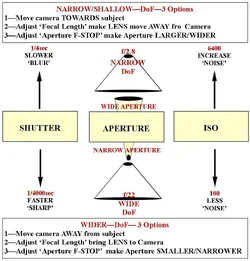
Your chart raises a few red flags. You watched the toothpaste video and you're showing possible influences from the Triangle Cult. Triangle Cult first: ISO does not control noise in a photograph and increasing ISO does not increase noise. Increasing ISO (especially since you're using a Canon camera) reduces noise. The triangulars are confused about cause and effect. They've attached themselves to a spurious correlation and converted that over to a cause - effect. Noise in a photograph is primarily a function of exposure. Less exposure = more noise and more exposure = less noise. ISO is related: When we don't have enough light to, as JC noted, achieve a fast enough shutter speed then we have to reduce exposure. If we don't have enough light to achieve the aperture we require for DOF then we have to reduce exposure. The noise is a result of reduced exposure. ISO does two things. It biases our camera meter to allow the reduced exposure calculation and then it post processes the sensor capture and brightens the image to compensate for the reduced exposure. In this post processing function ISO typically reduces the noise caused by the underexposure. It may sound like a subtle distinction but it's important to keep cause and effect straight. You can't control noise in a photo with the ISO setting; you have to do that with exposure. Noise is a function of exposure.
Joe
Joe,
I'm wondering if I've misunderstood what you meant to write.
Noise is a tricky subject to tackle and I honestly don't know anyone who feels completely comfortable tackling all aspects of it. One of the reasons is that noise is caused by lots of contributing factors... not just one thing.
Noise is more noticeable as a result of amplification ... which is the gain applied as a result of dialing up the ISO setting. (Changing ISO does not alter the sensitivity of the sensor.) This gain (amplification) is either applied via analog means prior to analog to digital conversion (ADC) and is sometimes called "upstream gain", or it could be applied via digital multiplication after ADC and is sometimes called "downstream gain", or a combination of both. How it's performed varies by camera manufacturer and model.
But noise is caused by lots of other factors... heat build up (which does tend to increase in long exposure images), even quantum effects (that we can't control). One type of noise is "read noise" and this is an amount of noise inherent in a sensor (due to electronics) and that amount of noise is considered to be fixed.
We regard an image as "not noisy" not because there is no noise... but because we don't notice it. This is a result of the "signal to noise ratio" (SNR). So if "read noise" is fixed... but I can get more "signal" by taking a longer image, then it stands to reason that I will have a better SNR by taking a longer exposure image than a shorter exposure image. This supports the hypothesis that a longer exposure duration should result in less noise (which is what I believe you are saying). But this is primarily a function of read noise. But there are other types of noise.
This is why I started with "I don't know anyone who feels completely comfortable tackling all aspects" of noise.
I can say that as an astrophotographer (where shooting really long exposures at high ISO is pretty common)... it doesn't matter that I can take a really long exposure. We still get more noise at higher ISO levels (regardless of exposure duration). (Astrophotographers deal with this by taking loads of images of the same object and then using "stacking" software to integrate the images ... especially using statistical integration algorithms which do a pretty impressive job of knocking down the noise.)
If the hypothesis that noise is primarily just a function of exposure duration, then we should be able to predict that if, in addition to increasing ISO, we also increase the exposure time, then we should not see an increase in noise because we've maintained the exposure duration.
So for example:
ISO 100 at f/2.8 for 30 seconds ... compared to ... ISO 12,800 at f/32 for 30 seconds
(trading 7 stops of aperture for 7 stops of ISO so we can maintain the same 30 second exposure duration).
But if I do this test... I get no
noticeable noise in the ISO 100 image, but loads of noise in the ISO 12,800 image.
The data does not support the hypothesis that noise follows exposure time (instead of ISO).
I could also shoot at ISO 12,800 but trade 7 stops of aperture for exposure duration (so f/2.8 at 1/4 seconds instead of f/32 at 30 seconds). This also results in a noisy image. There may technically be less total noise in the longer exposure due to the improved SNR ratio w.r.t. the "read noise" component of the total noise, but because this is being overwhelmed by other contributors to noise, I don't notice an obvious improvement to the image. The only way I do notice a dramatic and obvious difference, is to lower the ISO value.
In testing that I've done... noise primarily follows ISO setting (at least with my cameras). I have specifically tested the scenario where I set a low ISO with a long image duration (30 seconds) to get a representative sample of how much noise I get. Then used a very high ISO but still use the same 30 second exposure time (compensating by stopping down aperture) and can confirm that the long exposure does not help smooth out the noise problem in any meaningful way. The only way to get a meaningful reduction in noise from a single image is to use a lower ISO value.
There are loads of contributing factors to noise. And one major wrench-in-the-works is that accurately assessing a sensor relies on having information available which manufacturers do not share. We do (now) know that many manufacturers "cook" their RAW images (in other words the true read noise & shot noise is higher than they let on... but they de-noise the images ... and still tell us these "cooked" images are "RAW") and this makes it difficult to accurately assess the camera at a technical level.
In science, if we observe a behavior and try to ascribe a cause, we might be able to do that if there is
only one cause. If there are multiple causes, it is difficult to understand how much of the observed behavior should be ascribed to one factor vs. another factor. If we can gain confidence that we thoroughly understand one of those factors, then we can more accurately understand the
other factor (because it's responsible for whatever is left over). But if you have multiple factors (more than two) ... especially when you don't know how many factors you're dealing with (and some of it's trade-secret) it gets really hard to be able to say we understand or can accurately explain the observed behavior.
So I wont attempt to say "why" noise follows ISO (more than exposure duration). I can only state that testing the camera shows that it does.
Tim





![[No title]](/data/xfmg/thumbnail/32/32715-2fc6326453c7dda13dae0bbb0cc16864.jpg?1734162341)

![[No title]](/data/xfmg/thumbnail/32/32708-c55da623febe9d91efe5f28aa54c3090.jpg?1734162300)