Robin_Usagani said:
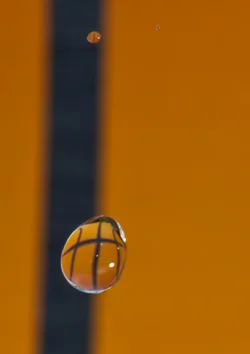
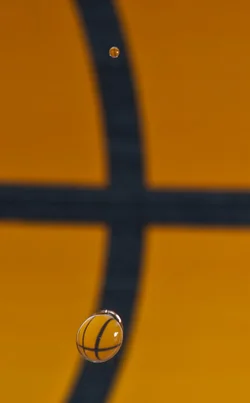
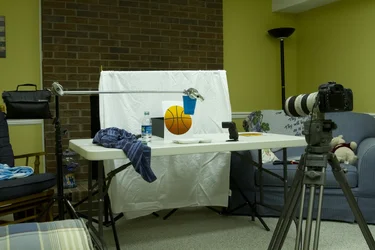
Here are a few I just did. Hand held, focus was all over the place, HSS, shutter was 1/2000 or faster. Unfortunately since this is handheld, I had to burst the shot so I had to lower the flash power so I can fire it consecutively. Because of that I had to bump up the ISO. If I had used a tripod and keep adjusting the focus, I can probably shoot it at lower ISO and get better timed shots. I have no idea what derrel is talking about.
View attachment 44292
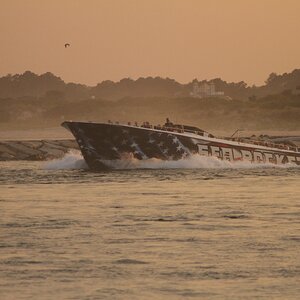
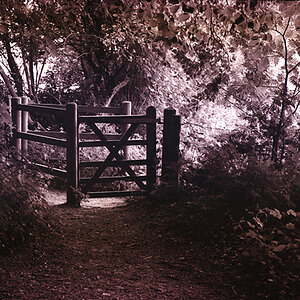
Blurry. Not round. Shows motion blur, as I predicted it would.
View attachment 44293
Blurry. Sorry Robin, just as I predicted.
View attachment 44294
In your last picture you show us a nice
stroboscopic effect, but it does not stop or freeze the motion...just as I said it would not. HSS is a series of very rapid flash micro-bursts, up to 199 flashes per second, according to the Canon website. You can see here that no motion has been "stopped", or frozen. Exactly as I stated. I can see 15 discrete background images here...this water is not frozen, as you stated it would be using HSS. It is rendered exactly as I predicted...a series of very,very rapidly-paced micro-flashes were emitted, turning this into over an inch-long rendering. "stroboscopic rendering"
Your personal attack in this thread Robin, with you calling me an ass,as well as your beginning of a new,separate thread with some calculations, but none of these blurred photos to support your calculations...weak sauce.
Your photos above proved that I was right, and you were incorrect. Sorry, but your very own photos demonstrate that your technical knowledge and understanding of Canon HSS flash is faulty.
HSS flash is sequential, micro-burst flashes that a fired over a relatively looooooong duration, in order to make the flash last for the entire duration the mechanical focal plane shutter is traversing the film plane.
What a person wants to do in trying to render high-speed motion utterly stopped, as in
frozen, is to use a SINGLE, very brief-duration flash. This is normally accomplished by using AUTO-thyristor flash, fired at low fractional power, usually between 1/16 and 1/128 power, which fires a very short,duration flash of as brief as perhaps 1/64,000 second. Your first two, blurry images prove that I was correct, and you are not fully aware of how HSS actually works,
in the real world.







![[No title]](/data/xfmg/thumbnail/37/37617-2a07b7e10a8d9f154e8cd9727551e0ef.jpg?1734170742)



![[No title]](/data/xfmg/thumbnail/37/37621-b86590cf53fc4001d12701ee3091029b.jpg?1734170745)