What's new

Confused

jlw94061

TPF Noob!
Joined
Sep 30, 2026
Messages
1
Reaction score
0
Location
usa
Can others edit my Photos
Photos NOT OK to edit
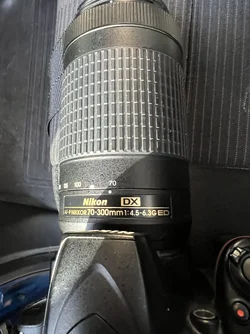
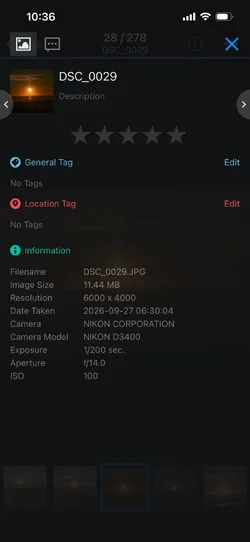
Hi and thanks for any help, I have a Nikon D3400 and actually love it still, but I’ve noticed something odd . It appears to allow me to set the aperture to levels my lenses don’t go to, how is this possible? I’ll attach the lenses data then the data from a sample photo, I’m confused
 

Attachments

  • IMG_6757.webp
    IMG_6757.webp
    641.2 KB · Views: 6
  • IMG_6758.webp
    IMG_6758.webp
    53.8 KB · Views: 4
The aperatures printed on the lens are the widest the lens will open at the listed focal lengths. So that lens will open to F 4.5 @ 70mm and F 6.3 @ 300mm. Most lenses close down to at least F 22; you'll have to check the specs for that specific lens.
 
Old mechanical film cameras were limited to click settings for shutter speed and lens apertures. The diaphragm had indents for these apertures, although one could cheat a bit and set the lens to in between settings. Exactly what the setting was in this no click,in between spot was anyone's guess. BTW, these settings were generally in full stops, meaning twice or half the amount of light for exposure.
But modern cameras can adjust aperture and shutter speeds in smaller fractions, often one half or one third stop increments. In between twice or half light portions. Your camera is doing this automatically.
Sometimes, there is a setting in the menu where you can dictate if increments will be in half or a third stops.... Google it.
Try not to overexposed,but generally half stops are more than adequate, at least for me.
Remember, f/stops will give twice the amount of light in the following succession: 22, 16, 11, 8, 5.6, 4, 2.8, 2, 1.4, 1.... See the pattern?
In between numbers will add additional light. As to whether is a half or a third stop, you can Google that.
Good luck.

 
As post #2 answered, the apertures printed on the lens's label are not the only apertures the lens can set, they are the maximum apertures (largest iris opening.) The minimum apertures (smallest iris) well be at least f:16, and possible an f-number in the 40s.

When a lens label shows a range, that indication a varifocal lens, commonly called a zoom, and the range is the maximum aperture at each end of the lens's focal length range., and at focal lengths in between, the maximum aperture will be something in between those numbers on the label.

Generally speaking, the difference between a varifocal and a true zoom is that the aperture is constant as the focal length changes. Additionally, the actual subject focus distance is constant when the focal length changes, as well. With most lenses we call "zoom" lenses, if you shift for 70 to 300 mm, you'll also have to re-focus on your subject; a "true" zoom won't require that. Most of the lenses we refer to these days as zoom lenses are technically varifocal, meaning simply that you can change the focal length but you can't rely on the aperture, or the subject distance being focused on, remaining constant. If a zoom lens only shows a single maximum aperture on the label, it's a true zoom.
 
That particular lens, depending on the Focal length you're using at the time of the shutter release, will have a maximum f-stop between f22 and f32.

The user's manual for probably every modern camera and lens made today, can he downloaded from the manufacturer's website.

I've bought all my equipment used, and I've downloaded every manual for every piece of equipment....it's a good idea to acquire and read them at your leisure, as there's ALWAYS something to be learned....and as we know from the age old adage: KNOWLEDGE IS POWER!!

Enjoy that lil' Nikon and lens combo, you can take fantastic photos with that combo!!! 💪
Screenshot_20261025-210030.webp
 

Create an account or login to comment

You must be a member in order to leave a comment

Create account

Create an account on our community. It's easy!

Log in

Already have an account? Log in here.

Back
Top Bottom