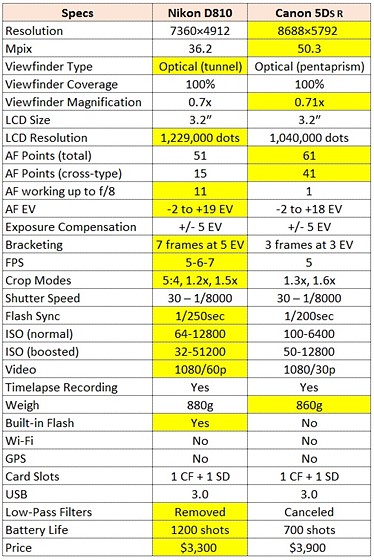
Two very well specified cameras. Both require the best glass to get the full potential out of them. At the end of the day, they are just tools. Like any tool, it's what you do with them that counts above all else. It's so easy to get wrapped up in the BS marketing hype, speculation, numbers and everything else that has come before it made to seem redundant.
Go to any forum and look at the post counts in the camera/lens/equipment section and compare it to the gallery/critique sections. You generally find waaaaaay more posts in the former than you do in the latter. People like to talk and get all excited about gear and brands. It's like arguing over top of the line sports cars, when you drive a Ford Fiesta. And if you do actually get to own one of the top of the line sports cars, it spends more time being cleaned and polished and talked about, than being driven to it's full potential.
Most people don't even make full use of their 16MP cameras, let alone anything bigger. We display stuff on the internet in Jpeg format, at forum limited sizes or what our screens can handle. For the overwhelming majority of people, these high resolution cameras are complete overkill. Unless you're printing huge canvases or billboards, doing corporate work or your photography specifically requires the ability to crop in, then you aren't going to use the camera to it's fullest.
I'd far sooner have a camera with excellent ISO performance, dynamic range and more importantly, a global/electronic shutter for significantly improved flash syncing. You know, things that actually will make a difference to the vast majority of photographers, than a resolution so big that I've got to drop nearly $5k on glass and another $2k+ on a computer to handle the PSD/PSB files. It's no wonder some of these large camera manufacturers sales figures are in the toilet. They aren't innovating enough, whereas the 3rd party lens manufacturers have upped their game and giving the big boys a real hammering!




![[No title]](/data/xfmg/thumbnail/34/34041-c8aed4d2c55b167d1ec03d9cfbaca453.jpg?1734164448)


![[No title]](/data/xfmg/thumbnail/34/34042-f37784c4a5db3d0cf34059cad22b288c.jpg?1734164453)