What's new

First few infrared landscapes

Gavjenks

TPF Noob!
Joined
May 9, 2013
Messages
2,976
Reaction score
588
Location
Iowa City, IA
Can others edit my Photos
Photos OK to edit
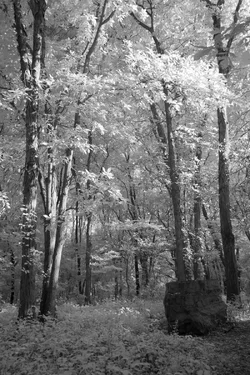
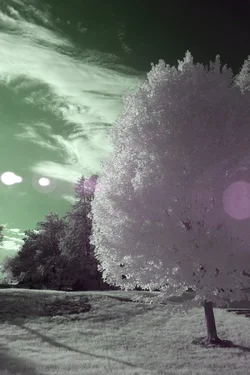
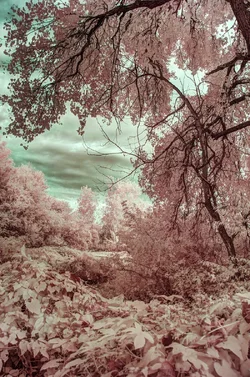
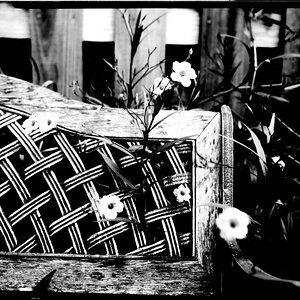
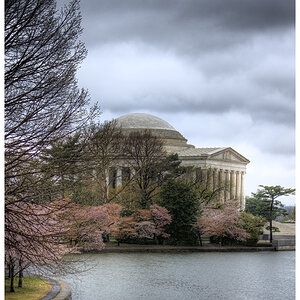
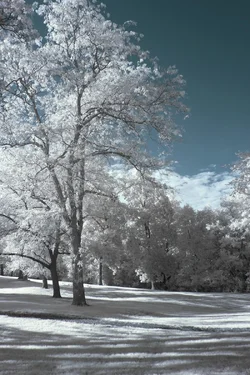
I got my infrared-converted old T2i body back about a week ago, and got the chance to walk around some local parks and such with it. Playing around with different false coloring schemes, etc. I kinda like any color scheme, actually. Just seems to depend if you want a creepy or a serene look, or a more traditional/serious feel with B&W.

$Land2.webp$Land6.webp
$Land5.webp$lAND7.webp
 
These are great. I like the 2 on top the best. The hot ghosting is unfortunate in 3.
I've always wanted to get one of my bodies converted. If I don't give my D90 to one of my kids I may get that converted.
 
Very cool. for some reason I'm drawn to #4
 
love #4. these are really neat.
 
Great shots! I like all except the third. How did you process the sky in one and four? Channel mixer?
 
Thanks all!

Great shots! I like all except the third. How did you process the sky in one and four? Channel mixer?
I have a filter that lets in a little bit of visible light as well as infrared. Just enough to give me a little color to hook into in post processing. Then:
1) white balance until the color in the image is split across red/cyan boundaries distinctly
2) saturate a bit usually
3) Do whatever you want now with channels or colors. There are lots of ways to do the same thing. Just ctrl-U menu and slide the hue slider to do the same thing as channel swapping but much faster (and many more in between options). Or slightly more powerful but much more tedious channel mixing (and usually people don't take advantage of the extra power anyway). Or if you want to choose two colors that are not phase-locked to each other the same way, just choose one of the colors (like cyan only) in the saturation drop down at the top, and then change only the hue for that.

For #1, I just chose reds alone using that dropdown menu, and lowered saturation to zero to make the leaves white instead of slightly pinkish/orange, etc. which is also an option.

 
Thanks all!

Great shots! I like all except the third. How did you process the sky in one and four? Channel mixer?
I have a filter that lets in a little bit of visible light as well as infrared. Just enough to give me a little color to hook into in post processing. Then:
1) white balance until the color in the image is split across red/cyan boundaries distinctly
2) saturate a bit usually
3) Do whatever you want now with channels or colors. There are lots of ways to do the same thing. Just ctrl-U menu and slide the hue slider to do the same thing as channel swapping but much faster (and many more in between options). Or slightly more powerful but much more tedious channel mixing (and usually people don't take advantage of the extra power anyway). Or if you want to choose two colors that are not phase-locked to each other the same way, just choose one of the colors (like cyan only) in the saturation drop down at the top, and then change only the hue for that.

For #1, I just chose reds alone using that dropdown menu, and lowered saturation to zero to make the leaves white instead of slightly pinkish/orange, etc. which is also an option.
Thanks! I can't get my foliage to turn as white as yours in #1. I shoot with a Hoya filter, then convert into B&W in Lr but the leaves and grass won't look as white as most IR photos I've seen. Any advice?
 
Thanks all!

Great shots! I like all except the third. How did you process the sky in one and four? Channel mixer?
I have a filter that lets in a little bit of visible light as well as infrared. Just enough to give me a little color to hook into in post processing. Then:
1) white balance until the color in the image is split across red/cyan boundaries distinctly
2) saturate a bit usually
3) Do whatever you want now with channels or colors. There are lots of ways to do the same thing. Just ctrl-U menu and slide the hue slider to do the same thing as channel swapping but much faster (and many more in between options). Or slightly more powerful but much more tedious channel mixing (and usually people don't take advantage of the extra power anyway). Or if you want to choose two colors that are not phase-locked to each other the same way, just choose one of the colors (like cyan only) in the saturation drop down at the top, and then change only the hue for that.

For #1, I just chose reds alone using that dropdown menu, and lowered saturation to zero to make the leaves white instead of slightly pinkish/orange, etc. which is also an option.
Thanks! I can't get my foliage to turn as white as yours in #1. I shoot with a Hoya filter, then convert into B&W in Lr but the leaves and grass won't look as white as most IR photos I've seen. Any advice?

If you don't have the camera actually converted, then the IR filter on the sensor is blocking most of the deeper IR light. Your filter then blocks almost all visible light. What you're left with is only a tiny sliver of very near-infrared light, and depending on which filter, maybe a little sliver of visible deep red.

Neither of those wavelengths reflects off of leaves nearly as well as deeper infrared (still "near" technically but more up around 900nm)

[White zone] [less white] [leaves are green] <---spectrum
xxxxxxxxxxxxxxxxx______________________ <---sensor filter
_______________________xxxxxxxxxxxxxxxx <---Hoya filter, probably, maybe a little more blocked.


________________________xxxxxxxxxxxxxxx <---converted camera body is only this.
 
Sweet! I wish I had an infrared converted camera.

Regards,
Jake
 
These strike me as pretty much nothing pictures except for the IR and color processing. #2 and #4 are chaotic jumbles, #1 is a boring picture of a tree. #3 is a boring picture of a tree with some pretty nice clouds.

There's no visual hierarchy here, there's just stuff jazzed up with special effects.
 
amolitor, as I said in the OP, I just got this like last week and walked out to the nearest park and snapped some photos. I didn't claim these were at all interesting subjects.

That said, the fact that trees are boring and chaotic in general is a fact that comes mostly from our visible light experience with them. I can't say I agree with your claim that trees like these have anywhere near the sort of chaos and jumblyness that they do in visible light. Infrared allows them to have much starker contrast between wood and soft tissue, making them have more composition-relevant lines. And leaf clusters become noteworthy objects/shapes that can successfully draw the eye as a main subject much better than is possible in visible light.

For instance, in #2, the leaf clusters form distinct oval shapes of white. I was then able to fit these in the frame neatly without cutting them off, and I think it dramatically helps to give you bright contrasty targets to draw your eyes between to keep it in the scene, using the much-more-visible-than-normal trunks as visual roads in between. Also, the grass/whatever it is on the floor being white makes that boulder stand out whereas it was almost invisible to the eye. So the end result is that you get a "leaf cluster-->follow trunks down to rock-->follow trunks back up to another leaf cluster" sort of dynamic. That most definitely is a visual hierarchy, and one that is made posible almost entirely due to the properties of IR reflectance. There's a reason I went immediately to the woods when I got my body in the mail, not downtown.

Is it as cool as it would be if I waited for dramatic weather patterns and found a more unique main subject? No. But is it vastly more interesting and compositionally intentional than I could have possibly done in visible light in the same scene? Yes. The same shot in visible was just a muddy green incoherent blur. So I think the examples do a decent job of showing off what the spectrum change is capable of.


You're totally right though that conceptually, a couple trees isn't terribly exciting. I hope to be able to get out and get some cool mixed foliage/cityscape/river etc. sorts of shots with more interesting weather soon. Or models. This is just a first experiment.

Infrared also would allow for wonderful portraits in the forest, by the way. The leaves reflecting all that light makes it sort of like a giant softbox, even in harsh noon light, and it cuts down on dappling by a lot. I didn't happen to have any models with me on my first outing, though. Hopefully I can grab somebody before the leaves all fall off. Otherwise the camera won't see full potential again until spring.
 

Create an account or login to comment

You must be a member in order to leave a comment

Create account

Create an account on our community. It's easy!

Log in

Already have an account? Log in here.

Back
Top Bottom