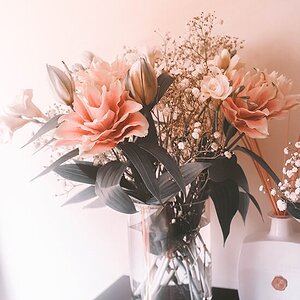
Out of interest what kind of surface did you have the flower and camera on and was it windy? A surface that shifts (esp something like carpet that shifts as you move around) is a nightmare to work with when stacking because even with tripod and rails it will move around - wind is another thing to keep an eye on (sometimes a mobile light "box" can be a great thing to slip over a subject to reduce wind) and breath, if you get right over your subject even your own breathing can move and cause problems.
The cut and past feeling that some are mentioning is because I can see some of the ghosting and details surrounding the subject, rather than a nice pure black background; the lack of a leading line (in this case the stem of the flower) can also give it a chopped/cut feeling.
However in addition to that the nature of focus stacking can also introduce its own artificial look. Because you boost the depth of field over a select area, often using a wider aperture rather than a smaller one, you can end up with a photo that looks like the background is artificially blurred, because of the sudden and sharp divide between the out of focus and in-focus areas. A trick around this is to use smaller apertures at each end of the focus stack (or at the far end only if there is no foreground parts out of focus). That way you get a more natural appearing drift into the out of focus areas.
It might go something like - f4, f4, f4, f4, f4 f5.6, f8, f13 - for example, but you can experiment and play to find a style that suits your needs.
Of course with a black background photo this method is of less use, but its a good one to know for when you've a more promenant background.
From there we've also the exposure side of things, strictly speaking you should be careful when overexposing key points of a photo because our eyes naturally focus on the brighter points of a photo first, and I'm fairly sure that the middle of the flower is more where you want our eyes not the edges of the petals. You should be able to get the contrast up without blowing sections of the photo, though you may well have to use selective contrast increases with layermasks to help avoid blowing the whites.



 ).
).