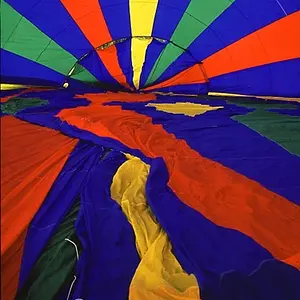
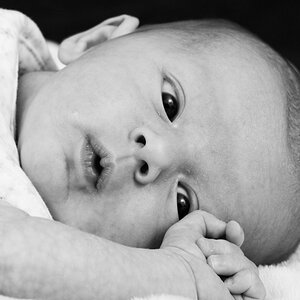
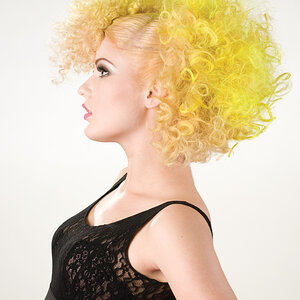
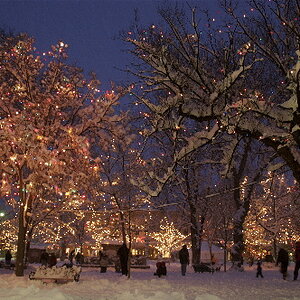
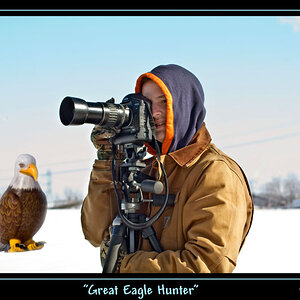
You'll also notice that the full frame one has some vignetting while the crop sensor one does not....
Don't base that judgement on my photos. I have $hit all over the place and dirty walls to boot.
Pretty much all lenses cause some degree of vignetting, you never see it on a crop sensor though.
I call bull$hit on that.
Well, maybe not 'never' - but it is certainly less noticeable.
Yeah, I'd say that a lens that shows vignetting on a 1.5x sensor has pretty severe light fall-off if the fall-off shows up on 1.5x. Unless the lens is a really wide-angle or wide zoom--those things have pretty severe fall-off most of the time, and it'll show up on 1.5x or FF. Luckily, today we have excellent tools to control fall-off,either to eliminate it or to create it!! It's so,so much nicer now that images can be edited at a computer in daylight,and changes made and evaluated for free,instead of having to make expensive prints and only then get to see the final look of a shot.
Most narrower-angle lenses have better control over peripheral illumination loss than wide-angle lenses do.
FF cameras like the Canon 5D and 5D-II and the Nikon D700 and D3 series shoot a much bigger capture area than 1.5x or 1.6x or 4/3 bodies do, so the pixels in FF are bigger than in comparable MP count, but smaller sensors. And the actual capture area on FF is something like 864 square millimeters, whereas a Nikon 1.5x sensor is 370 square mm, and a Canon 1.6x is 329 square mm. This means shallower DOF on FF, and vastly different camera-to-subject distances on FF with the same,exact focal length lenses. That changes both true perspective, and background rendering in very significant ways.
For a standing wedding couple, using 85mm lens on 1.6x Canon, you must be 34 feet away. With the same lens on a 5D or D700 FF body, you can get the same couple framed from a distance of only 20 feet. There is an eastern European wedding team, a father/daughter combo, that uses the D3 and 14-24,24-70,and 70-200 Nikkor lenses, and they shoot absolutely STUNNING wedding work, utilizing the full frame advantages. I believe his first name is Alexander, but could be mistaken. The work his studio shoots on-location in these eastern European cities is simply staggering in its beauty,and the shots WILL NOT,could NOT,look the same if shot on crop-frame cameras.



![[No title]](/data/xfmg/thumbnail/40/40294-85063966547e41d91fa4fcc007f0896c.jpg?1734174706)
![[No title]](/data/xfmg/thumbnail/1/1592-cfae4a7ea791f96c6e2d03484be2e454.jpg?1734142210)
![[No title]](/data/xfmg/thumbnail/40/40293-6f5ffaecd4c1aac1ffc73bb0972aab51.jpg?1734174705)