What's new

How Best to Begin: 35mm Film or Digital (esp. for black and white)?

MLJ1764

TPF Noob!
Joined
Apr 14, 2012
Messages
3
Reaction score
0
Location
Rhode Island
Hello:

I am relatively new to these forums. I had an interest in photography when I was a kid but it waned through high school and college. Now, though, that old interest seems to have steadily come back, to the point where I want to move beyond what I call armchair photography to actually making photographs. I am primarily interested in low/available-light photography (including nighttime street shots), portraits, and landscapes, primarily in black and white.

My question for the community is this: if I really want to learn the techniques of photography and attempt to master them so that I can hopefully, someday, perhaps make some photographs of aesthetic worth, how should I begin - with 35mm film photography or with digital? And, depending on which type of photography I should begin with, which camera/lenses would be best for the type of photography in which I am interested?

Regardless of whether I start with 35mm film or not, I definitely want to learn how to develop film. I, for some reason, think that that has to be one of the most amazing feelings: to see your work (almost) miraculously appear before your eyes.

I realize that this question has likely been asked countless times before. I am also trying to decide what camera system to invest in to make the best photos I can within my budget. The key components, of course, being the lenses. I have no loyalty to Canon or Nikon (these are the two brands with which I am familiar) or to any other.

Thanks and all the best,

Michael
 
You could probably find a good used manual-only film camera for lunch money these days. Invest in some GOOD glass that will transition to digital if you want, or a mid-grade film camera later on.
 
I would go digital SLR.
 
+1 ↑ ↑ ↑

Doing film based B&W often means having a selection of colored filters for the lenses, a variety of negative films (speed, brand, and type), and if you want total control, a variety of film developing chemicals, and a variety of print papers to make your own prints.

All of that goes to managing the contrast in B&W film images.
 
Canon/Nikon? Flip a coin and go with it. Most photographers are brand loyalists not because one is better than the other, but because we're invested in our lenses.

Film/Digital? Digital. I love film and all, but I don't think anyone should tackle learning it without having someone to teach you how it's done. Developing is tough business that takes a lot of knowhow and a significant investment.
 
Additionally, since you stated an interest in low light, digital is much better in low light without flash. Good full frame digital cameras can shoot at ISO 12,800 these days with little to no issue. Film, uh, can't do that.
 
I too would suggest going digital. I started out with film about 40 years ago because that's all there was. Transitioning to digital opened a whole new world for me, and I shoot way more with digital because I can control how the images are after shooting.

If you persist in wanting to do film, are you aware of the gear that is needed? A film developing tank, thermometer, a bunch of different chemicals, etc. And making prints is another thing that needs gear - a suitable enlarger, trays, chemicals, safe light, a way to wash and dry prints, etc. And of course this all needs to be done in a dark room. I started using the kitchen then bathrooms as we moved into different apartments, had dedicated dark rooms in our last two homes. Don't miss it at all!
 
I have been a film shooter for as long as I can remember. I have a darkroom and use it a lot. Being retired now, I thought I would try digital before my time ends.
The companies that make B+W film are getting fewer and fewer. Most are Europe based. Kodak is about gone due to finacial reasons, so I am leaning to digital more and more. Time and things change with technology. I bought a scanner and printer. Still haven't scanned all the negatives I have but am getting there. I do enjoy film and will keep using it.

Film cameras are cheap now along with darkroom equipment. If you have the $$, try it.
Digital isn't too expensive unless you go high end.

I can't say which way to go but which ever you do, enjoy it and good luck.
I am more Nikon for digital, but that is just my decision due to that is about all I have ever used over the years even with film.
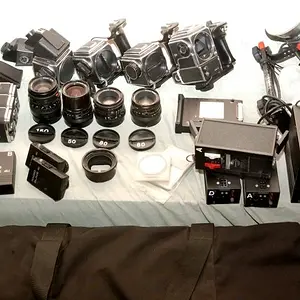
Film cameras----Olympus, Pentax, Nikon, Mamiya RB, Hasselblad, and twin lens are what I have now. Mostly use the Nikon F4s when using film.
Digital camera--- Nikon D90 and still learning how to set it up.

Good luck in your venture and show us something soon.

Richard
 
Thanks to everyone for the informative and well-considered replies. The suggestions are very helpful.

It seems that many lean towards digital as the way to go (at least to begin). Personally, I have no idea what is best since I do not know which photographic medium will appeal to me most at present. I do know that I have stared for hours at the works of Adams, Steiglitz, Bresson, Brady, and others and have always come away (even after repeated viewings) with a deepened appreciation for the seemingly limitless depth of expression that photography can afford. I am not sure, though, whether my enjoyment was influenced by the medium (film) or not. More than likely, it was the vision of the photographer that had the greatest effect and the method of conveyance was secondary. But, I will say that there is something entrancing for me about a well-conceived black-and-white film image.

As for the challenges of developing film myself, I am aware of many of them. I have developed holographic film before for laboratory experiments, so I have at least a rough idea of the issues involved (though black-and-white would likely be more challenging, especially with regards to light-tightness of the darkroom environment). I don't doubt that if I went with film it would be a very steep learning curve to achieve proficiency in developing my own images. I haven't decided whether I want to invest the time and money to pursue that route yet.

I guess the real (perhaps more easily answered) question is, can working with digital teach you the necessary skills of photography as well as film seemingly could? Not being intimately familiar with the design of many of the modern DSLRs, I do not know whether you can shut down the automation of the system, relinquishing full control to the user and solely using the camera as a means to capture the image with no processing/compression, etc.? Basically, if a digital camera could act in the same manner as a manual film camera, with the sensor and electronics simply taking the role of the film negative in acquiring the image, then I am less hesitant to go with digital than I would be otherwise.

The other question is, for landscape, low-light, and portrait photography, what are the best lenses I should get for these jobs? I pretty much know (from film days) that I'd like a 50mm prime (f/1.4 or so). Likely, a 24-70 or 24-105mm zoom, and perhaps a tele and a wide-angle later on. Specifically, though, I do not know what maker offers the better glass for these purposes. What is most confusing to me is the quality levels between Canon and Nikon. Canon seems to distinguish with the "L" badge but seemingly Nikon has no such distinguishing category. Therefore, in each of these makers, for my purposes, which lenses would compare favorably (assuming I'm willing - which I am - to invest heavily in the lenses to achieve the best images I can)?

Thanks for bearing with me through this long-winded post. I really appreciate it.

All the best,

Michael
 
Last edited:
Digital can teach the skills of "photography" very quickly. One can literally try various techniques and receive near-instant feedback. Digital can teach a novice HOW to shoot the right way--FAST! With digital, the experience of "doing" and the viewing of the results is paired with immediate feedback and the ability to evaluate and then RE-SHOOT immediately, to arrive at the truly desired results. With digital, because there is no real "pinch" of financial or time constraints for film,processing, and time, it's possible to approach the MOST-challenging shooting situations, and take enough exposures to get a feel for just "how" to achieve difficult-to-achieve results. On the types of photos that often depend upon vast numbers of shots fired to get even one good "keeper", the digital SLR shooter has a tremendous advantage over the film shooter.

A digital SLR can easily be configured to operate very much like a film SLR. The main difference is that the d-slr captures to a sensor, the film camera to film. "RAW" capture captures images with basically no processing of the image, allowing huge post-capture manipulation of brightness, contrast, sharpness, and even the decision to go B&W or color, and so on.

For low-light work: the best option is a fast lens, like the Nikkor 24mm f/1.4, or the 28mm f/1.8, or the 35mm f/1.4, or the 50mm 1.8 or 1.4 models, and the 85mm f/1.4 or 1.8 primes. 24,28,35,50,85--these few prime lenses are ideal lengths on Full-Frame Nikons. Or full-frame Canons. Canon has a Luxury or L-series to help people feel good about buying good lenses that are suitable for professional use. Nikon allows users to choose based on price: the price indicates the quality. Some Canon L lenses are quite average,optically, but are built better than their run of the mill stuff.
 

Create an account or login to comment

You must be a member in order to leave a comment

Create account

Create an account on our community. It's easy!

Log in

Already have an account? Log in here.

New Topics

Back
Top Bottom