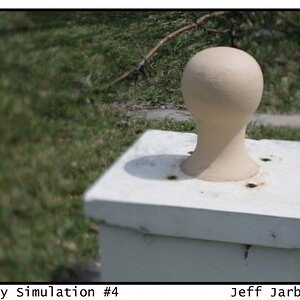
How is Bokeh best achieved?
By carefully choosing what lens you use.
Don't confuse depth-of-field (DoF) and circle of confusion (CoC, or bokeh). They are not the same thing and are not interchangable terms.
Circle of confusion - Wikipedia, the free encyclopedia
Depth of field - Wikipedia, the free encyclopedia
The English spelling bokeh was popularized in 1997 in Photo Techniques magazine, when Mike Johnston, the editor at the time, commissioned three papers on the topic for the March/April 1997 issue; he altered the spelling to suggest the correct pronunciation to English speakers, saying "it is properly pronounced with bo as in bone and ke as in Kenneth, with equal stress on either syllable".
The original Japanese word is 'boke' which refers to the aesthetic quality of the blur in out-of-focus areas of an image, or "the way the lens renders out-of-focus points of light.
CoC (bokeh) is not adjustable, DoF is. There are 2 kinds of bokeh effect - Cream Cheese and Hollywood. The shaped bokeh linked to above is a type of Hollywood bokeh. Note that the shaped bokeh effect is a function of the shape of an aperture made by the photographer.
CoC has a lot to do with the internal structure of a lens, particularly the number, shape, and edge finish of the lens aperture blades.
Some inexpensive lenses, like Canon's 50 mm f/1.8 II have decent optics but few lens aperture blades that are straight and have sharp blade edges. consequently the bokeh, or visual quality of the out-of-focus portions of a photo have a harsh, angular, jittery, and somewaht distracting visual quality.
For many the worst looking bokeh is the donut looking OOF elements produced by catadioptric mirror lenses, particiularly the el cheapo mirror lenses.
To see good examples of 'cream cheese' bokeh, look for images made with Nikon's, AF 85 mm f/1.4D lens. That lens has been nicknamed the "Cream Machine".


 . And which other post? are you referring too? Are you saying I should shoot the same glass jar but with 22 aperture/7 second shutter speed? Sorry for the confusion






![[No title]](/data/xfmg/thumbnail/31/31708-69f4ec98ec000d4fc9a9a1cc282e8e16.jpg?1734160384)