What's new

ISO performance on crop sensor- Canon Specific

wyogirl

Oh crop!
Joined
Jun 18, 2013
Messages
1,593
Reaction score
611
Location
South West Wyoming
Can others edit my Photos
Photos OK to edit
ok, here goes.... I shoot with a Canon T2i. Its entry level, I know, but I like it. For the variety of things I do, I really like a crop sensor, because I like the "extra reach" I can get.

What I don't love about the T2i is the ISO performance above 800. Pretty much, anything above 800 is noisy.

Is there, or what is, a better Canon Crop Sensor in regards to ISO...and also is the improvement significant? I see Canon has crop sensors with a larger ISO range, but is the performance any better?

PS: I'm not switching brands at this point in my photography... too much glass and also shoot with a Canon film camera.
 
Hi.

If you go to DxOMark - DxOMark by DxO Labs and look at the camera sensor data, you can see how well they perform at high iso, and compare up to three cameras at a time.

I am more of an Nikon guy, so i dont know that much about Canon iso ratings, but the site i linked above should help.

John.
 
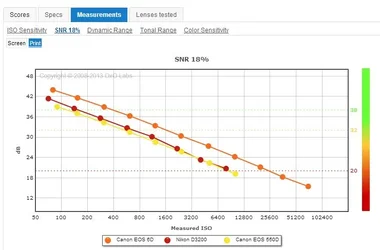
As I just mentioned on the other thread, do NOT just rely on the "scores" tab of the DxO Mark website. Click on the measurements tab, and go to "SNR 18%" to get noise data at all ISO values.

Even though it is usually a boring curve, this will be much more informative to you than the "sports" score is, because their sports score is calculated in a stupid way that doesn't really summarize low ISO noise very well.

What you will discover is that almost all crop sensor cameras from any company score the same on noise. And that any full frame cameras offer a significant bonus. For example, here is a Nikon d3200 crop frame, with almost equal noise, maybe 1/7th of a stop better. And then a full frame at about 1 stop better performance. Other company full frames will be about the same improvement.

$noise.webp

Physical size of pixels is pretty much the main factor that matters currently in sensor noise levels. Most companies are already close to ceiling in the design of the sensor technology, and few improvements have been made very recently, honestly. The way to get significant improvements is to use physically larger pixels that can collect more of a data signal with less relative amount of noise.

There are rumors of a new high end Canon camera that might use foveon-type sensors that actually use entirely different technology, and perhaps other companies are working on similar changes in the future. But for now, they all use the same basic design that is limited by its dimensions, more than its technology.
 
Thanks. I can see no significant ISO performance difference between all of Canon's crop sensors models. So I guess until I can afford a full frame camera, there is no immediate need for another body other than having a spare.
 
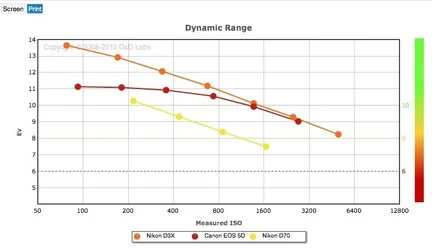
$D3x 5D D70 DxO Dynamic.webp

Anybody who is not a brand fanboy can literally SEE above how poorly the Nikon D70 performed in DYnamic Range. Why? It has an OLD sensor!

I just scrolled through the top 100 sensor overall performance tests results at DxO Mark, and the Canon EOS 7D ranked at #95. Your Canon EOS T2i (aka EOS 550 in Europe) scored #97. Keep in mind, all Canon APS-C cameras made since 2009 have all been built on the same, 18-megapixel CMOS sensor. So, the five new models introduced since 2009 all used the same sensor. DxOMark - Camera Sensor Ratings

Using DxO Mark's "Sports Low-Light ISO" criteria, the very highest-rated Canon APS-C camera in the top 100 is the Canon 7D, with a score that puts it 62nd, the old 10D at 63rd place,the Rebel T3i at 77th place, the Nikon D300s at 78th place. Canon has not introduced a "new" APS-C sensor since the 7D in 2009. They have built new camera model, yes, but all have been fitted with the 18-MP sensor they developed for the 7D back in 2009.

Going back to the chart above, the Nikon D70 is in 152nd place in the Sports Low-Light ISO rankings; the Nikon D3x in 13th place; the Canon 5D Classic in 21st place. Once again, DxO mark reflects that the newer, and better, a sensor, the better the performance.
 

Attachments

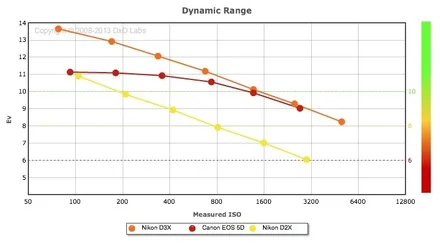
  • $D3x 5D D2x DxO Dynamic.webp
    $D3x 5D D2x DxO Dynamic.webp
    23.2 KB · Views: 432
Last edited:
Looks like the only full frame Canon that I will buy is the 6D because the rest are just too far out of my price range and I'm not ever going to make photography anything more than a hobby that sometimes makes me money.

Secondly, with price in mind, I think I'd like to upgrade to the new 70D for the added autofocus points and a few other features. But truth be told, I think I can make good images with what I have so unless Canon steps up its game in the sensor department, I'm not sold on anything new at the moment.

I would rather spend my money on faster glass.
 
The Nikon D70 is a crop frame sensor.

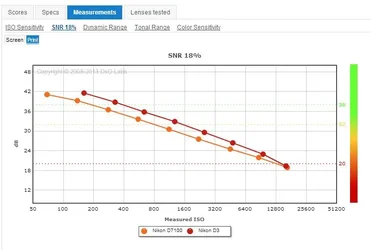
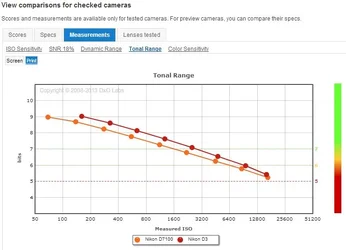
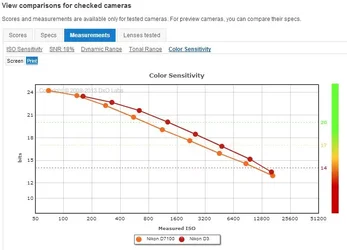
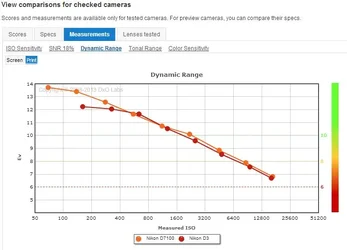
You seem to be misunderstanding my point about pixel size. Of course the D70 performs terribly compared to two full frame cameras you pitted it against. Brand NEW crop frame cameras also compare poorly. For instance, the D7100 with a brand new crop frame sensor loses soundly compared to the Nikon D3, with 5 year OLDER technology but much physically larger pixels:

Noise, the old large sensor wins:
$noise.webp

Tonal range, the old large sensor wins:
$tonal.webp
Color depth, the old large sensor wins:
$color.webp
Dynamic range, the old larger sensor ties:
$dynamic.webp
 
ok, here goes.... I shoot with a Canon T2i. Its entry level, I know, but I like it. For the variety of things I do, I really like a crop sensor, because I like the "extra reach" I can get.

What I don't love about the T2i is the ISO performance above 800. Pretty much, anything above 800 is noisy.

Is there, or what is, a better Canon Crop Sensor in regards to ISO...and also is the improvement significant? I see Canon has crop sensors with a larger ISO range, but is the performance any better?

PS: I'm not switching brands at this point in my photography... too much glass and also shoot with a Canon film camera.

Let me ask you this, do you use any software that has noise reduction? This shot was taken with Canon 40D body which introduced back in 2007 with ISO set at 1600. Noise reduction was done with Light room. I heard from other people saying that there are better software out there.


7040572495_ef8fa2a291_c.jpg


So before you spend money on a new camera body, maybe take a look at the options at the software side.


And this one shot at ISO 800 with the same camera and POST software

6894472530_9d0e88f891_b.jpg
 
I use Lightroom 4 with the basic noise reduction settings. I have to admit that I don't fully understand what settings work well when it comes to noise in Lightroom. However, I have found that when I play with it to reduce the noise, I end up making the image softer than I like.

ETA: The only reason I was looking at new bodies is because I would like to have two bodies in my kit... ya know, just in case.
 
If you want to avoid noise, the best thing to do is to always try and expose generously. Meaning, do not underexpose if at all possible. What happens when you underexpose, and then in software need to "brighten up the picture"? well..that's when all that nasty noise in the shadows tends to become very visible. But yes, the T2i is an older, APS-C sensor, and it does not perform all that well at higher ISO values, compared against either larger sensor (as in full-frame) cameras, or newer, APS-C sensor designs from Nikon, Sony, or Pentax. SONY is manufacturing the sensors in most, but not ALL Nikon APS-C cameras, and in all Pentax bodies that I am aware of, and in of course, all of the Sony cameras.

Noise reduction software does reduce noise, but it also reduces resolution. I think many times, people worry way too much about applying noise reduction, and go over-the-top and apply so,so much NR that sharpness and acuity both suffer, and the photos look very "weird". At times though, there really is almost nothing a person can actually "do" when the need is for a high shutter speed and a smallish f/stop, and the light is simply not bright enough, and so the ONLY course of action is elevating the ISO level until the speed is adequate, or the depth of field is adequate, and suffering the consequences.

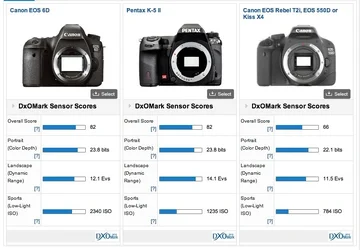
Until Canon makes a new APS-C sensor and gets it on the market, there really is NO significantly better current APS-C Canon available for High ISO work than your EOS T2i. TO get better higher ISO performance, you would need to get an APS-C camera made by Sony, or Nikon, or Pentax, OR buy a FF Canon, like the EOS 6D. And apparently that's not in the cards currently.
$Canon 6D vs Pentax K5-II vs EOS T3i.webp
 
Software is all well and good, but it applies equally well to ANY camera, so it shouldn't really factor into camera comparisons.

Unless you have a specific cutoff of ISO that you really need, and you know you won't use anything higher than that anyway. In which case, it might affect your decision insofar as you could get the cheapest camera that reaches that cutoff with software, and no better. Such a situation is not true of most people though.

Until Canon makes a new APS-C sensor and gets it on the market, there really is NO significantly better current APS-C Canon available for High ISO work than your EOS T2i. TO get better higher ISO performance, you would need to get an APS-C camera made by Sony, or Nikon, or Pentax, OR buy a FF Canon, like the EOS 6D. And apparently that's not in the cards currently.
This is pretty legit. There are better APS-C sensors. Just note that better means on the order of like half a stop on average across the board at most (between the worst really old ones still for sale and the best brand new), maybe 1 stop at the extreme for particular variables at particular ISOs.

Also note that the 70D is indeed a completely new sensor in crop size from Canon. Even uses a new type of technology entirely. Although probably not out for some additional months, so no actual reviews on how it performs yet.

It uses split pixels, so there is a possibility it might not get much better in low light performance. But there's also a possibility it may do significantly better. I don't entirely understand how the software works. Regardless, it should massively increase live view autofocus performance (video ability, and an important first step toward a future of all mirrorless cameras that last longer and are cheaper)

http://www.dpreview.com/previews/canon-eos-70d/3
 
To OP, depending on how strict you are with your shots, ISO 800 and even 1600 should be pretty good on a t2i if exposure is good etc. I have printed ISO 6400 from a 7d that has the same sensor at 8x12 but I don't think I am as fussy about noise as some. At the moment what you have is probably as good as canon supplies with a crop sensor. A few higher ISO example photos below, and while the shots themselves may not be great, i think the noise level for there settings is respectable

ISO 1600 example

bee2 by jaomul, on Flickr

ISO 3200 example

Walking2 by jaomul, on Flickr

ISO 6400 example

caves grotta di nettuno (9) by jaomul, on Flickr
 
Well, I mean technically the 1D Mark IV is a crop sensor...it's just 1.3 instead of 1.6, and it has much, much better ISO performance than any of the other crop sensors. If a 7D interests you, I'd strongly suggest trying to save up some more and go for the Mark IV if you want a crop sensor. Much, much better performance and still more reach than a FF body. Just my .02.
 

Create an account or login to comment

You must be a member in order to leave a comment

Create account

Create an account on our community. It's easy!

Log in

Already have an account? Log in here.

Back
Top Bottom