[
How far is your subject from the background? This will play a role in the bokeh.
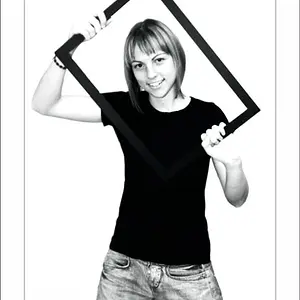
She was very, very close to the background. We were using some tall flowers as a the background and she practically had her back touching them. I guess if we move her away form the background the bokeh should improve?
The anwer to the ff vs 4/3's is that it's not the camera, it's the lens and aperture that has more to do with it. Yes, a ff with quality fast glass will beat a 4/3's camera in bokeh.
Right, but lets assume you have the same quality of glass for both the 4/3's and the FF camera. You are able to get both lenses open to f 1.8 and and take the shot on both cameras at the same 35mm equivalent focal distance. Would the bokeh quality in the shots not be equal, or would the FF camera still have better bokeh quality even though all factors are the same?
Thanks for your help so far everyone, much appreciated.
Yes, Ron is entirely right: if the subject is close to the background, then the defocused nature of the background will berather unremarkably defocused, because the subject and background are CLOSE to one another, and the depth of field will have the in-focus and the out of focus distances quite close to one another.
The easiest way to get a very out of focus background is 1) have the subject CLOSE to the camera: this is very critical and then 2) Have the background be as far behind the subject as is practical. These TWO factors are the primary ways to get strongly defocused backgrounds. Coming in at 3) is Use a longer focal length lens, rather than a shorter lens and 4) Use a rather wide aperture, such as f/2,f/2.,2, f/2.5,f/2.8, f/3.2, f/3.5, or f/4,etc..
As to the m4/3 versus FF debate. The simple physics are this: the smaller the format, the MORE you get in-focus with the SAME picture angle. So...a telephoto lens length used on a m4/3 camera has MUCH more depth of field than say, a 250mm lens used on a 6x6 cm rollfilm camera that is capturing the SAME picture angle. The larger the film or larger the sensor, the more difficult it is to achieve deep, expansive depth of field. This means that smaller-sensored cameras, like smart phone cameras and compact P&S and compact superzoom and bridge cameras can all make deep depth of field shots very,very easily. The inherently deep depth of field that small-sensor digital cameras posses can be viewed as an advantage in many situations, and a liability in other situations.
m4/3 has significantly MORE depth of field than FF digital does, and that characteristic,at least to me, makes the m4/3 cameras better choices for social photography situations and documentary/street shooting where having MORE in-focus, or with less critical focus needed for every shot, a really big advantage for that camera format. IF on the other hand, a person wants to "blow out the background", then the m4/3 camera's smaller capture size and correspondingly shorter lenses makes it LESS of a plus, and more of a negative.



![[No title]](/data/xfmg/thumbnail/42/42351-b976e32171d0405397bf5237bc4b902e.jpg?1734176880)