Yes, MrLogic began a thread, based on the dPreview tests done by Marianne Oelund. That was on Dec. 3,2009, in this thread
http://www.thephotoforum.com/forum/...-70-200-ii-effective-focal-lengths-200mm.html
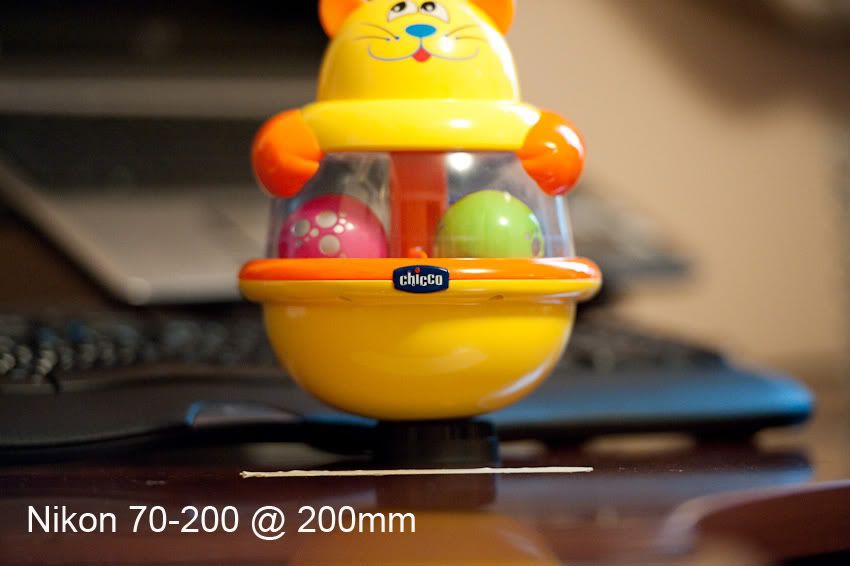
Extreme loss of focal length at CLOSE focusing distances is pretty common in many lenses; With the 70-200 VR-II, the lens at Infinity focus is longer than Nikon's 200mm f/2 AF-S VR-G lens. Nikon's 18-200mm VR loses so much focal length when focused at its closest distance that is is scarcely longer than an 85mm lens...LOSING focal length as a lens focuses closer is very,very common. Macro lenses for example, the Tamron 90mm is about 73mm at 1:1.
Nikon optimized the new VR-II lens for full-frame, with very high sharpness across the frame, even on FX, AND they made it very flat-field at closer ranges, which is something that is going to be important to people shooting on the D3x,and on future cameras with even higher MP counts and big sensors.
Marianne Oelund's tests were very,very good and very informative, but YES, the new 70-200 VRII loses focal length at close,indoor ranges--just like dozens of other lens designs. People wanted a shorter, more-compact, water-resistant, internal focusing 70-200VR suitable for 25MP captures, with no vignetting on FX, high corner sharpness, and flat-field performance at MFD....they got it!
Here's a bit from that post of Dec 3:16-85mm AF-S DX Lens Review by Thom Hogan
In his review of the 16mm-85 Nikkor lens, Hogan writes:
"Many Nikon DX users had already picked the 18-200mm VR as their walkaround lens, partly because they were seduced by numbers. Quick question, which gives you more range: the 18-200mm or the 16-85mm? The answer might surprise you a bit. The 16-85mm has a horizontal angle of view range of 16 to 73 degrees, the 18-200mm has an angle of view range of 7 to 66 degrees. However, because the 18-200mm changes focal length so much at the long end when focused close, for many situations its angle of view is only 10 to 66 degrees, which is not looking a lot better than the 16-85mm. I personally value those extra 7 degrees at the wide end much more than the extra 6 to 9 degrees at the telephoto end--they make a more dramatic impact on my photography."
From one thing I read, the new 70-200 VF-II is more like 65mm at the short end; to me, that would be more welcome than a few extra millimeters on the long end. And also, it's important to note that at Infinity, the new 70-200mm VR-II zoom lens is actually a little bit longer than the 200mm f/2 VR-G prime. The loss of focal length as the lens is focused closer is VERY normal for internal focusing zoom lenses, and for macro lenses as well. It's not that unexpected to people who are actually intimately familiar with optics. The new lens has flatter field at closer ranges than the old lens, leading to improved image quality. At very close ranges, internal focusing lenses may LOSE FOCAL LENGTH as a way to keep the actual, effective light transmission the same--note the use of the word "may". If a lens cannot change its overall length AND the user wants the actual, effective aperture of the lens to remain the same, the simplest solution is to allow the focal length to drop at very close focusing ranges. On the other hand, with a lens that focuses by extension of the barrel, like most old-style, non-internally focusing macro lenses, the aperture drop will be quite pronounced. A Tamron 90mm f/2.8 or old-style 105mm Nikkor D-series, the maximum aperture will DROP to f/5.6 as the lens is focused close, at 1:1 magnification.
It's clear the new 70-200 VR-II has had design optimization choices that favor a perfectly flat field at close ranges, leading to better edge-to-edge sharpness, and very little vignetting on full-frame. At Infinity, where actual focal length is important, the lens is *longer* than a Nikon 200mm f/2 prime lens. With ever-higher and higher MP sensors, the need is for a lens with the absolutely BEST optical performance--resolution, center sharpness, corner sharpness, contrast, and flatness of field and freedom from vignetting.
If anybody wants a lens that is optimized for something like a 24.5 megapixel FF Nikon D3x sensor, the new lens is that lens. For those shooting with DX camras, the old lens is stil quite good, and the new lens is a little bit better, but both are streets ahead of say, the 17-year old to 12-year old 80-200/2.8 lens designs.



 I know, I keep saying that. But that right there flops my mop. I really want to get clean ISO 12800 and the D3S certainly appears to deliver.