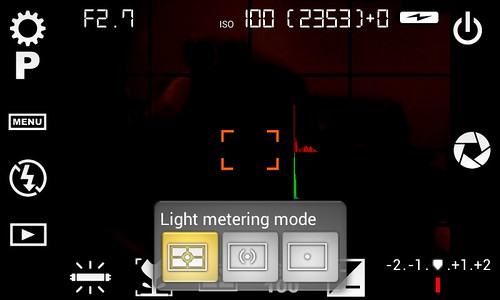
"Left one:
No, you do not have to take the red pill to understand matrix metering. It’s actually a very simple concept: The meter divides the scene up into zones, then analyzes each zone for highlight and shadow. It then takes an average for all the zones and determines the exposure based on that figure. Though the idea is simple on the surface, matrix metering systems actually use a complicated algorithm, and most manufacturers do it in their own special way, which is kept secret from the general public. Depending on the manufacturer, matrix metering systems may average just a handful of zones or more than a thousand of them. Other factors besides light are taken into consideration, such as the point within the scene where you have focused, the distance between the camera and the subject, and the colors within the scene. Nikon even has an on-board database of exposure information for more than 30,000 different photos that the metering system can refer to when determining the exposure for similar scenes. - See more at:
Which is best? Spot, Center Weight, or Matrix metering? - Digital Photo Secrets
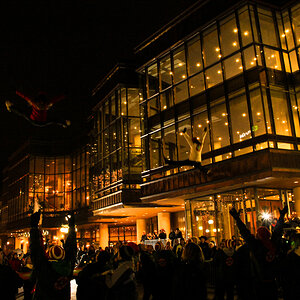
Center one:
Center-weighted metering gives the most importance–usually between 60 and 80 percent–to the light that is concentrated in a circular area in the center of the frame. The corners are given much less importance, though they are usually included to a small degree in the calculation. Some cameras will even allow you to adjust the size of the circle. This is usually considered to be the most consistent form of metering, since most photographic subjects are near the center of the frame and rarely fall into the outer four corners. For this reason, center-weighted metering is often the default metering system used by many point-and-shoot cameras of the variety that don’t allow the user to have control over the metering system.
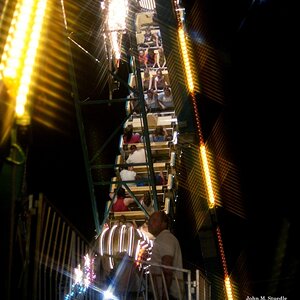
Right one:
Spot and partial metering operate under the same basic premise: the light in a much smaller part of the scene (usually the center) is measured and the exposure is set based on that reading. With spot metering, this is usually a space occupying 1 to 5 percent of the total scene. With partial metering the space can be up to 15 percent of the scene. Depending on the camera’s manufacturer, you are either stuck with a metering from the center of the frame, or you can actually tell the camera which part of the frame you want it to take the reading from. Spot metering is a very accurate form of metering in that it will give you a precise reading for a very small part of the scene, so it is most useful for shooting high-contrast scenes where your subject may otherwise fall into shadow or be washed out by very bright highlights."-
digital-photo-secrets.com





![[No title]](/data/xfmg/thumbnail/32/32941-f21147be61c00828a23d6ce011d840eb.jpg?1734162763)
![[No title]](/data/xfmg/thumbnail/32/32942-4440dd4ca2ff307a5d19277feedf1d94.jpg?1734162769)
![[No title]](/data/xfmg/thumbnail/32/32154-8c44f76cb4a7777142bd645c3624daac.jpg?1734161045)

![[No title]](/data/xfmg/thumbnail/42/42024-bf0604d67b26c7acb5e4d59254692618.jpg?1734176407)
![[No title]](/data/xfmg/thumbnail/37/37091-18fa97e6ac84c47479921254caf164c3.jpg?1734169826)