The angular diameter of the moon is "about" 1/2º wide (the moon's distance from Earth varies about a 10% across the lunar month). That means even with a 300mm lens, the narrowest measurement of the frame (the vertical) on an APS-C crop-frame is about 3º across.... roughly enough to fit 6 moons in it.
You can calculate the angular dimension of a lens (and many other calculations) using this site (I have this bookmarked in my Photography bookmarks):
http://www.tawbaware.com/maxlyons/calc.htm
Basically what this means is... use the longest lens you have. When I image the moon, I use a telescope.
This image was taken with a apochromatic refractor... in this case it was a Meade 80mm ED Triplet APO (an f/6 scope with a 480mm focal length). This gave me an angular field of view that was only 1.8º high -- so the moon occupies a little over 1/4 of that height. I can crop in from there and not worry about it.
The exposure for the moon will roughly be one stop below the Sunny 16 rule (f/11 rather than f/16) BUT... when shooting through a telescope you don't get to pick your f-stop... the scope "is what it is". In my case it's an f/6 scope. That's nearly 2 stops down from f/11 which means I need to use a shutter speed two stops up to compensate. BTW, while I make a practice of always including EXIF Data in my images, ignore the EXIF data on this image. I'm not sure why, but it's wrong and I'm not quite sure how some random data got attached to this image. Usually when I'm attached to a scope it will not know the lens or the aperture and it leaves them blank, but this time it actually added random values. I may have used a filter with this image... I don't recall. I did do a tiny bit of sharpening, exposure and levels adjustment on this. It was brighter straight out of the camera.
Here's the result:
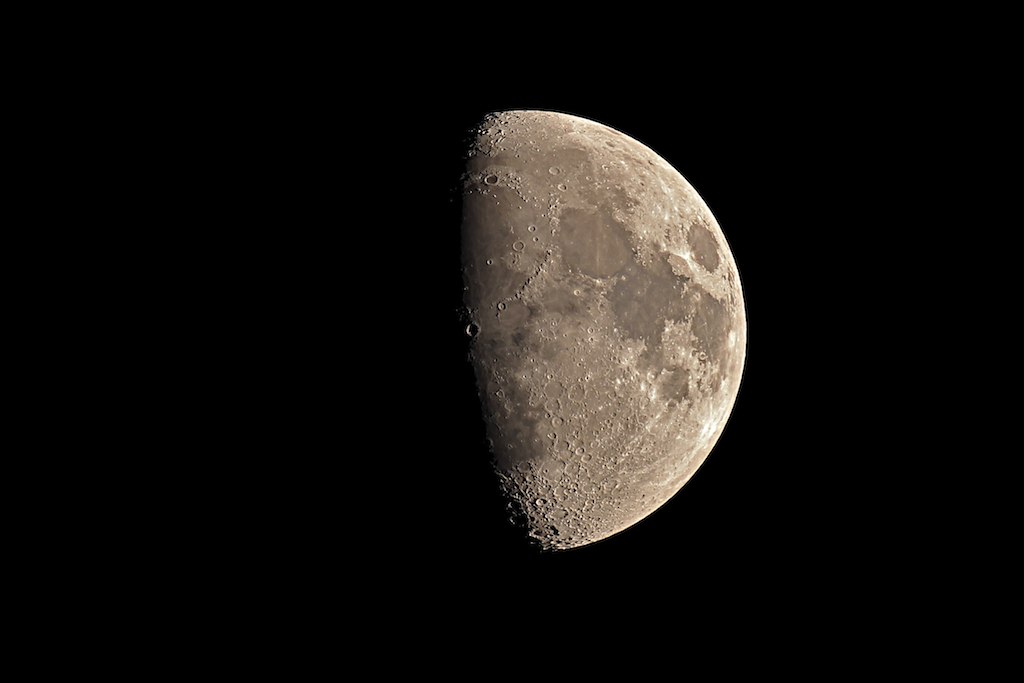 Copernicus Crater
 by
Tim Campbell1, on Flickr
(One of these days I'll re-take this shot using my TeleVue NP101 -- a 540mm focal length f/5.4 scope, but it has even better optics than the Meade at the observatory.)
ALSO... I should point out the problem of "seeing". The atmosphere causes distortions in astro-photos. It's the reason stars "twinkle". If you see a lot of twinkling stars when you're trying to photograph the moon... best to just wait for another night.
I made a video of this at the observatory to show off the effect. This a shot of the moon through the observatory's Celestron C-14 SCT telescope. This is a telescope with roughly a 3900mm focal length (so this is rather magnified). We've got a Stellacam mounted to the scope (this is basically a video camera designed specifically for astro-video use). I'm playing the "live" video feed onto an observatory monitor. The Stellacam, unfortunately, _only_ puts out "video" ... not digital (there's no USB or Firewire) so I would have needed a video capture box to capture this directly on the computer. As such, I just used an iPhone to show the effect. The video is only about 10 seconds long but you'll QUICKLY get the idea of what "seeing" is.
We tell people to imaging they're trying to get a photograph of a penny on resting on the bottom of a swimming pool. If the water is flat then you'll be able to get a pretty good image of that penny. But if I start making waves on the pool it will be EXTREMELY difficult for you to manage a sharp shot. That's what astronomers mean when they refer to "seeing" conditions.
Here's the video:








![[No title]](/data/xfmg/thumbnail/40/40305-2fbdc00adce4fac5e62dccb3f6f9c633.jpg?1734174713)