What's new

Please share your exercises

blackrose89

TPF Noob!
Joined
Nov 14, 2011
Messages
1,451
Reaction score
265
Location
South Florida
Can others edit my Photos
Photos OK to edit
I would love to hear everyone's different skill building exercises!
 
Shoot, post, learn from constructive criticism, shoot. ;)

I also read all day and watch instructional video but actaully setting out with idea to practice and learning from error works best for me.
 
I hope to one day put together an exhaustive noob guide to photography, but at this point I don't yet think I'm qualified. But until then...

I enjoy performing mental exercises without a camera:

1. Finding things in groups of 3.
2. Finding things that repeat into the distance.
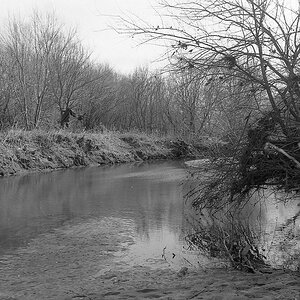
3. Finding natural things that are completely isolated. (Yesterday was good for this here... on the way home it was misting and the contrast was very low, and things in the distance vanished with distance. I love single trees in this kind of environment.)
4. Finding storytelling scenes.
5. Finding scenes with limited color pallettes.

etc...
 
Put the camera into manual mode. Practice 'metering' on different things and adjusting your exposure settings to 'get to zero'. Once you have a good handle on that, learn why getting to zero isn't always your best choice (dig further into the topic of metering), and practice getting to 'proper exposure'.

For most people, it takes some time to get used to the manual controls on their camera...practice, practice, practice. Then it takes some head scratching to figure out how to get proper exposure (there are several different methods)....and eventually, many photographers can do it just by making accurate guesses based on knowledge and experience.

Again, for most people, this can be a lot to think about while trying to take a good photo. So the more you practice, the more intuitive it becomes, the easier it will be to concentrate on the other aspects of photography.

 
I would love to hear everyone's different skill building exercises!

USF Photography Program (and practice practice practice). I'm attending these certification courses and about halfway done, although I'm a hobbyist.


  • Photography Introduction
  • Photography Intermediate
  • Studio Lighting Introduction
  • Business Essentials for Photographers
  • Digital Image Management
  • Studio Lighting Advanced
 
TIMING. Shoot images where a small subject is visible through a chain link fence, or in a reflection, or between two parked cars, or whatever. The idea is to take the camera and practice making the exposure so that the subject is captured at a precise time and location in the frame. Do this on your lunch break for 5 to 10 minutes. Practicing this timing exercise will help you be able to nail the exact right heel-lift that makes images of people walking look "just right", and not all stilted and flat-footed.
 
Since the essence of photography is recording light, that's what I mainly study.

I look at shadows and highlights in every day life, and notice the placement of light sources that produce those shadows and highlights.

I look at professional photographs and try to de-construct the placement of lighting and lighting aids.

When I watch a movie, I'm always looking for catchlights in the actors eyes, or take notice of when they use of big reflectors or constant lights in a scene.
When I watch movies, I'm also looking at the way they use composition, because they can't change the orientation of the image frame like still photographers can.
 
When I watch a movie, I'm always looking for catchlights in the actors eyes, or take notice of when they use of big reflectors or constant lights in a scene.
I do that too.
It seams that more often that not, in movies, the lighting is inconsistent within a scene when they change the angle/view. Like when someone is talking and they are lit on the camera side of their face, but when we see them from the other angle, it's the opposite side of their face that has the key light. It's understandable, they want the best lighting for each shot....but few people notice or care about the inconsistency.

Another one is movies where the actors always seem to be strongly back lit, no mater what the setting of the scene. The Lord of the Rings movies did this a lot. It seemed like every shot of a Hobbit has strong back lighting on their fluffy hair. I think that is a favorite technique of the head cinematographer, Andrew Lesnie.
One of my favorite movies, partially for the lighting style, is Babe. Which was also shot by Lesnie.
 
I try to learn to "reverse engineer" a photo and what is right and what is wrong. Then I try to do what is right and avoid what is wrong. I read a lot of the CC posts on here :D
 

Create an account or login to comment

You must be a member in order to leave a comment

Create account

Create an account on our community. It's easy!

Log in

Already have an account? Log in here.

New Topics

Back
Top Bottom