What's new

point n shoot with good depth of view

qwertyjjj

TPF Noob!
Joined
Jun 7, 2012
Messages
97
Reaction score
3
Can others edit my Photos
Photos NOT OK to edit
I currently have a Canon G12, which although a little chunky is just about good enough for everyday photos, travelling, etc.
I recently got a bit more into photography and started learning about exposure, depth of view, aperture, etc.
So, I quickly found that the Canon doesn't really do a great job for DOV on anything unless you are really really close to the object and you can't often set aperture lower than around 4.

I then looked at using a Sony Nex 5, which I liked for a short while but then found it very cumbersome to change lenses all the time and it just wasn't easy to carry around with you.
So, I sold it on again.

What are my options either getting some extra attacment for the G12, which I don't think exist or are there going to be any small Point N Shoot cameras in the future that have good DOV, low aperture enabling background objects to be blurry?
 
What you mean by 'good' and 'depth of view' is unclear.

If by 'good depth of view' you mean that the depth of field is shallow so that only the subject is in focus and the background is out of focus, then you are out of luck.
Optical principles mean that very short focus, small lenses - like in every point and shoot - have a very large depth of field at even the widest opening.

You can demonstrate that for yourself by looking at the tables on DOFMASTER.COM or doing some sample lens combinations. Look at the depths of field for different lenses.

You are out of luck because you can't fight Mother Nature or in this case the principles of optics.
 
If switching lenses for you is a problem then you'll never get the DOF you are looking for. Come on, join the DSLR gang :D lol. I know what you want though which is portability, haven't seen any amazing ones lately because I hardly look at point and shoots haha. Will there ever be one with an aperture of f/2.8 that has a fixed zooming lens? Idk the future.....it's not impossible I'm most certain.
 
Hmm...I suppose there are no attachments for the G12 to enable this as it is a built in zoom lens?
What about the Lumix LX5, is it shallow enough or better than the G12?
 
Hmm...I suppose there are no attachments for the G12 to enable this as it is a built in zoom lens?
What about the Lumix LX5, is it shallow enough or better than the G12?

IT HAS LITTLE TO DO WITH THE CAMERA BODY BUT MOSTLY WITH THE FOCAL LENGTH OF THE LENS.
LOOK AT DOFMASTER.COM and YOU CAN SEE THAT FOR YOURSELF.

VERY SHORT FOCAL LENGTH, SMALL SENSOR LENS DISTANCE


You can't violate the laws of optics because they aren't convenient.

Mother Nature does not change her mind because you nag her.
 
Hmm...I suppose there are no attachments for the G12 to enable this as it is a built in zoom lens?
What about the Lumix LX5, is it shallow enough or better than the G12?

IT HAS LITTLE TO DO WITH THE CAMERA BODY BUT MOSTLY WITH THE FOCAL LENGTH OF THE LENS.
LOOK AT DOFMASTER.COM and YOU CAN SEE THAT FOR YOURSELF.

VERY SHORT FOCAL LENGTH, SMALL SENSOR LENS DISTANCE


You can't violate the laws of optics because they aren't convenient.

Mother Nature does not change her mind because you nag her.

I don't totally understand that page although I have had a look and changed the focal length :) So, a short lens changes the hyperfocal distance and therefore DOV.
I can't often go below f/4 on the G12.
So, I have to get a lens attachment to change the focal length?
 
To create that effect that subject is in focus while the background is out of focus, you can try ....

- Wider aperture. Wider the better (lower f number)
- User a longer focal length (longer the better)
- Shorter subject to camera distance (shorter the better)
- Longer subject to background distance (longer the better)
- Larger the recording medium size (larger the better for the same framing. But that is something you cannot change unless you change your camera)


So If I were you, I will try to use the longest focal length on the camera and set the aperture the widest at that focal length (smallest f number). Then position the subject and frame it so that the subject is closer to the camera. As for the background, find one which is far away from the subject.

With your G12, it is harder to do since the sensor is much smaller. If you cannot produce the result you like, replace the camera with one that has a larger sensor will help. Of course with a interchangeable lens setup is better since it allow you to have a telephoto lens that equip with wide max aperture. If you have to stay with a point and shoot type camera, than look for one that offer larger sensor such as the G1X.

This is a sample photo from Canon taken by the G1X, it shows some level of background blur.

http://usa.canon.com/app/images/cameras/powershot/PS_G1X/sampleimg/original_sample_2.JPG
 
It's not Depth of View, the phrase is 'Depth of Field' and it means how much of the image in front and back of the item focused on is in focus.

The shorter the focal length of lens the greater the depth of field and thus the longer the focal length the shallower the depth of field.
The wider the lens opening (the larger the f number) the shallower the depth of field

On small cameras with a small lens to sensor distance, the focal length of the lens is very small in order to produce a image over the entire sensor.
On small and inexpensive cameras, the lens is often f 4 at its greatest opening (because it's cheaper that way)

SO, the combination of short focal length and slow lens (small opening) means that P&S cameras have a fairly deep DOF - which is what you don't want.

And no gadget added to the lens will change that.
 
Image sensor size also has a large influence on depth-of-field (DoF AKA CoC). Circle of confusion - Wikipedia, the free encyclopedia

In photography, the circle of confusion (“CoC”) is used to determine the [/FONT][/COLOR]depth of field, the part of an image that is acceptably sharp.

Specifying the camera at dofmaster.com is required, because the size of the image sensor in a camera influences the DoF calculations.

The smaller an image sensor is, the less it costs to produce, but the deeper the shallowest DoF it can produce.

The image sensor is the single most expensive part in a digital camera.
So P&S cameras have small, usually tiny, image sensors to keep the total costs of the camera. With a tiny image sensor, they can also save money on the lens because the lens can be small too.
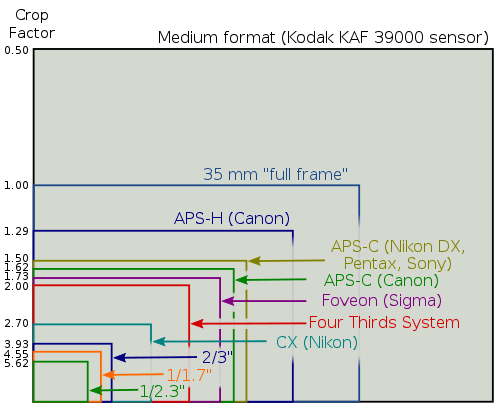
Most P&S cameras have the smallest - 1/2.3" image sensor:

500px-Sensor_sizes_overlaid_inside_-_updated.svg.png

This file is licensed under the Creative Commons Attribution-Share Alike 3.0 Unported license.

Note that DoF is also influenced by the additional factors of lens focal length, point of focus distance, and how far the background is from the point of focus.

See -
http://www.cambridgeincolour.com/tutorials/depth-of-field.htm
 
Last edited:
Just to clarify a minor detail: the sensor obviously cant do anything about what is in focus, this is exclusively a property of the optics.

BUT a larger sensor means that the same focal length will be something different. For example, a 35mm lens will have the same depth of field on both an APS-C sensor and a full frame sensor, BUT the full frame sensor is more than twice as large and archieves a much larger viewing angle - you can see everything outside the frame of the APS-C sensor too.

So in order to archieve the same image (or viewing angle) on the APS-C sensor as the full frame sensor sees it through a 35mm lens, the APS-C sensor has to use a 23mm lens.

And to have the same view the APS-C sensor has with a 35mm lens, the full frame sensor needs a 53mm lens.

And the larger the focal length, the more shallow the depth of field will be. This is why the 1" sensor on the Sony RX100 can probably archieve the smallest depth of field of any "real" compact camera (there are fake compacts like Canon Powershot G1 X or Fuji Finepix X100 or Sony Cyber-shot DSC-RX1, but they arent really compact in the literal meaning, they are only not really system cameras), the 4/3" cameras from Olympus and Panasonic can archieve even smaller depth of field (especially with the manual f/0.95 lens available for this system), the Canon f/1.2 and Leica f/0.95 on full frame are even smaller, and medium and large format cameras might be even more drastic.

I would also like to add that the small 6mm f/1.9 (28mm to full frame) optics of my Ricoh GR Digital IV compact, with a 1/1.7" sensor, in the macro mode, where the camera can focus as close as 1cm, literally has NO depth of field at all at f/1.9, or at least I failed to detect any. I had to stop down to f/9 to actually see a depth of field appear and get some stuff into focus. So yeah, moving closer is a very effective tool to get shallow depth of field.
 
If switching lenses for you is a problem then you'll never get the DOF you are looking for. Come on, join the DSLR gang :D lol. I know what you want though which is portability, haven't seen any amazing ones lately because I hardly look at point and shoots haha. Will there ever be one with an aperture of f/2.8 that has a fixed zooming lens? Idk the future.....it's not impossible I'm most certain.

The fixed zoom lens on my P&S is an f/1.4. Do you have a zoom for your DSLR as fast as the zoom on my P&S? haha.

Joe
 
If switching lenses for you is a problem then you'll never get the DOF you are looking for. Come on, join the DSLR gang :D lol. I know what you want though which is portability, haven't seen any amazing ones lately because I hardly look at point and shoots haha. Will there ever be one with an aperture of f/2.8 that has a fixed zooming lens? Idk the future.....it's not impossible I'm most certain.

The fixed zoom lens on my P&S is an f/1.4. Do you have a zoom for your DSLR as fast as the zoom on my P&S? haha.

Joe
And we all know now what compact you use ... well except if its the version from Panasonic or the Leica variant of it. :D
 
swiftparkour94 said:
If switching lenses for you is a problem then you'll never get the DOF you are looking for. Come on, join the DSLR gang :D lol. I know what you want though which is portability, haven't seen any amazing ones lately because I hardly look at point and shoots haha. Will there ever be one with an aperture of f/2.8 that has a fixed zooming lens? Idk the future.....it's not impossible I'm most certain.

Do you ever post about things you are actually knowledgeable about? There are plenty of point and shoots with sub f/2.8 apertures.
 
If switching lenses for you is a problem then you'll never get the DOF you are looking for. Come on, join the DSLR gang :D lol. I know what you want though which is portability, haven't seen any amazing ones lately because I hardly look at point and shoots haha. Will there ever be one with an aperture of f/2.8 that has a fixed zooming lens? Idk the future.....it's not impossible I'm most certain.

The fixed zoom lens on my P&S is an f/1.4. Do you have a zoom for your DSLR as fast as the zoom on my P&S? haha.

Joe
And we all know now what compact you use ... well except if its the version from Panasonic or the Leica variant of it. :D

That's a very good guess. The LX7 was my second choice and I'm sure I'd be pretty happy with it, but I went with:

Samsung EX2

Joe
 
Last edited:
Contax 645 + 80mm f/2.

Its what I use as a point and shoot.....
 

Create an account or login to comment

You must be a member in order to leave a comment

Create account

Create an account on our community. It's easy!

Log in

Already have an account? Log in here.

New Topics

Back
Top Bottom