What's new

Help me With Macro

William Baroo

No longer a newbie, moving up!
Joined
Aug 30, 2023
Messages
255
Reaction score
34
Location
FL
Can others edit my Photos
Photos OK to edit
I finally got around to trying some tips for macro photography. A guy named Micael Widell has some informational videos, so I listened to him.

He said to try 1/200 of a second, ISO 200, magnification 1:1. He said to use a diffuser and set the flash to 1/16. He also said to set my camera to 5500 K. He said to use focus peaking instead of auto focus. He said to use f8.

I was using a 200D today, and I found out it can't be set to 5500 K unless I shoot a white object in the sun and use the camera's custom feature to set the camera's temperature to the photo's temperature, so I went with 5200 K. I also found out this camera doesn't have focus peaking, but there is a bootleg firmware from an outfit called Magic Lantern, and it will provide this feature. I have not tried it.

I went out in the yard and shot a few things, and the results were not great.

Focusing was impossible at f8. The depth of field was so small, even a tiny object was out of focus on one end and sharp on the other. I went to a lower value, and I was still not happy with the results. I took a number of shots of each subject, and the majority of the shots were horrendous.

Below, I insert a shot of a peach blossom. All I did was open the photo in Affinity in ARW, crop it, save it as a jpg, and resize it to post it here. As you can see, almost none of it is in focus. This blossom is probably one inch high.

I was using a Sigma 70mm 1:2.8 DG Macro EX, which is supposed to be pretty good for this purpose.

Where would you start if you were trying to do better?

I have a better camera and another macro lens, but it would be nice to get this one working before abandoning ship.

On the up side, I was very impressed with the beauty of the peach blossom, so when my tree really gets going, I expect to have some good subject matter.

IMG_0402 cropped small.webp
 
  • Like
Reactions: LWW
I think I have a lot of good opportunities. These photos would be pretty good if I could get them in focus.

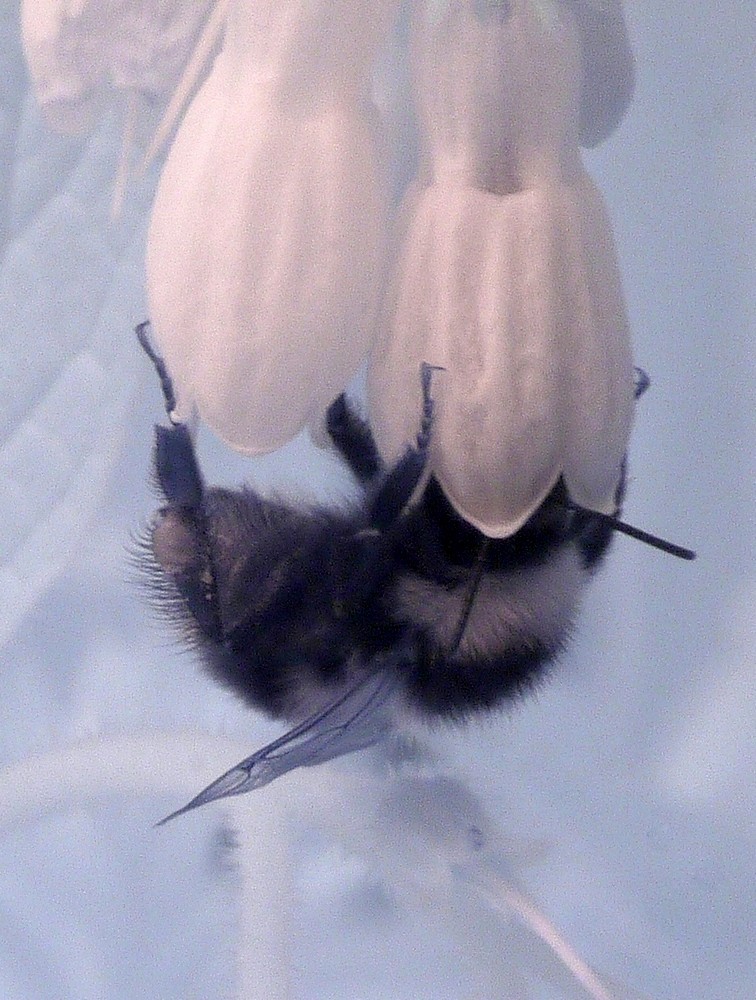
25 11 07 bug on pink blossom in yard cropped small.webp


25 11 07 bug next to yellow blossom hard crop affinity small.webp
 
  • Like
Reactions: LWW
Use a tripod and take 3-4 pictures slightly changing the focus point on each. Then use stacking software to combine them into one picture. There is free software called CombineZP. There are many others.
 
Thanks for the response.

I found a lady who appears to disagree with the advice I took. Her photos are very good, so she must know something. She says to use a high f-stop. I think I'll start at f22 and go lower if I don't like the results.

 
Macro is very difficult and take a lot of patience, especially when shooting bugs. I gave up on using a tripod and stacking, as the bugs that I shoot often move when getting the first shot. A flash with a diffuser is useful as are extension tubes.
 
The lens you are using has a minimum focus distance of 10.2". If you are closer than that nothing will be in focus.

Depth of field is a function of aperture AND distance to subject. The closer you get the less DOF. With your setup at the minimum focus distance your DOF would be approximately 1/8".

The solutions are to increase your aperture, back up, or use focus stacking to shoot multiple slices that you combine post. Bumping your aperture to f/22, and increasing your distance to 12" would give you approximately 3/4". If your shooting a static subjects, mounting the camera on a focus rail and sturdy tripod, can give you unlimited DOF depending on the number of images you stack. On flash, a ring flash works well, as does the angled hood diffusers.
 
You said you started at f:8 and went to a lower value. If that means that you went to f:5.6 or f:4, then you made your depth of field narrower.

Shooting macro involved incredibly narrow depth of field and will almost always require stacking several images with software. These are a couple of frames I stacked manually, first focusing on the hind leg, then on the head.
51722274524_e30b665093_c.jpg


51721615996_3e58bc9a23_c.jpg


I manually copied the focused head onto the other shot and blended it in to get the final result.
51722274499_4133271acb_c.jpg


Neither shot is useful alone, which was your experience. I shot these at 1/160, shutter-priority, ISO 200, which gave an aperture of f:6.3. This was not a macro lens, it was my 70-300 at 300mm from almost 6 feet away. I could have used a higher ISO to get a smaller aperture like f:11 or f:16, but the camera in use at the time, a D5000, was horrible above ISO 200, and useless above 400.
 
Smoke665,

Interesting numbers regarding depth of field. Can you post info on how you made those calculations?

Marc
 
Smoke665,

Interesting numbers regarding depth of field. Can you post info on how you made those calculations?

Marc
Here's the formula if you want to do it manually Depth of Field Equations There are also links to an online calculator and a link to a table. Google Online DOF calculator and you'll find numerous similar pages. Here's another online tool for determining step size in Focus Stacking Focus Stacking Step-Size Calculator for Macro Photography | Wildlife Macro
 
Last edited:
Depth of field is a function of aperture AND distance to subject.
and focal length or more usefully aperture & magnification.

FWIW 1/200s wouldn't be any good for several of my cameras as that's faster than their sync speed.
Flash on 1/16 power will depend on the flash & it's distance to subject/diffusion etc. For ease of use having the flash on TTL simplifies things, especially if you shoot the way I sometimes do with the flash in my left hand & camera in the right...
Watch Macro by Mike Kanssen, on Flickr

Altogether I must have used over 50 different set-ups for macro, each one needs slightly different settings - especially as some set-ups loose the auto aperture shut down. Then I generally can't see through a DSLR viewfinder with the lens shut down. Adding IR filters into the equation makes view finders even more tricky
fortunately not an issue with mirrorless.
Bee in infra red by Mike Kanssen, on Flickr
 
In general a high F-stop is your friend, a good ring flash helps greatly allowing both high F-stop and fast shutter speed.
 
and focal length
Yes, I was focused on his lens and failed to mention that. As the focal length goes down, the DOF available at equivalent distance goes up. IE had he used a 35mm at the same distance (assuming the same minimum focus distance and aperture) the DOF would have risen to just over 1/2".
 
You said you started at f:8 and went to a lower value. If that means that you went to f:5.6 or f:4, then you made your depth of field narrower.

Shooting macro involved incredibly narrow depth of field and will almost always require stacking several images with software. These are a couple of frames I stacked manually, first focusing on the hind leg, then on the head.

Yes. When I went lower, things definitely got worse. Thanks for the suggestion about the software. I don't know how well it will work when I can't use a tripod and get the same things in the frame every time, but I will look into it.
 
Today I tried the Sony A7IV. I thought focus peaking might make life easier. I have been using an Angler diffuser on both cameras. I used a Sigma 105mm F2.8 DG DN Macro Art and a Godox something or other at 1/16.

This is a very complex camera to set up. It has a feature that drastically magnifies the image while you focus manually, and it blows macro images off the screen. I had to fix that, and I also had to disable the feature that shows what the image will look like without flash, because my monitor was totally dark.

I didn't do all that well at 1/200, so I fiddled with it. I also jacked the ISO up from 200. It just would not work at that setting.

I don't know if this camera will let me save a set of settings and go back to it. If not, I am going to have to write things down.

I did much better today. Maybe half of the shots I took were so bad there was no use in even opening them, but that was mostly because of my problems setting the camera up. The depth of field was greater, and I managed to get things more or less in focus. It gives me hope.

I am not totally clear on using the flash. I would think the ambient lighting would be irrelevant with macro. Is that true? You're a few inches away from things, and the flash is blasting them. But maybe the sun is so bright it still matters. The sunlight was starting to fail when I went out, and I wonder if it made things harder.

I will post a couple of shots just to show that I can now at least get recognizable shots of things. I think they were both underexposed.

The first shot is another peach blossom. The focus is nothing special, but at least I can see what it is. It looks somewhat better at full size. The second is a bolt head from an excavator. It's about 5/8" across.

25 11 08 peach blossom 01 edited in affinity small.webp


25 11 08 bolt head excavator edited in affinity 01 small.webp
 

Create an account or login to comment

You must be a member in order to leave a comment

Create account

Create an account on our community. It's easy!

Log in

Already have an account? Log in here.

Back
Top Bottom