What's new

Question: which light meter is best?

3bayjunkie

TPF Noob!
Joined
Jan 4, 2011
Messages
576
Reaction score
12
Location
United States of America
Can others edit my Photos
Photos NOT OK to edit
Hopefully you got the reference to "the office" in the title.

But seriously what do i look for in a light meter to know why one would be better than another. I mainly want one for spot metering the amount of light falling on a persons face using natural light.

Thanks in advnce!
 
While it certainly won't hurt, a handheld light meter really isn't necessary if you have a modern camera with a built in light meter. It's just a matter of learning how to use the built in meter.

Most light meters these days are capable of (and mainly used for) metering external flash, which is something that the camera can't do on it's own.
So for that reason, the most popular light meter seems to be the Sekonic L358
 
While it certainly won't hurt, a handheld light meter really isn't necessary if you have a modern camera with a built in light meter. It's just a matter of learning how to use the built in meter.

Most light meters these days are capable of (and mainly used for) metering external flash, which is something that the camera can't do on it's own.
So for that reason, the most popular light meter seems to be the Sekonic L358

What mike said... that is correct that the camera can't meter with flash, BUT.... you have a PREVIEW screen! Use your eyes as light meter :).

Personally I think a light meter is a waste of money. Even when you use a lightmeter, it is still a trial and error because you need to input your cam settings and trigger the lights and see the result. OR, you can just shoot it without lightmeter, see the result... adjust the powers as needed.
 
Schwettylens said:
SNIP>... you have a PREVIEW screen! Use your eyes as light meter :).

Personally I think a light meter is a waste of money. Even when you use a lightmeter, it is still a trial and error because you need to input your cam settings and trigger the lights and see the result. OR, you can just shoot it without lightmeter, see the result... adjust the powers as needed.

Oh-My-Gawd....incredibly bad advice from somebody who doesn't even know HOW TO USE a light meter properly, telling you one is a waste of money...

Geebuzz....

Look into the best Sekonic or Minolta meter that you can afford if you want to be able to determine the exact exposure, and the entire exposure parameters of a scene, without the need to fire a single shutter click...learn photography the professional way, using scientific instruments, OR...listen to novices who tell you to rely on an un-calibrated LCD. Do you want to learn how to meter, evaluate, and set the camera properly? OR, do you wish to shoot, guess,re-shoot,make another guess, re-shoot, chimp, and then make a final guess?
 
While it certainly won't hurt, a handheld light meter really isn't necessary if you have a modern camera with a built in light meter. It's just a matter of learning how to use the built in meter.

Most light meters these days are capable of (and mainly used for) metering external flash, which is something that the camera can't do on it's own.
So for that reason, the most popular light meter seems to be the Sekonic L358

What mike said... that is correct that the camera can't meter with flash, BUT.... you have a PREVIEW screen! Use your eyes as light meter :).

Personally I think a light meter is a waste of money. Even when you use a lightmeter, it is still a trial and error because you need to input your cam settings and trigger the lights and see the result. OR, you can just shoot it without lightmeter, see the result... adjust the powers as needed.

Dood, thats the craziest thing I've ever seen you post. A light meter will DECREASE all that and SAVES time. I can walk in a studio, put my cam down. Decide I want say...a studio f/8. Trigger the sekonic 358 to trigger the light(s). It will immediately tell me if my lighting is off and which way its off. Adjust lighting. One or two more light pops, done. Insanity that its a waste of time in comparison to chimping and such

Also outdoors it gives an ambient/to lighting ratio. Blows chimping away in regards to time, especially at times the sun is setting fast and light is changing quickly.

OP: Give a good quality meter a try, you'll keep it handy forever.
 
Thanks for all the different advice. If you know me, for one thing i only shoot film so i dont have this mystical LCD whatchamacallit, but i dont use flash unless it is too dark to get at least a 1/15s shutter either, not very often with my film and lens combinations.

Mainly i would use it out doors in shades areas with consistent lighting or as the sun is setting or at dusk where i would want an accurate reading so i can just set my camera to M and punch in the settings.

Also it seems more pleasing then poking the camera in peoples faces to get an accurate light reading off of the most important part of the portrait, the faces.
 
Here's a 1 pop play snapshot in my living room "studio".....one pop because fortunately I have a light meter and exposure setting isn't factor
cheers.gif


561400_3115628204278_41930241_n.jpg
 
Thanks for all the different advice. If you know me, for one thing i only shoot film so i dont have this mystical LCD whatchamacallit, but i dont use flash unless it is too dark to get at least a 1/15s shutter either, not very often with my film and lens combinations.

Mainly i would use it out doors in shades areas with consistent lighting or as the sun is setting or at dusk where i would want an accurate reading so i can just set my camera to M and punch in the settings.

Also it seems more pleasing then poking the camera in peoples faces to get an accurate light reading off of the most important part of the portrait, the faces.

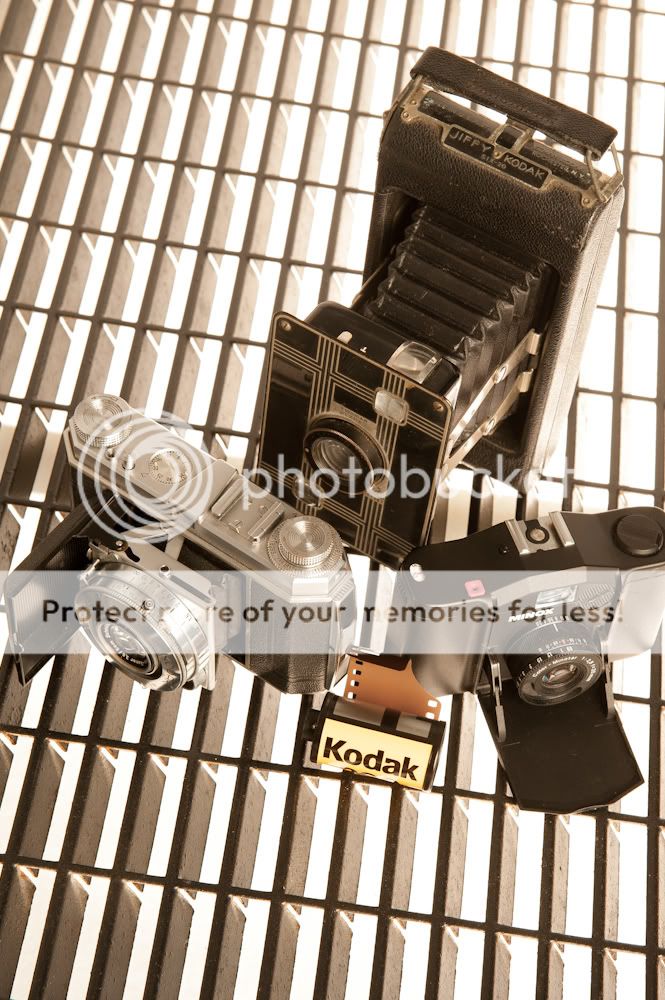
I use all these old cams, and I don't even take them out without my meter. No need to waste film or be silly. Simply input film speed, take a meter readuing, set your aperture and shutter, and fire away
bigthumb.gif


SRW_2513.jpg
 
Cute photo. I dont do test shots obviously since i use film so its always one shot one kill for me. And i have to just hope my cameras light meter knows what its talking bout haha
 
Cute photo. I dont do test shots obviously since i use film so its always one shot one kill for me. And i have to just hope my cameras light meter knows what its talking bout haha

Yes sir, I don't either that was my point with the meter and film cams.

That oldest cam in the pic shoots some pricy film and doesn't have a meter. The later cams in the pic have mediocre meters but my Sekonic light meter just ROCKS and makes it nice and affordable to shoot film in them =)
 
BUT.... you have a PREVIEW screen! Use your eyes as light meter :).

Personally I think a light meter is a waste of money. Even when you use a lightmeter, it is still a trial and error because you need to input your cam settings and trigger the lights and see the result. OR, you can just shoot it without lightmeter, see the result... adjust the powers as needed.

:biglaugh: That's in line with photographers that have never used and don't know how incoporate flash into a scene, only to claim that they are "natural Light" photographers. Again, :biglaugh:

A good light meter like the Sekonic L358 (which I use) has more uses than to measure flash output. However from previous experience to achieve a certain light pattern, if I know that I want my Main to be at f/9, the Fill at f/5, the Hair Light at f/6.3, the Kicker at f/7.1, what's the quickest way to get those exposures? Your eyes can see the light, but how reliable are they for determining the proper exposure?
 
Yeah Scwetty's post surprised me too.
 
Personally I think a light meter is a waste of money. Even when you use a lightmeter, it is still a trial and error because you need to input your cam settings and trigger the lights and see the result. OR, you can just shoot it without lightmeter, see the result... adjust the powers as needed.

That is my opinion, just telling him what I think. But if he shoots with film and flash, of course he will need it.

I don't care if you think what I said is stupid. There are a bunch of pros who will back me up on this. My mentor shot for ESPN, did a lot of studio photos of famous athletes. He has been very influential with my development. He said he hasnt touched his lightmeter ever since he stopped using film.


When you use a lightmeter, you still have to trigger them to read. Then you adjust the power. It is essentially trial and error but more precise reading. With digital the precision does not to be that accurate and my eyes are capable enough to tell. Even if the screen is uncalibrated, you cant be that wrong.
 
I like my L358 lightmeter. Don't use it when doing snapshots, and don't use it when the light is very static. But if I'm trying to combine ambient with one or more off-camera flash, then it's very valuable. It's also valuable when you have variable light, and you need to understand how that light is varying. For instance, I take a reading in full light, in the shadow, and in the reflected light area. That can tell me that the shadow is three stops darker than direct, and the reflected light is 1 stop darker than direct. Since my dynamic range is 4 stops on the dark side, I know that I have to be careful with the shadow area. Without the meter, I'd have less of a feeling about the light distribution.
 
An experienced professional who has BEEN USING A METER FOR A DECADE (or more!) or so knows: 1) HOW to use a light meter and 2) Probably learned how to set up his lights and get the RIGHT exposure--not by GUESSING, but by PROPERLY USING a light meter.

I don't think you can lay claim to either of those qualifications, 1 or 2.. In fact, you just shot your very first roll of film this month. And I saw your results. Lousy exposures, big-time. You proved my point nicely. By the time an experienced shooter, who learned with a meter and film, finally made it to the pro level, he did not need to rely on a meter. You on the other hand, muffed an entire assignment of your three kids with horrific exposures made on film. Horrible exposures!!!!

Too bad you did not have the knowledge of how to properly meter light. Messing up exposures on modern Black & White film is almost inexcusable...yet, you managed to do that. Amazing.
 

Create an account or login to comment

You must be a member in order to leave a comment

Create account

Create an account on our community. It's easy!

Log in

Already have an account? Log in here.

New Topics

Back
Top Bottom