What's new

spots, lense flare?

ralphbrunt

TPF Noob!
Joined
Sep 24, 2013
Messages
25
Reaction score
7
Location
long beach, ca
Can others edit my Photos
Photos OK to edit
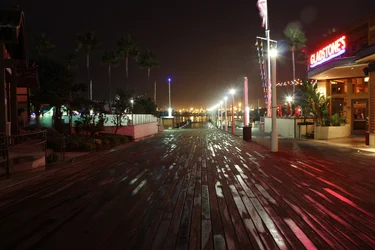
does anybody know what the spots in the upper right is from, sorry im new and trying to learn
$IMG_4079.webp
 
Yes, that's lens flare.

Lens flare is caused by reflections inside the lens, and occur whenever there are bright light sources in the image frame.
 
Using a lens hood will help; however, when you point that lens directly into light nothing is going to avoid lens flare
 
Yep. A lens hood only blocks bright light sources that aren't yet in the image frame.

Once the bright light source is in the image frame the construction of the lens determines amount of lens flare.
Air gaps between lens elements are where most lens flare is produced.

Most lenses have some coatings that help reduce lens flare and help the lens transmit more light.
Generally, consumer grade optics will deliver more lens flare than professional grade optics.

Adding a clear or UV 'protection' filter to the front of a lens tends to make lens flare worse because it adds an air gap, particularly when bargain basement filters are used.
 
Here's how I usually handle the unavoidable lens flares...I make them part of the image! Move things around a bit until you get a cool looking flare, and then snap away, a lot of times people even add these things to their images in Photoshop, so why not capitalize on the moment? :)

Of course, if you really don't want it, take a shot with the desired composition, move the camera slightly till the flare is somewhere else, take another shot then copy the blank portion of the 2nd image and paste it over the flared portion of the first! Obviously a bit of a photoshop hack, but hey it's easier than trying to clone the dumb things out later.
 
Adding a clear or UV 'protection' filter to the front of a lens tends to make lens flare worse because it adds an air gap, particularly when bargain basement filters are used.

This is a fairly common problem. In the days of "film", a UV filter was encouraged because many films were sensitive to UV light even though human eyes are not. Each different wavelength of light wants to focus at a different distance after passing through the lenses. The correcting elements in the lens do a fairly good job (or at least try to) but the farther apart the wavelength frequency, the more difficult that is to do. Since UV (and also IR) lie outside the visible spectrum... they cause a more extreme version of the problem. The result is an image that looks slightly "soft". The UV filter simply blocks the UV light completely so it's not an issue.

Whether or not film was sensitive to UV depended on the film -- but if the film was sensitive, then the only way to correct the problem was to use the filter.

With digital, all sensors are sensitive to UV light -- it's always an issue. BUT... the camera manufacturers include a UV filter built into the camera (it's located just behind the shutter but in front of the imaging sensor.) That means a UV filter in front of the lens is not only redundant... but can only hurt the quality of the optics. I do own UV filters for in each size necessary to protect all my lenses. These filters are not actually attached to the lenses. If I'm going to be someplace that I might deem hazardous to the lens, then I might slip on the UV filter as a form of protection. But for normal use... I wouldn't bother with UV filters on your lenses because your camera does not need them.
 
You can try to use a hood to reduce the flare cause by the light come the the side. However, in this photo, you are point directly to the light, that mean a hood may not help. Sometime when I face this situation, I will try to make the flare into the composition and blend with the photo. You can see the flare in the viewfinder actually. And if you think the flare cannot blend good with the composition, just re-compose and shoot with another angle.
 
If the flare is unavoidable then try to have it in a place like the sky. You can edit it out in post.
 
The image sensors in digital cameras also detect light that humans cannot see, and DLSR cameras have a UV filter (and others) right in front of the image sensor.
Not all of the light humans cannot see gets filtered out.
 
Just bought an Halogen Oven and i was taking some photo`s of the food cooking, and i noticed a line of small green dots in the viewfinder and in the photo`s , i removed my Hoya HTM UV(c) filter and the green dots vanished, so i have now seen it with my own eyes that filters can cause problem with reflections.

Though i will still keep the filter on and remove it when i see a problem.

John.

 
Last edited:
That's a very informative article JerryLove thank you for sharing. I'm thinking of investing in a new camera some time in April hopefully, articles like these get me pretty excited I look forward to actually experiencing these things. In the mean time, I'm just trying to absorb what I can through what I read and pictures taken by others.
 
That's a very informative article JerryLove thank you for sharing. I'm thinking of investing in a new camera some time in April hopefully, articles like these get me pretty excited I look forward to actually experiencing these things. In the mean time, I'm just trying to absorb what I can through what I read and pictures taken by others.

When I click on the link now, a month after it was posted, they seem to have removed the associated images from the article. I don't see the images referenced by JerryLove in the section on Distortion and Aberration, so I've no idea what he was referencing. But Distortion and Aberration, as discussed in the article, isn't really related to lens flare.

The part of that article that is related to flare has to do with lens coatings. Notice they point out that each surface can reflect at much as 5% of the light, and in a multi-element lens that doesn't have appropriate coating on each surface there might be nearly 50% of the light that enters the front element that is reflected off in the wrong direction and never makes it to the sensor! At exactly 50% would make an f/2.8 lens pass the same light as a perfect f/4 lens. But the bad part actually is what happens to the light that is reflected. Most of it hopefully lands on a black surfaced wall in the lens (a baffle) where it is absorbed.

But when it it reaches the sensor: Flare!

Most of such flare is spread out evenly, and will only be obvious as a lack of contrast. Light from the such reflections is cast into every shadow. So the lens will not only be darker than expected, it will exhibit low contrast.

And in certain circumstances the reflected light will bunch up in one place on the sensor, causing a more specific and visible flare. The most commonly seen examples are reflections that show the shape of the aperture. That happens with very bright light (the sun is directly in the frame, for example), and it is sometimes possible to actually count how many glass surfaces there are in a lens, because the shape of the aperture will reflect from each and every one of them!

With digital sensors we get another common type of flare that didn't exist with film. The sensor itself can reflect light back at the lens, and if the rear element of the lens is not properly coat it will in turn reflect it back at the sensor. With a bright scene (daytime sky for example) that might result if a rather large roundish blob of light near the center of an image. Several older lenses from the film era are relatively poor in this way.

Something to keep in mind then, is that not all flare is visible as a shape in an image. Flare usually manifests as lower contrast.

 

Create an account or login to comment

You must be a member in order to leave a comment

Create account

Create an account on our community. It's easy!

Log in

Already have an account? Log in here.

New Topics

Back
Top Bottom