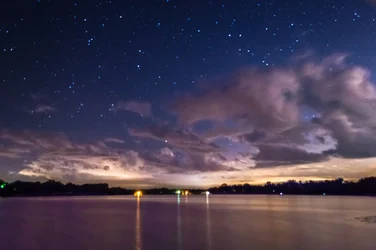
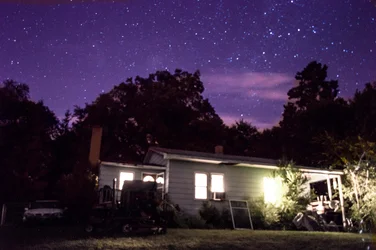
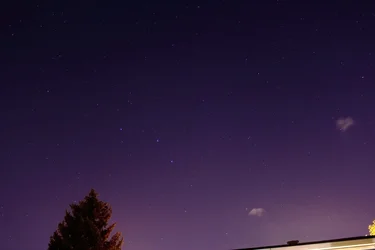
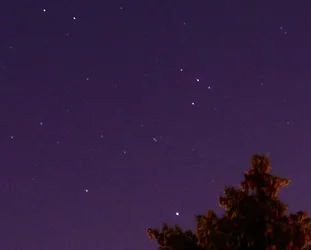
I REALLY liked your shot in the little thumbnail, but then I clicked on it and saw the focus issues with it. would have been a beautiful shot if not for that.
I believe he's recommending f11-f16 for depth of field perhaps, not quite sure? but I'd not recommend stopping down that much, you'll lose so much light and when you're shooting stars you want all you can get, I'd say stay close to wide open, get all that light you can possibly get. push your ISO to the point you're comfortable with, you've got a decent amount of noise at 1600, you could probably work with it a little and clean it up, but personally I probably wouldn't go much past that. The focus issues you're getting aren't due to depth of field, its a focus mistake, you should be focusing at infinity since everything in that shot is far far away (proper infinity focusing is NOT all the way at the stop point of the focus ring, its just slightly before that). what you want to do is to switch to manual focus, go into live view mode, and find a star or point of light or something and zoom the live view screen in on it as far as you can, then while watching that, adjust your lens focus manually until you get it to the best focus you can (remember that you're focusing through MILES of atmosphere and temperature fluctuations and stuff, so it may not look perfect even in live view when you're zoomed in at 4-5x, but get it to it's best point), then exit live view, and trip the shutter.
2 minutes is way too long an exposure if you're wanting to avoid star trails. to (roughly) figure out the max shutter speed before you start getting noticeable star trails take 500 for a DX sensor, 600 for an FX and divide that by the focal length you'll be using, this will give you the approximate time in seconds that you can leave the shutter open without discernible star trails. so for example, using a 18mm focal length on a DX sensor, take 500, divide it by 18 and you get ~27s. you might be able to push it to 30s without too much issue (remember its a rough estimate)
you can stack images like was mentioned, like a bunch of 30 second shots, but remember that the stars will continually be moving (as will the clouds at a different rate), so when you align your images for stacking, either you align them for the stars and your foreground and clouds won't align, or vice-versa, you'll have to separate the foreground from the background, and separate the clouds from that, align and stack them separately and individually, then combine them after the fact. which would be fairly difficult (though still possible and an option) for this kind of shot, it would work well if you wanted to get super long star trails, but for alignment without trails, it would probably not be the ideal way to do it.
try it like you did in your first shot, f3.5, ISO1600, 18mm, 30s, but focus it using the live view method.






![[No title]](/data/xfmg/thumbnail/31/31755-9bffabfa76f6307bcd78f535b2421cb5.jpg?1734160477)
![[No title]](/data/xfmg/thumbnail/32/32177-3a3d923fa1584c6ef7d6602aaa24fbc6.jpg?1734161047)
![[No title]](/data/xfmg/thumbnail/31/31757-4f5257d19be4e34c6bdcbd2519380d53.jpg?1734160480)
![[No title]](/data/xfmg/thumbnail/39/39474-4ba9b46daa507ab0506d70b86d8622ee.jpg?1734173567)