

RacePhoto
Pete
- Joined
- Dec 29, 2006
- Messages
- 877
- Reaction score
- 125
- Location
- Wisconsin
- Can others edit my Photos
- Photos NOT OK to edit
Canon 20-D what is the maximum auto exposure duration Aperture-priority mode? Canon says Max. is 30 seconds, but I only get 4 seconds? I had to dig around quite a bit to find that 30 seconds number.
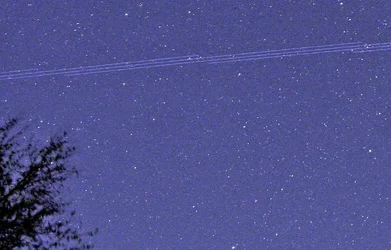
I thought maybe there was light leaking in through the eyepiece and tricking the meter. I tried a lens cap on, and then a body cap, no lens. If you are wondering why I'm out in space on this question, that seems to have no useful purpose or reasoning. I'm trying to set up a time lapse camera, to run 24/7 and I need it to be fast enough for the daylight, so the shots aren't over exposed and slow enough at night, so I still see the stars.
My base point is f/4, 1600 ISO, if that will allow a "normal" exposure at 1/4000th of a second. (so far) And the same setting, AV f/4, if the camera would go up to 30 seconds, would also make a reasonable star shot.
Anyone have any ideas why Canon says the maximum automatic exposure duration is 30 seconds, but I only get 4 second exposures? Something I'm doing wrong or is there something I'm missing in the specifications?
By the way, this is an example, using the older camera, the newest have the same automatic time limit in the software as far as everything I could find. It's not just an irrelevant old camera question.
Update, I covered the eyepiece and that does make a difference, but still, no Max. time. I had an idea, I turned off the protection, and also tried changing the ISO. Funny thing, as soon as I went to 800 it flashed 30" and then switched to 8 seconds. When I change to 400 it flashes 8 then changes to 15 seconds. (or if I turn off the camera and start again, it flashes 30 and switches to 15 seconds) This is no lens, just a body cap. The camera is somehow sensing the ISO and adjusting the Maximum exposure duration.
I thought maybe there was light leaking in through the eyepiece and tricking the meter. I tried a lens cap on, and then a body cap, no lens. If you are wondering why I'm out in space on this question, that seems to have no useful purpose or reasoning. I'm trying to set up a time lapse camera, to run 24/7 and I need it to be fast enough for the daylight, so the shots aren't over exposed and slow enough at night, so I still see the stars.
My base point is f/4, 1600 ISO, if that will allow a "normal" exposure at 1/4000th of a second. (so far) And the same setting, AV f/4, if the camera would go up to 30 seconds, would also make a reasonable star shot.
Anyone have any ideas why Canon says the maximum automatic exposure duration is 30 seconds, but I only get 4 second exposures? Something I'm doing wrong or is there something I'm missing in the specifications?
By the way, this is an example, using the older camera, the newest have the same automatic time limit in the software as far as everything I could find. It's not just an irrelevant old camera question.
Update, I covered the eyepiece and that does make a difference, but still, no Max. time. I had an idea, I turned off the protection, and also tried changing the ISO. Funny thing, as soon as I went to 800 it flashed 30" and then switched to 8 seconds. When I change to 400 it flashes 8 then changes to 15 seconds. (or if I turn off the camera and start again, it flashes 30 and switches to 15 seconds) This is no lens, just a body cap. The camera is somehow sensing the ISO and adjusting the Maximum exposure duration.
Last edited:




![[No title]](/data/xfmg/thumbnail/37/37602-1ef8dbb1c2d0e4ff347ee65d328c3603.jpg?1734170730)
![[No title]](/data/xfmg/thumbnail/42/42058-8597ac0f687fb4007aa3ca0210936f04.jpg?1734176451)

![[No title]](/data/xfmg/thumbnail/37/37606-3c9ffb5906173fa2aa489341967e1468.jpg?1734170733)
![[No title]](/data/xfmg/thumbnail/42/42328-c1143adda9734f7d05ce4361e79c27a7.jpg?1734176824)