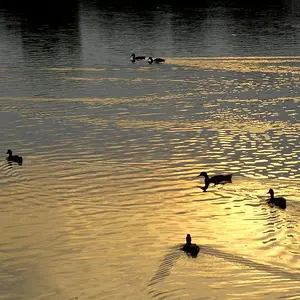
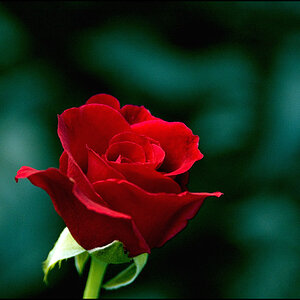
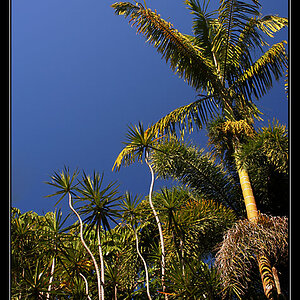
So here are my questions:
When do you all shoot with a CPL?
If I'm outside, there's a good chance I might be using my CPL. If I'm shooting anything with reflections, there's a good chance I'm using the CPL.
The CPL works by blocking light which doesn't match the polarization tuning of the filter. Reflections that come from the sides get the most dramatic reduction (if the sun is at your back and you're getting reflections you'll notice the CPL wont work as well.)
Because of the way it works, it has the side-effect of "saturating" colors. Technically what it's _really_ doing is remove the glare from the color that was already there. Regardless of why it works... the effect is that blue skies look richer, plant foliage looks greener, etc.
I don't use it with a wide-angle lens (and I think others have already provided excellent examples of what happens when you try to use it with a wide-angle lens.) Imagine you had a 180º fish-eye... keep in mind that a CPL has to be "tuned" to the polarization angle of the the wavelengths that get to pass. The reflections which appear straight-ahead (relative to where you're pointing the lens) will not have the same angle of polarization as compared to light coming from the sides -- we're referring to reflections from the same light source... such as the sun. This means it's not possible to tune the CPL to any position that works for the entire field of view. The wider the field of view, the more you'll see that banding effect.
Do you always have one in your bag?
Yes - always.
Last summer I did a short weekend getaway, went out shooting, reached for my CPL ... and it wasn't there. I had to go to four of five different camera stores to find a decent CPL (they either didn't have them, had junk (I wont use a poor quality CPL... I may as well not have one), or if they had them, they didn't have them in my size (77mm... which actually surprised me since this is one of the most commonly used sizes.)
If you own lenses with more than than one filter size, buy "step up rings" to use the CPL on smaller lenses. My 24-70 & 70-200mm lenses use 77mm threads, but I have a macro lens that uses 67mm threads. My CPL costs $150, so I didn't want to buy a 67mm version just for one lens. Instead I invested about $10 for a 67 to 77mm step-up-ring (it's an adapter).
What sorts of situations do you use it in?
Glass surfaces are obvious for reflections, but even if I'm shooting something with some shine to it -- think... furniture for example, or anything with a luster.
I recall shooting some close-ups of blooms with a macro lens ... but no CPL (I didn't think I'd need one). Got back to my computer, unloaded the images, and then kicked myself for not using the CPL.
Is it always on the back of your mind as another tool in your bag of tricks?
Or is it for you a rare (or never) used item?
Yes - always. I don't use it _every_ time I'm outside... but I DO ask myself the question "would this scene benefit from a CPL?" and if the answer to that is "yes", then I put it on.
One thing I will say... I _very_ good CPL can remove almost all of the reflection. If I'm shooting glass, sometimes I'll tune the CPL, then just slightly de-tune it to add back in just a tiny bit of reflection to make the image a bit more natural.
Most of my local friends at their varying levels of expertise (all have been shooting longer than me, so I ask them lots of questions) don't even have CPL filters at all.
That's too bad. Every photographer should own one.
In the days of "film", we used to carry several effects filters. Misty / spot-diffusion, starlight, etc. etc. Today, there are a lot of "effects" that can be applied in software (although I find that for some of these you'll get a better version of the effect if you use a physical filter.)
But there are filters that you CANNOT do in software... one is polarization. Yes, I KNOW there's a "polarization" effect in Photoshop, it's not the same and doesn't really work. Think of it this way. Suppose I'm taking a photo of a "green" leaf, but it has a reflection -- probably due to the waxy coating that so many leaves have. In any case, with no CPL, the camera registers a pixel on that leaf as some near-white color. It's not like the pixel records that the leaf is really "green" with a "near white" reflection on top of it... what should have been green is now near-white. That's "data" which is lost forever. If you use a CPL, it filters out the undesirable light wavelengths and leaves me seeing the true green color that was behind the reflection.
The other filter is a neutral density. I've seen people mistakenly believe that the job of an ND filter is to "tint" the image... a good ND wont tint anything... it changes your shooting circumstances so that you can shoot with different settings. In the end you're getting the same exposure, but since you can use different settings you can use longer shutter times or wider apertures that you'd otherwise have been able to use.
If you only buy two filters, they should be:
1) A CPL (preferably a good quality CPL because there are a lot of junk CPLs on the market. You can find lots of YouTube videos that demonstrate the difference.
2) An ND filter. These come in LOTS of strengths (I own a 2 stop, 3 stop, and 10 stop ND). If you only buy ONE, then get a 3-stop. This is because a CPL will tend to cut "about" 2 stops of light (keep in mind these are tunable so this can vary mildly). That means you could stack a 3 stop ND with a CPL and get roughly 5 stops of light reduction.





![[No title]](/data/xfmg/thumbnail/42/42494-ba608b57b09b00c0ee005a2360a510f5.jpg?1734177014)