What's new

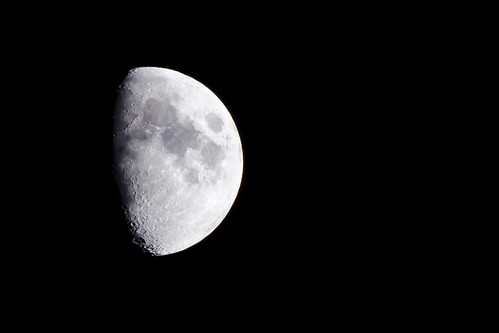
Trying to photograph the moon.

Specifically pick the two latter options. The longer your lens the worse a low shutter speed is for potential lens shake. If your lens gets long enough the mere act of opening the shutter can affect the sharpness of your pictures, though that isn't an issue with a normal lens. You want to aim to keep it high and instead bring your aperture down to f/8 or f/5.6 even. There's also a lot of room to move on ISO in modern cameras, but don't take it too high or you get noise.

The other thing is photos of the moon taken with a still camera (as opposed to a video camera) are highly dependant on "seeing" which is the astronomer's term for the atmospheric turbulence that affects the quality of your pictures. You may find keeping everything else identical you'll get better photos of the moon on certain days with certain temperature conditions, or simply a different location.
 
The atmosphere also plays a huge role in lunar imaging. For sharpest results, it's best the moon be at it's highest point in the sky as it travels east to west. Of course, half the time both the sun and moon are both above the horizon. So unless you limit yourself to shots between first and last quarters, the sky will be blue.

And weather plays a factor as well. Not just cloudy/clear skies, but turbulence in the air causes the image to 'boil', as well as particulate matter / water vapor being suspended between you and the moon. Astronomers call this effect seeing.
 
How would you get it to expose brighter? Longer SS?

If I were to personally take that shot again and go for brighter I would either up the ISO to maybe 200 or 400, or set the Fstop faster, say f8 or f9. I would NOT increase the shutter time for the exact reason Lizard mentioned... it's moving and I was zoomed in as close as I could get.
 
Using a tripod?
 
Using a tripod?

Yes, but not a remote.

If you aren't using a remote, at least set a 2 second timer. This gives the tripod time to stabilize any vibration you pressing the shutter might cause. This is one of those things I learned not from photography but from astronomy. The more zoomed in you are the more pronounced any vibration is. When I really dial in my telescope someone walking past it is enough to make the view shaky. Anything you can do to reduce vibration will lend itself to a crisper image.
 
Using a tripod?

Yes, but not a remote.

If you aren't using a remote, at least set a 2 second timer. This gives the tripod time to stabilize any vibration you pressing the shutter might cause. This is one of those things I learned not from photography but from astronomy. The more zoomed in you are the more pronounced any vibration is. When I really dial in my telescope someone walking past it is enough to make the view shaky. Anything you can do to reduce vibration will lend itself to a crisper image.

Mirror-up as well......
 
^ What he said, I knew I was forgetting something
 
Yes, but not a remote.

If you aren't using a remote, at least set a 2 second timer. This gives the tripod time to stabilize any vibration you pressing the shutter might cause. This is one of those things I learned not from photography but from astronomy. The more zoomed in you are the more pronounced any vibration is. When I really dial in my telescope someone walking past it is enough to make the view shaky. Anything you can do to reduce vibration will lend itself to a crisper image.

Mirror-up as well......

What is mirror up??
 
When you press the button to take the picture, before the shutter is opened (and closed) so the light can get to the sensor, the mirror that allows you to see through the viewfinder also has to get out of the way so the light gets to the sensor. The "Lock Mirror-Up" mode, separates this process in two steps: You press the button once to lift the mirror and leave it up, and then again to open/close the shutter to take the picture... It's basically another thing you can do if you want to have the minimum possible camera shake when taking the picture.
 
Why would you use f/8 or f/9? It's not like you need DOF.

DOF has nothing to do with it at that distance. F/8 for that lens produced the least amount of distortion, and I wanted to maintain 1/250
 
Why would you use f/8 or f/9? It's not like you need DOF.

DOF has nothing to do with it at that distance. F/8 for that lens produced the least amount of distortion.

I understand DOF has nothing to do with it. That was my point. I would shoot at 5.6 so I could use a quicker shutter speed. Sorry, didnt notice the lens, but I wouls think 9 would be way too high on any lens.
 
Why would you use f/8 or f/9? It's not like you need DOF.

DOF has nothing to do with it at that distance. F/8 for that lens produced the least amount of distortion.

I understand DOF has nothing to do with it. That was my point. I would shoot at 5.6 so I could use a quicker shutter speed. Sorry, didnt notice the lens, but I wouls think 9 would be way too high on any lens.

I was saying that there is more to aperture than just DOF. I find 1/250 to be a perfect SS for the moon, I've gotten shots slower, but @ f/8 I get the sharpest results.
 

Create an account or login to comment

You must be a member in order to leave a comment

Create account

Create an account on our community. It's easy!

Log in

Already have an account? Log in here.

New Topics

Back
Top Bottom