What's new

Two questions on astro photography

battletone

TPF Noob!
Joined
Sep 22, 2009
Messages
285
Reaction score
1
Location
Somewhere in the lower 48.
Can others edit my Photos
Photos NOT OK to edit
Its supposed to be a clear night tonight, and I don't think the moon is out. I am excited....two nights in a row.

So I am going to go take a few pics here in a bit, but I am too anxious to google this (I will try if time permits), plus I have some other stuff I need to try to get done soon.

What is a good exposure guideline for stacking multiple images? (high iso? low iso?, wide open?) I plan on shooting at 18mm. I have read about it in the past as being a great way to even use webcams to get much more light than is possible without one of those tracking machines.

Also, is this cloudy area across the middle (which is the second time I have captured it) the Milky Way? This is what I would like to do the stacking process on.
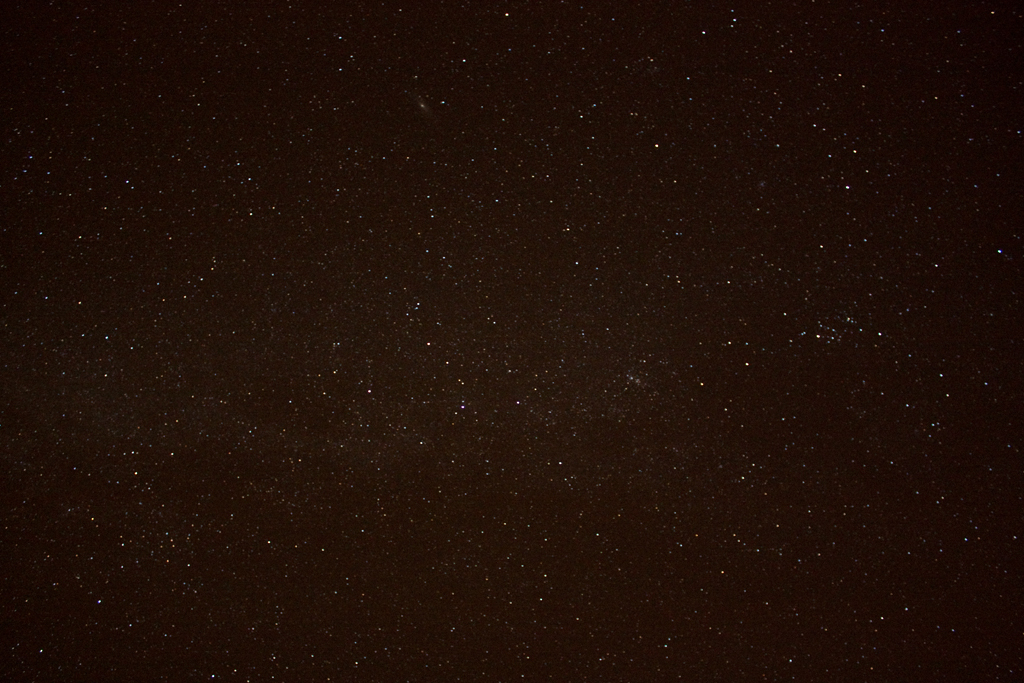
stars_f3-5iso1600sec30.jpg
 
http://photos.sjrdesign.net/processing.html said:
Taking Multiple Exposures - An alternative to taking a very long (e.g., 8 hours) single exposure of an object is to take many shorter exposures and average them together. In other words, you could take 8 1-hour images, or 32 15-minute images. You can then add them together and divide by the number of images you took and come out with the same noise characteristics as you would in a single 8-hour image. Since every pixel is represented by a number, it does not matter that the actual value of the pixel will be much less than a single exposure since we can then just scale it up or down. This is often preferable to taking a single long exposure in case something happens over the course of your observing (like a satellite flies through the image), and if your tracking is not 100% accurate (so you would start to see star trails being recorded).

Would this be effective in taking multiple exposures of 20 seconds each? I have no tracking device.
 
I have no tips for this type of photography, but yes, that is the milky way.

Back in high school we used to watch the sky at night on the beach, and after about twenty minutes your eyes adjust and you can see it, sometimes pretty well.
 
Ugh, I wish we could see the stars as well where I live! Here in Southern California, we'd be lucky if we could see at least thirty points of light in the sky.
 
Well, I wasn't going to respond, but since that quote is from my website ... I guess I should. :P

Of course it's a great way to do it! It's on my website!!

Okay, but seriously, I think with an 18 mm lens you could go for 30 seconds without seeing trails (do a test). If you want to have the sharpest possible photograph, then you're somewhat limited to around an f/8 aperture. I think on your first try, though, you can get by with something smaller, perhaps 1 stop smaller than your widest aperture (3 f/settings smaller as each is 1/3 of a stop).

Then, use the lowest ISO you can while still getting as many stars as you want. With a wider aperture, you'll get more faint stars. With a smaller aperture, you'll get less. Compensate by boosting the ISO.

If you do end up stacking, then the background noise of the sky (not the stars) will decrease because the little specs of color noise (from the higher ISO ... or just regular camera noise (and I'm not being very specific here because I don't want to get too technical)) will average out because they won't be the same in every photograph.

I wrote that guide more for deep-sky objects where your object isn't moving, so you can't actually average the images together for star trails (if you do, the trails will be very dark). What I would suggest is actually doing a 2-step processing, where you average all your photos together and use that as the "background" sky. Then use an equivalent MAX() function on the same photos and what will come through is just the stars. Layer that on top of the background one and you'll come out with something reasonable.

I realize that I may not have explained that all very well, but to go into more detail would require many many paragraphs. Perhaps another forum member who's done this can post it more concisely.
 
Thanks. Is the Milky Way considered deep space ant not really moving?

The image I posted was:

Camera Make: Canon
Camera Model: Canon EOS DIGITAL REBEL XSi
Image Date: 2009:11:15 22:44:25
Flash Used: No
Focal Length: 18.0mm
CCD Width: 5.35mm
Exposure Time: 30.000 s
Aperture: f/3.5
ISO equiv: 1600
White Balance: Auto
Metering Mode: Spot
Exposure: Manual
Exposure Mode: Manual


I realize 1600 might be considered too noisy, but I really like how many faint stars I am able to get. I think anything lower than 800 and the cloudy MilkyWay doesn't really show up well. But maybe stacking will fix that.

I will get a handful of shots from different apertures and iso settings.
 
Yes definitely. You do not want to shoot at High-ISOs. Stack multiple ISO100-200 shots together to get much better results.

I am confused as to the topic of deep space objects. The milky way will move in relation to the ground, so if you have something in the foreground then you'd need to layer two images on top of each other as said above, however for just a shot of the sky a lot of stacking software will do automatic alignment of images to compensate for the fact that the stars move as the earth turns.
 
Oh ... Garbz makes a good point (and I was hoping he'd post here). I was thinking that the original poster wanted to do star trails. That's what most people want to do when photographing stars, so I kinda went into auto-pilot there.

If you just want effectively a long exposure of the sky but don't want to see the trails, then you either need that correcting mount, or you have to stack. Automated software that will also rotate the images will be required because the sky does rotate relative to Earth.

And you can also ignore what I was saying about doing the two-part stacking, one for sky and one for trails, if you're just looking for the stars to look like stars and not trails.

I left it out but now it makes sense to say it -- the Milky Way, in my opinion, looks pretty bad when shown in a star trail ... it just comes out as this blurry streak and not as a recognizable, sharp structure.
 
Ugh, I wish we could see the stars as well where I live! Here in Southern California, we'd be lucky if we could see at least thirty points of light in the sky.

And those are just the planes you can see through the smog!
 
Yes definitely. You do not want to shoot at High-ISOs. Stack multiple ISO100-200 shots together to get much better results.

I am confused as to the topic of deep space objects. The milky way will move in relation to the ground, so if you have something in the foreground then you'd need to layer two images on top of each other as said above, however for just a shot of the sky a lot of stacking software will do automatic alignment of images to compensate for the fact that the stars move as the earth turns.

Well I couldn't bring myself to shoot anything lower than 800. Its a hard habit to break I supposed, but everything looks so dark at 800 with any aperture smaller than f3.5....but I think I averaged about 8 exposures at 30 seconds each with various apertures going from f3.5, f5.6, f6.7, and f8.

Oh ... Garbz makes a good point (and I was hoping he'd post here). I was thinking that the original poster wanted to do star trails. That's what most people want to do when photographing stars, so I kinda went into auto-pilot there.

If you just want effectively a long exposure of the sky but don't want to see the trails, then you either need that correcting mount, or you have to stack. Automated software that will also rotate the images will be required because the sky does rotate relative to Earth.

And you can also ignore what I was saying about doing the two-part stacking, one for sky and one for trails, if you're just looking for the stars to look like stars and not trails.

I left it out but now it makes sense to say it -- the Milky Way, in my opinion, looks pretty bad when shown in a star trail ... it just comes out as this blurry streak and not as a recognizable, sharp structure.
Yes, no star trails. I have been enjoying doing those with 20 minute exposures lately, and did one last night at the end. (didn't stay up for the meteors, I know...:thumbdown:)
My goal is two fold, either get the maximum amount of stars in my image, or get the Milky Way to show up as best as I can...or both.
I run CS4, so I was planning on using the auto align for all my images, after that I am lost. I would assume it might be one of the blending options that I will be using, but I can't think of one that will really do what sounds like is needed.

To both of you, if a lower ISO will really make the difference even at those smaller apertures (like 5.6 and 8), if it is clear tonight (like it says it is) and the moon stays away, I will give it another go. Its just really discouraging to see so few stars that make it into the image when using 30 second exposures at those low ISOs. ...and I probably should have taken more than 8-10 images of each, but I didn't know how far to go.
 
Last edited:
I run CS4, so I was planning on using the auto align for all my images, after that I am lost. I would assume it might be one of the blending options that I will be using, but I can't think of one that will really do what sounds like is needed.

Look up "photoshop stacks." This seems to give you a basic idea.
 
Thanks. Is the Milky Way considered deep space ant not really moving?
Everything is moving and the concept of deep space is notional, though space is aptly named. There is lots of space out there.

Our galaxy is called the Milky Way. It's a flattened disk that rotates once every 250 million years or so out here where our Sun is. It's home to a few hundred billion stars. Those bright lanes you see in the sky (the Milky Way) is the combined light from a few billion of those stars, to far away to be resolved as discrete points of light without some pretty serious equipment.

It wasn't know until the 1940's (Edwin Hubble) but, The Milky Way is just one of several hundred billion other galaxies (each containing several hundred billion stars) in this universe. There are a couple other galaxies that can be seen with the naked eye because they are close, relatively speaking. The few that are close are known as "The Local Group". Andromeda (seen in Northern hemisphere) and the Large and Small Magellenic Clouds (seen in the Southern hemisphere) are members of The Local Group.

So, what is deep space. It's not likely that the human race will ever venture beyond our own solar system, which is much larger than most people realize. Our solar sytem extends way beyond the orbit of Pluto.

So for human purposes anything beyond our own solar system could easily be considered 'deep space'.

Edit: Astrostu has pointed out that Hubble made his discovery in 1925, no the 1940's.
 
Last edited:
It wasn't know until the 1940's (Edwin Hubble) but, The Milky Way is just one of several hundred billion other galaxies (each containing several hundred billion stars) in this universe.

Try 1925.
 
Went out shooting last night, and again tonight.

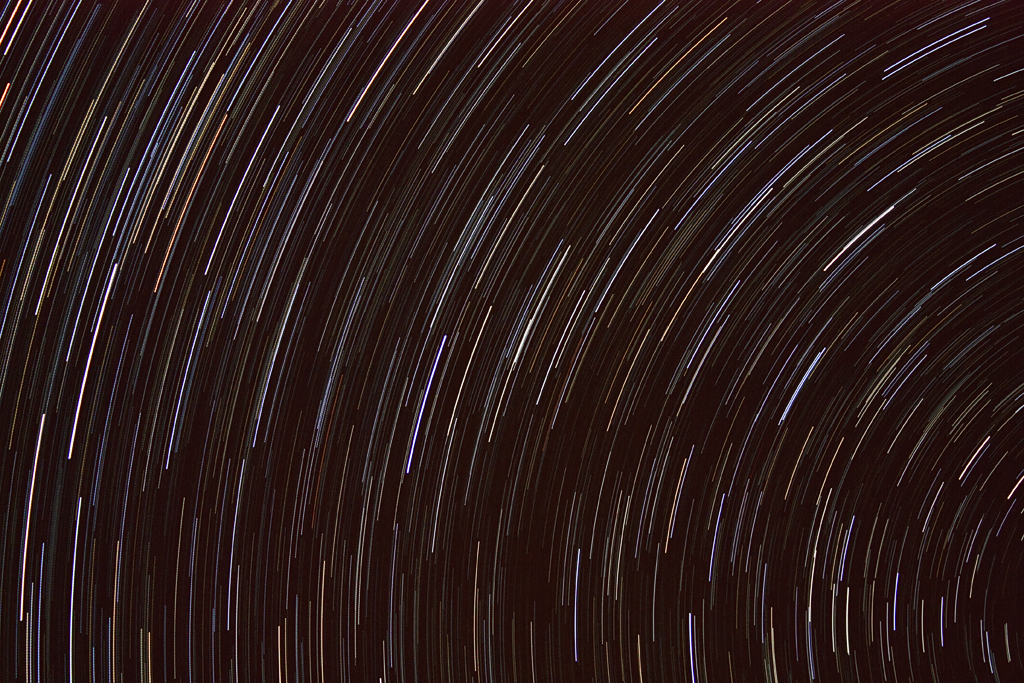
Here is what my current status is....

CS4 doesn't want to align last nights photos. So since it won't do that, my hopes of using the Median function is on hold.

But for tonight, I went out and shot at ISO200, f5.6, 30 seconds. Continuous shooting for just shy of 45 minutes. (I used JPG because I know better than to even think of opening that many 16 bit files at once.)

I stacked them all, in two separate sessions, and used Maximum, and was presented with the below image. (the final has a hair of sharpening)

Its amazing how just that moment of time between shots can interrupt so obviously. I might get it printed just to see how it comes out.

But the BIGGEST thing I learned was how so many dim photos can produce so many trails. Even though this was made from JPGs, I was able to boost the EV in ACR on my composite by +3.25. And I don't think the noise is too out of hand. For noise reduction I used 26 for Luminance and 41 for Color.

I would like to know further how noise works when stacking with Maximum because the last exposure I took at f3.5, ISO200, @20 minutes was much noisier. Granted that was a stop and a half (?) more open. But it seems less noisy than the same at ISO100 too.

[crop of the moment between shots]
stopmotion_star_crop.jpg


[the goods]
stopmotion_star.jpg
 
Last edited:
Noise is exactly what it's all about, and it's also your biggest friend in stacking. Noise in a digital camera comes from many sources, but all in all is statistically random and has a Gaussian distribution. What this means is that if you have many images and stack them together the noise literally averages itself away.

Now consider that in every 3rd image a photon hits one of the pixel. This is way too dark to register on the sensor, way beyond the noise floor, and you would not see it in any single image. However that photon will slightly skew the noise distribution, stack many of these images together and the noise disappears leaving behind detail that was previously invisible. This is how some of those psychos take 30 5 min long exposures of the sky which appear almost black and end up stacking together a picture of the Andromeda galaxy Peltier Cooled Modified Canon Digital Rebel XSi 450D & Astro-Tech 127mm Triplet- M31 Andromeda Galaxy - Cherry Springs Park - by Gary Honis.

Also that small gap you have between your images serves another important role. It keeps the sensor cool. You can damage your camera if you do one continuous exposure for long enough. Sensors get very hot.
 

Create an account or login to comment

You must be a member in order to leave a comment

Create account

Create an account on our community. It's easy!

Log in

Already have an account? Log in here.

New Topics

Back
Top Bottom