What's new

What would "faster glass" matter when you're using a high F number?

snapsnap1973

TPF Noob!
Joined
Jan 18, 2013
Messages
147
Reaction score
4
Location
Portland, Maine
Can others edit my Photos
Photos NOT OK to edit
I was thinking the other day about "fast glass". I was thinking about getting a prime lens. A 35mm F1.8 that Jorod Poulin said "Everyone should have". I actually don't think I will though at the moment, but that's beside the point of this post.

I'm wondering what a difference "fast glass" or something at F1.8, etc matters when you're using it with a higher F stop number.

Actually, I'm new to all of this, so I actually don't even KNOW if a "f1.8" lens will go to F16 or F22,etc ..... do they?

So, I'm wondering. If I have say, an "f2" lens and put it at F22, will it be identical to one of the included lens that came with my camera at the same fstop? The 2 lens that came with my D3200 are the KIT and a 55-200 NON VR lens by the way.

So, I guess the main question is : Do faster lenses have superior picture quality at higher F numbers also or just when they're at F2 or similar?

Thanks :)
 
'Fast glass' can aid in both AF and manual focusing, as well as composing/framing in low light.
 
I was thinking the other day about "fast glass". I was thinking about getting a prime lens. A 35mm F1.8 that Jorod Poulin said "Everyone should have". I actually don't think I will though at the moment, but that's beside the point of this post.

I'm wondering what a difference "fast glass" or something at F1.8, etc matters when you're using it with a higher F stop number.

Actually, I'm new to all of this, so I actually don't even KNOW if a "f1.8" lens will go to F16 or F22,etc ..... do they?

So, I'm wondering. If I have say, an "f2" lens and put it at F22, will it be identical to one of the included lens that came with my camera at the same fstop? The 2 lens that came with my D3200 are the KIT and a 55-200 NON VR lens by the way.

So, I guess the main question is : Do faster lenses have superior picture quality at higher F numbers also or just when they're at F2 or similar?

Thanks :)


The biggest "idea" is that a f1.8 lens at f2.8 will be sharper than a f2.8 lens at 2.8, simply because the faster-glass isn't wide open, while the slower glass is in face wide open. Most lenses (except for super expensive primes, like the Zeiss Otus primes) don't perform their best optically wide open, but rather are sharper when stopped down.

That being said, fast glass opens up for creativity, subject separation/isolation, low light capabilities, etc. There's a reason a 24 1.4 costs significantly more than a 24 2.8 lens.

Also, often-times fancy-FAST primes will have extra Low Dispersion elements, flourite glass, Nano-coating, etc. All of these expensive add ons increase performance, limit CA, improve contrast and clarity, etc.


So in short, I'll be picking up a Sigma 35 1.4ART lens instead of the nikon 35mm 1.8 counterpart, for many of the reasons listed above.

Hope that helps!
Jake

But really, at f22 or f16, it's all about diffraction. It's assumed that lenses with all of those coatings and fancy elements will have lower diffraction, and better sharpness.
 
Each lens has it's own characteristics, so they can vary a lot in performance ... so fast lenses are not always the best IQ.
Most lenses perform poorest wide open ... typically best is in the middle.
 
In general,"faster" lenses are better construction than slower lenses and will produce sharper images throughout their f stop range.
The average person probably won't know the difference. Especially with the 18-55 kit lens
And that's the truth.
 
Actually, I'm new to all of this, so I actually don't even KNOW if a "f1.8" lens will go to F16 or F22,etc ..... do they?

So, I'm wondering. If I have say, an "f2" lens and put it at F22, will it be identical to one of the included lens that came with my camera at the same fstop?

Thanks :)

Yes, a fast lens will still cover a range of apertures, usually to a similar f/22 or so.

At f/22 it may not matter, as nothing's going to look particularly good (how often do you shoot at f/22, anyway?). Faster lenses are constructed differently beyond just going to a larger maximum aperture, and as a result look different across the aperture range. Your kit lens and the 35mm prime (meaning fixed focal length, or no zoom) aren't really a good comparison, since there are many differences in their construction. Nikon's 50mm f/1.4G and 50mm f/1.8D are a better comparison, since they're fast 50mm primes that differ by 2/3 stop max aperture. Photozone is a great website for lens reviews, and if you compare the G and the D, they're somewhat different. For example, at f/2.8, they're both exceedingly sharp in the center of the frame, but the G is sharper as you move out toward the edges, while the D gets softer. The G also renders out of focus areas more smoothly, which is important to many photographers.

You can ignore that last part if it doesn't make sense, but the takeaway is that different lenses behave differently, even with similar specs on paper. Faster lenses tend to have more "premium" features to match their higher price tags, which may mean things like being sharper throughout the aperture range or being built more sturdily. In some cases, the opposite is true, and a less expensive and slower lens is a better performer, but of course lacks the maximum aperture abilities other lenses have.

Does this help?
 
Also, the viewfinder image is viewed through maximum aperture, so a 1.8 lens will have a brighter image in the finder than say, a long 5.6 zoom.
 
You ask a lot of interesting questions ... Do you ever take pictures?
 
If you are not going to be shooting in very low light and low ISO ten the extra weight, and huge increase in cost is wasted on fast glass. Fast glass will on the other hand usually provide better bokeh than slower because of Dof diffferences. That is the reason that portrait shooters like them. Wedding shooters and indoor sports people like fast glass for the better light gathering...but that reason is almost gone with the latest sensors having greatly reduced noise allowing for higher ISO' with same IQ. And remember the difference from 1.4 is one stop to 1.8, same to 2.8, same to 5.6 That one or two stops is damnably expensive and you really have to have a need to justify it other than if it is simply to impress others! (a reason quite common on the forums, but rarely admitted) ;)
 
The biggest "idea" is that a f1.8 lens at f2.8 will be sharper than a f2.8 lens at 2.8, simply because the faster-glass isn't wide open, while the slower glass is in face wide open.
Fast lenses used wide open use more of the glass out towards the edge of the lens elements in the lens.
The glass thickness out towards the edge differs from the glass thickness in the middle portion of the glass elements in the lens. Glass element thickness varies the distance light from the edge focuses relative to where light from the middle of the glass element focuses.
Stopping down uses the middle portion of all the lens elements in the lens where there is less variation in the lens element thickness.
That more consistent lens glass thickness is what improved sharpness.
The less expensive consumer grade lenses that have a max aperture of f/3.4, f/4, or f/4.5 usually do not need to be stopped down because wide open they don't use the outer regions of the lens glass elements..

That being said, fast glass opens up for creativity, subject separation/isolation, low light capabilities, etc. There's a reason a 24 1.4 costs significantly more than a 24 2.8 lens.
A 24 mm f/1.4 costs more than a 24 mm f/2.8 mainly because the glass lens elements have to be larger and larger glass elements cost more to make and take longer to 'figure'. Figuring is grinding the lens to the proper shape and surface smoothness.
 
You ask a lot of interesting questions ... Do you ever take pictures?

Nope, just a few, I'm still learning. This is a passing hobby, but lifelong I hope. My main hobby is classical guitar -
 
So, I guess the main question is : Do faster lenses have superior picture quality at higher F numbers also or just when they're at F2 or similar?

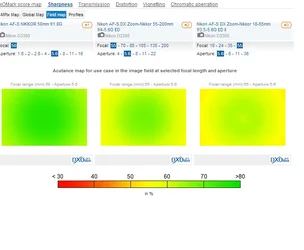
Nikkor AF-S NIKKOR 50mm f/1.8G on Nikon D3300 versus Nikkor AF-S DX Zoom-Nikkor 55-200mm f/4-5.6G ED on Nikon D3300 versus Nikkor AF-S DX Zoom-Nikkor 18-55mm f/3.5-5.6G ED II on Nikon D3300 - Side by side lens comparison - DxOMark

upload_2015-1-9_7-17-8.webp
 

Attachments

  • upload_2015-1-9_7-16-57.webp
    upload_2015-1-9_7-16-57.webp
    22.9 KB · Views: 189
It seems more and more people are pushing F 1.8-2.8 lenses, and they are great to have if you're stuck in really bad light. It's becoming almost a status symbol to have fast glass. With the cameras being able to handle a higher iso without much noise, for the average person owning a 2.8 lens is almost pointless. Having said that, the majority of glass I've owned has always been 2.8, and I find the only long lens I like using at 2.8 is my old 400mm manual focus. The 300 2.8 I use at f3.2-4, it doesn't look sharp at 2.8, I find the same with my 70-200 2.8.

To the Op, buy what you want, and can afford, but buy it because you have done all your homework(asking the questions on here is a start, there are some very good technical minds) and don't buy it because someone tells you "it's the only lens"

I use a 17-40mm f4 all the time, if I had the money would I have bought a 2.8, maybe. What the deciding factor was both money and that the bodies I use I can shoot higher iso. I don't buy gear I don't need, just to say I own it. I know lots that do, and never blow the dust off the box it comes in.
 

Create an account or login to comment

You must be a member in order to leave a comment

Create account

Create an account on our community. It's easy!

Log in

Already have an account? Log in here.

New Topics

Back
Top Bottom