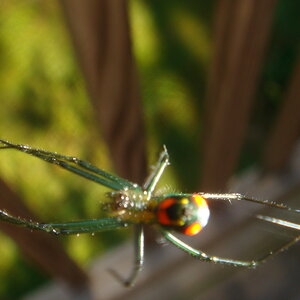
Poisonous spiders? Forget the 90mm. Go onto
ebay and find yourself a second hand Sigma 150mm f2.8 macro or better 180mm f2.8 macro lens. With macro photography the amount of magnification that you get is always the same for a true macro lens. Thus because the magnification (at the closest point of focus) is the same the frame you get is also the same.
A close up photo of a 2p coin with a 35mm macro will give you the same frame as one taken with a 180mm macro lens. The differences though will be that the 180mm will give you the closest focus from further away, whilst also giving you much more blurred background areas (actual depth of field remains the same, although with some compositions the reduced blurring of a very short focal length macro lens can give the illusion of a slightly greater depth of field).
The Macro lenses on the market are all pretty much top rate, even new versions make only small advances in the image quality. They are very high end lenses with regard to optics so you can be much more free to choose based on features, focal length and budget. The Sigma 150 and 180mm macro lenses have always been popular with insect photographers for the increased working distance* and the increased blurring of background areas.
Nikon also has a very good 200mm macro lens if you can get hold of one for your budget. 180mm can be a little bit more tricky handheld but I know quite a few who shoot with it handheld without any problems at all.
The bonus of the sigma (I'm not sure about the Nikon someone will have to chime in for them) is that the Sigma 150mm and 180mm will take Sigma teleconverters, which can give you a bit more working distance and also a bit more magnification at the closest focusing point. I've nearly always used a 1.4TC on my 150mm macro just for that little bit of extra magnification. A 2*TC makes things a little more tricky (you're working with double the magnification handheld - so that is harder, doable but harder) but gives you a 2:1 magnification to play with - great for very tiny insects (personally I prefer a shorter focal length for higher magnifications as you can get in close and lean in something as you shoot - longer focal lengths are more tricky handheld as motions get far more amplified - thus a tripod helps a lot more).
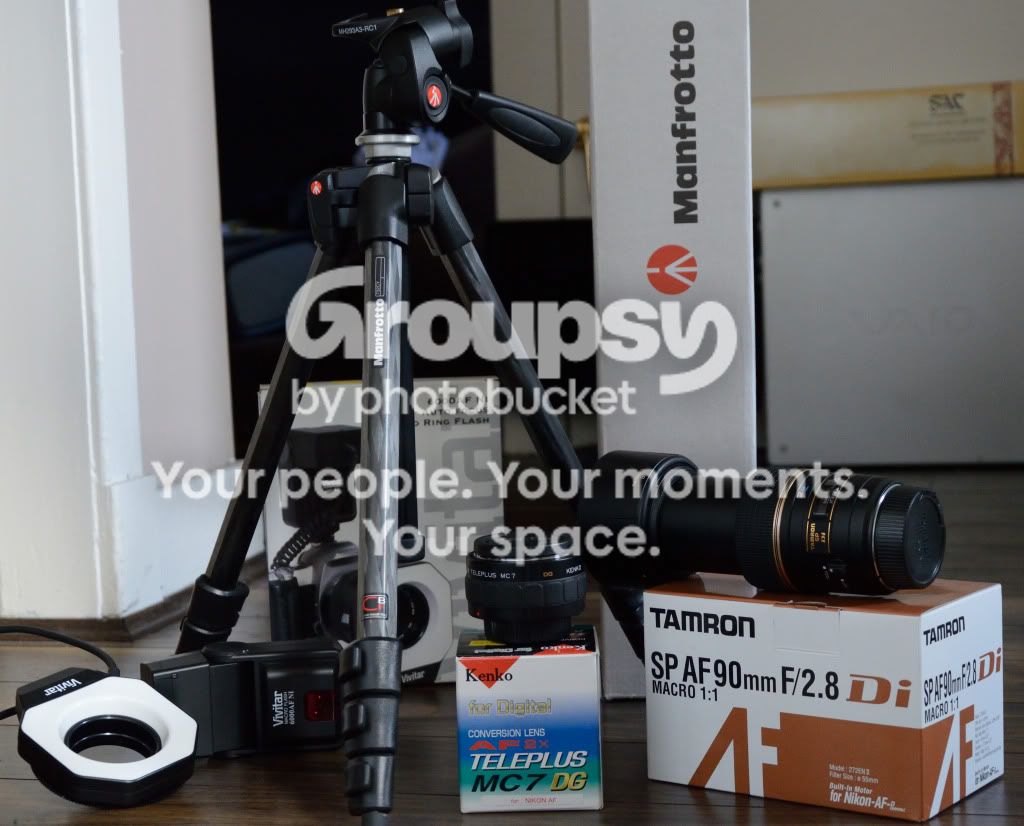
Lighting wise I would strongly suggest starting with a simple setup - a Speedlite design flash coupled with a softbox (a lumiquest softbox works well or anything of similar size). With the 150mm and 180mm you can even have the flash mounted to the camera with the softbox attached and get good lighting over the subject without much trouble.
Tripod wise if you're going to use it keep in mind 2 things:
1) Get a manfrotto junior geared head - pricey and heavy, but a wonder for macro work. It's a slower head to use, but it lets you adjust the angle of each axis with very fine and precise measurements, something that is very hard to do with any other kind of tripod head. It also doesn't have droop which can be a common problem (esp with ballheads - unless you shell out for a top of the range one)
2) Slow - tripod work is slow macro shooting. You'll want to be out early or using a lure of some kind (eg food) so that he insects are either very torpid or distracted as you shoot so that they are less likely to spook and move. Trying to chase active insects in the middle of a hot day with a tripod generally won't work.
*working distance is from the front of the lens to the subject - as opposed to min focusing distance which is from the sensor to the subject






![[No title]](/data/xfmg/thumbnail/32/32174-b57e340fadfeea99045595146efd64b1.jpg?1734161047)
![[No title]](/data/xfmg/thumbnail/32/32175-dfc7c053c145a53c7f2585ca44f122d4.jpg?1734161047)
![[No title]](/data/xfmg/thumbnail/31/31710-590f3b7a6de1d798bc007b6ace9cf234.jpg?1734160388)
![[No title]](/data/xfmg/thumbnail/32/32176-48b4ba2fc0e35afa267c5882154e7620.jpg?1734161047)