What's new

yet another focusing question

paigew

Been spending a lot of time on here!
Joined
Nov 15, 2011
Messages
3,935
Reaction score
1,876
Location
Texas (Hill Country)
Can others edit my Photos
Photos NOT OK to edit
Sorry for the barrage of questions I have been asking. Is it possible to choose more than one focus point? Other than all of them? I have the t3i. I looked in the index of my manual but don't seem to find anything.
 
Not entirely sure, but on my 60D (which is extremely similar), you can select either a single individual point, or you can allow the camera to choose which point. I'm pretty sure there are no other options beyond that.
 
hmmm, well then what do you do if you want to focus two subjects...for example in this photo I could only focus one of my kids

47cab0e6.jpg
 
This is not an issue of focus point selection, but instead of depth of field. When you shoot with a large aperture, the region of focus is small compared to shooting stopped down. This site: Depth of Field Table will show you exactly how deep your in focus area is at various combinations of focal length and aperture.

So, the way to get more in focus in this photo would be to stop the lens down. You could shoot this same shot at f/3.5 and ISO 1600, and get both kids in focus with the same exposure. On a crop body however, 1/50 second is a little slow for a 50mm lens. To reduce camera shake I'd probably shoot at 1/80 and boost the ISO another notch to 2000.

edit: Distance to the subject also affects DOF.... the closer your subject to the camera, the shorter the depth of field.
another edit: Just noticed you used flash, so the shutter speed will be less of an issue...
 
oh I see! Thank you so much :)
 
Excellent answer from analog.universe.

Just to expand on this a little bit. A lens can only be physically focused to one specific distance (or at the long end of the focus range, it's just at 'infinity'). So you could never actually get the lens to focus on each child separately. However, if both of them were the same distance away from the camera, then focusing on one of them, would have them both in focus.

So when talking about the focus points on your camera, there are two 'modes'. There is automatic point selection and there is manual point selection. Manual point selection is easy, you choose one of the points, and that's the only one the camera will use. But with auto point selection, the camera may use any of the points (you probably have 9 or 11 points, I think).
I'm sure you've seen situations where more than one of the AF points lights up. That doesn't necessarily mean that the camera is focusing on all of those points...but it does mean that those points are the same distance away, so they will all be in focus. So for an example like the one above, with people side by side, you may get an AF point of both of them to light up (but don't worry if they don't). But if, for example, you had a group photo with multiple rows of people, you could never get the AF points to light up on people in different rows (unless you were really far away) because they are likely different distances away.

But, as analog.universe talked about. We need to think about the Depth of Field (DOF) along with the focus points/distance. To get both kids in focus (or the rows of people), you might need a deeper DOF, which is done by using a smaller aperture (higher F number).
Other factors that influence the DOF are the focal length and the distance to the subject (focus distance).

DOF%20x%203.jpg
 
Thank you mike! I love the diagram.

So I could keep the same distance to the subject, up the aperture number and still get the same blurred background? Or does upping the aperture automatically decrease the amount of bokeh?
 
When you shoot with a large aperture, the region of focus is small compared to shooting stopped down.
When analog.universe says "the region of focus is small" what is really meant is it has little depth or is shallow. That's why it's called depth-of-field (DoF), and not size-of-field.

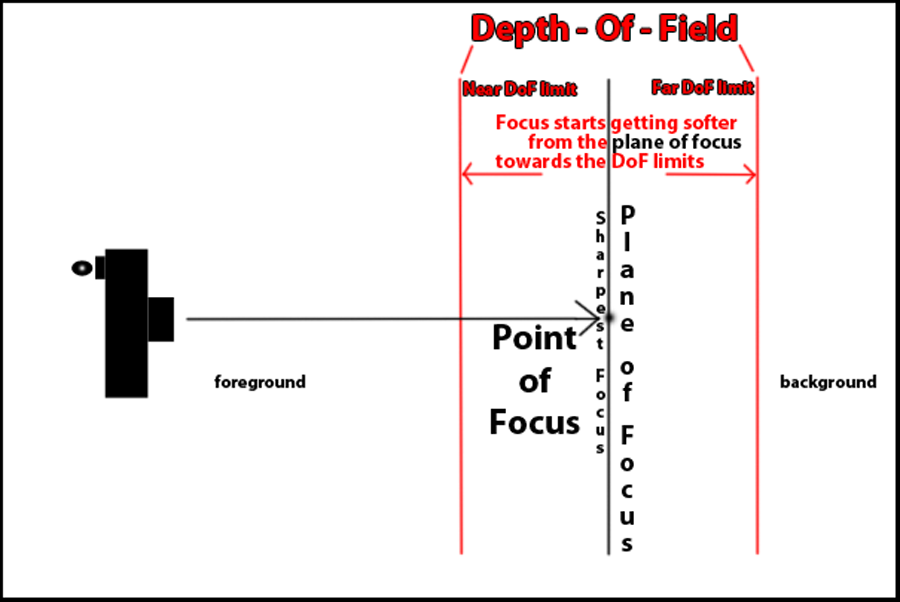
The DoF is a range of distance from the camera, and the DoF encompasses the entire image frame. What varies is how deep the zone of acceptably sharp focus is. With a normal focal length lens, a wide lens aperture, and being somewhat close to the subject, that range of distance may be just a couple of inches deep, a thin slice in the scene that will be sharply focused.

It helps to consider the DoF situation from a point 90° to the camera and lens axis.

DoF9x6.png
 
So I could keep the same distance to the subject, up the aperture number and still get the same blurred background? Or does upping the aperture automatically decrease the amount of bokeh?
If you 'up the aperture number', you would increase the DOF. So you could ensure that both kids are inside the DOF...and yes, the background may still be out of focus, as long as it's behind the DOF. But the deeper your DOF is (to get the kids inside of it) the less out of focus the background will look. So it might be a bit of a trade off in that regard.
 
Thanks everyone for all your help! I will try out all your tips :)
 

RE: focal length, I thought this had to do with working distance (didn't you say that, KmH) and not focal length? This is why a larger format sensor produces more apparent DOF using similar lenses, because you have to get in closer to gain similar magnification.

ETA:

Wait. No. That doesn't make sense.
 
RE: focal length, I thought this had to do with working distance (didn't you say that, KmH) and not focal length? This is why a larger format sensor produces more apparent DOF using similar lenses, because you have to get in closer to gain similar magnification.
Technically speaking, the focal length does affect DOF as seen. But in practical terms, if you are trying to keep the same composition, zooming in (longer focal length) would make you want to (have to) back up. So those two sort of balance each other out....which is why it's best to use the aperture to control DOF.
 
But the deeper your DOF is (to get the kids inside of it) the less out of focus the background will look. So it might be a bit of a trade off in that regard.
How far from the point of focus the background is, and the far limit of the DoF, determines how out-of-focus (OOF) the background can be.

If the background is immediately behind the subject it won't be OOF very much, even if the intention was to have a shallow DoF.

But, as DoF is adjusted to be deeper, the far limit of the DoF rapidly approaches infinity.

There are 4 things that determine the near and far limit of the DoF:
1. The lens focal length.
2. The focus point to image sensor distance.
3. The focus point to background distance.
4. The lens aperture.
 
So then focal length does affect DOF. I always thought it did, but someone must have led me astray thinking that this was a functional effect of working distance.
 
Wish I would have seen that diagram 6 months ago.
 

Create an account or login to comment

You must be a member in order to leave a comment

Create account

Create an account on our community. It's easy!

Log in

Already have an account? Log in here.

Back
Top Bottom