What's new

#1 recommendation after RTFM.

Joined
Apr 9, 2009
Messages
41,401
Reaction score
5,706
Location
Iowa
Can others edit my Photos
Photos OK to edit
Change the Light.

Too many photographers just accept whatever light they find.
Consider the possibilities and learn how to use: Time of day, subject position, strobed light (flash), reflectors, diffusers, flashlights, and anything else you can think of.

But take control of the light if you want to have better than average looking photos.
 
Need light to RTFM too
bigthumb.gif
 
So is it...CTFL?
 
Read The F___ing Manual.
 
So is it...CTFL?

CTFL Good one Big Mike!!!! I love it! Good thread topic you have brought us, KmH...I was gonna' say my #1 suggestion after RTFM is, "RTFM--Again!"
 
Hmm not sure I'd agree -

I mean I'm not disagreeing about the point with regard to light, but I would have said once one has learnt how to operate the tool one needs to learn how to use it before they can get to a point where they can pull proper advances out of controlling the scene with regard to lighting.

I'd say

1) Read the manual
2) Read it again whilst playing with the camera
3) Repeat step 2 outside in daylight (since many end up reading in the evenings and indoor snaps in poor light are -- dull and rubbishy)
4) Read a book on exposure - Understanding Exposure by Bryan Peterson is one popular option though most photography books cover the topic
5) Now you can use the camera operationally and also know better how to use it - now you can look to learning to control the light
6) Composition probably fits in somewhere around here too :)
 
What about the "Seeing Creativly" book everyone throws around here and there? I know that my pics aren't the best (since I am the noob) but I often find myself taking pics of things that are just plain boring because I don't know what to look for.
 
This reminds me of something I heard from an really good photographer who's since passed on.

"I shoot with available light. Which is any F___ing light that I can get my hands on."
 
What about the "Seeing Creativly" book everyone throws around here and there? I know that my pics aren't the best (since I am the noob) but I often find myself taking pics of things that are just plain boring because I don't know what to look for.
Study the visual arts.
 
I'd modify Keith's suggestion. The real problem with RTFL and CTFL is that we still don't get the understanding WHY some things work and others don't. And until that understanding starts to happen, we still have people getting essentially random results because they have not figured out the cause-and-effect.

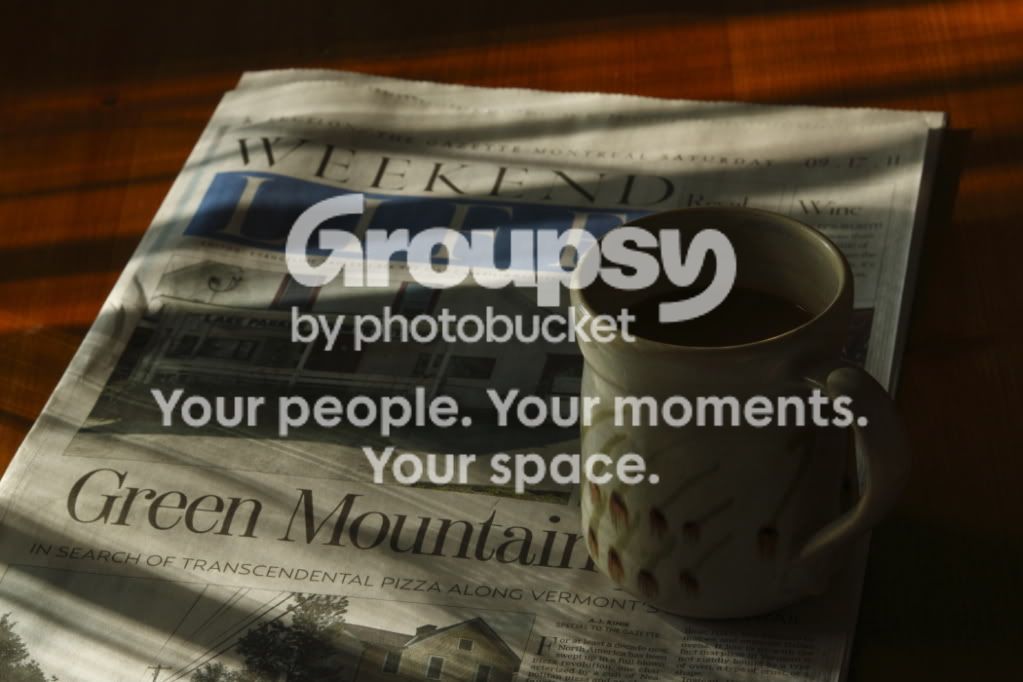
This morning, I saw the early morning sun throw a beam of light onto the table on which I had the paper and a cup of coffee. I liked the effect, and decided to photograph it. To get the perspective, I ended up shooting at a focal length of 67 mm (crop body). I needed at least 6 inches of DOF, and at the distance I was shooting (about 6 ft.) that meant a f/stop of about f/11. A shutter speed of 0.5 sec meanth that I needed a tripod. However, the difference between the light areas and the shadows was too pronounced, so I used a off-camera bounce flash and set the power so that meter reading at the subject was about f/5.6. That gave me a two-stop fill in the shadows, and while it was still clear they were shadows, there was now detail in them.

Here's the first (no fill):
Morningsunlightonpaper_1019.jpg


With fill:
Morningsunlightonpaperwithfill_1021.jpg


Are they great pictures? Not really. I took them because I liked the effect and wanted to record it. I played with various levels of fill and direction, as well as the orientation and framing... However, my point is that besides knowing what the buttons do (RTFL), and changing the light (as per Keith's suggestion), I understood enough about how the light worked to get the effect I wanted. That understanding came from lots of practice, which is perhaps where we're going with this.
 
pgriz's simple, daily-life snapshot of a moment he wanted to record shows just how marked an effect Changing The Frickin' Light can make on the final result one achieves in a photo. But, even more importantly is the comment pgriz made: he saw the lighting effects from, "the early morning light," which in this case created strong sidelighting, with almost perfectly even light intensity in the highlights--because the sun is so,so far away, that the light output it creates is very even, and the only modulation of early or late sunlight is from things that block the light, like the window blinds, or three-dimensional objects, which create shadows.

So, basically, we have an experienced photographer, pgriz, whose got his camera out in some of the best light of the day--early morning sunlight, coming in at a pretty strong side-lighting angle...he is in other words, shooting during a period of "good light". The very subtle,small specular highlight that the flash created inside the coffee cup, where the coffee touches the left side inner rim of the cup, adds a BIG visual clue that the original photo lacked, because the inner part of the coffee cup is just blackness. There is also a very soft, subtle diffused highlight on the surface of the coffee in the flash-added shot. These two things, specular and diffuse highlights, are two of the KEY, CRITICAL THINGS FLASH CAN ADD to photos. Specular highlights and diffuse highlights.

He wants a bit more shadow detail, which is sensible, since the sensor tends to make the shadows look unnaturally dark compared to the way the human eye and brain can see the shadows, so he introduces some electronic flash..just a little bit...not too much...but enough to lighten up the shadowed side of the coffee mug. Tripod, slow shutter speed +small aperture for decent depth of field + ambient light exposure appropriate to the light level + flash for fill...only five basic things to make the shot work and work well. But the MAIN THING is that pgriz was shooting a scene that had good light, attractive, interesting light, to begin with. Early and late in the day are good times to shoot interesting photos. provided that you have the right tools (like a tripod, for example, or a VR or IS lens used carefully),and you use good methods, like reflector fill, or flash fill.

 
Thank you, Derrel. Although truth be told, my "experience" with flash is probably only about four years old, and I'm still learning the nuances. An important moment of personal liberation was my putting aside the reliance on ETTL flash control (due to the inconsistent results), and learning to use flash in manual mode (much more consistent, more pleasing, and ultimately, faster in getting to the desired result).

I come back to ETTL for specific situations, but manual flash has truly opened up a world of opportunities for better lighting.
 

Create an account or login to comment

You must be a member in order to leave a comment

Create account

Create an account on our community. It's easy!

Log in

Already have an account? Log in here.

Back
Top Bottom