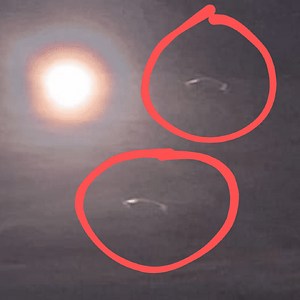
Ok, so I decided this experiment is worth repeating. This is actually something I originally did to convince new astronomers to stop trying to clean their telescope optics, but I'll repeat the experiment with the camera lens.
Please inspect the following image -- taking particular care to notice any "dirt" that may be on my optics. (I just pointed the camera out the window and took a shot.)
View attachment 149791
Ok...
Now about that "dirt" on the optics... let's have a look at that.
View attachment 149792
Yes... I cut a post-it note to about a 1/4" square piece and stuck it onto a junk filter (I don't normally use UV filters... I own them, but I rarely put one on the lens when I'm shooting).
Having seen this... go back up to that original image and see if you can figure out where the post-it note is in the image?
When you give up (because you will)... think about how a lens actually works.
If I'm taking a photo of a subject (any subject) -- let's say it's a portrait. Suppose we just think about the light that comes from the tip of the subject's nose. The light "reflecting" off a subject's nose is traveling in many directions. Most of those directions miss the camera lens, but several of them hit the camera lens. In other words if we could be microscopic people who lived on the front surface of your camera lens... would we still be able to see the persons nose if we change where we stand on the front of the lens. The answer is "yes". This is because the light from that single point on the subject is not just passing through one particular point on the lens... it's passing through EVERY point on the lens simultaneously. That light then re-converges back to a single point on the sensor (assuming you focused on the subject). Literally the most out-of-focus place in the entire optical path is that front lens element.
This means individual bits of dirt will be missed by the overwhelming majority of the light and only a tiny tiny fraction of light will be absorbed by the dirt. If a lens was very dirty, it could result in a slight loss in contrast. In order for dirt to show up in the image... it needs to be very close to a focus point in the optical path and the only two focus points are at the focused subject distance and at the focused sensor distance. This is why you can notice dust spots ON your camera sensor... but you wont really notice dust spots on the lens (the lens is much too far away from the point of focus on the sensor.)
The point is... STOP obsessing about cleaning your lens.
I take some care to avoid getting my lenses dirty... put the dust cap on when not using it. Use a hood. But do not rush to clean it every time you see a dust particle.







![[No title]](/data/xfmg/thumbnail/39/39193-6ebc8ca9478a68b5fe2120c2163f40d3.jpg?1734173069)
![[No title]](/data/xfmg/thumbnail/42/42026-4f14b406e4eb9c886f454721fb021fba.jpg?1734176410)