Firstly a point - I understand how you want to show fullsized images to show the quality you are seeing, but please keep your images to 800pixels or shorter on the longest side when embedding them into the forum. This helps keep the image size down and thus means that those on slower connections are able to view and use the site. If you want to you can put a direct link to the larger versions so that we can follow that.
As for the images a few points:
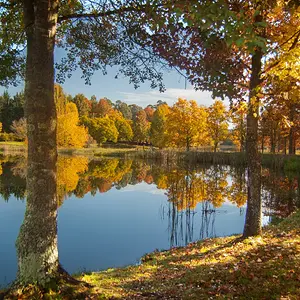
1) Avoid f22. The smaller the aperture the closer you get to where diffraction starts to affect your overall image quality. For most lenses they tend to get sharper as you approach f8 and then will start to soften again as you head away from f10. On most camera bodies and lenses you can get away with f13 and even f16 without too much trouble from diffraction, but going any smaller and your shots will get softer and softer no matter how well you take the shot itself. This is what I suspect is leading to the softness you are seeing in shot 1.
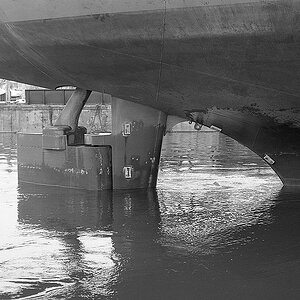
2) Your second source of softness is the shutter speed of 1/10sec. Whilst you used a tripod which means that shake at the camera end is not a problem, your shutter speed is way too slow to capture motion - which means the cars will blure, the trees and vegitation and anything that moves (even in light wind) andany mpeople or other moving elements. The only things that will come out sharp are going to be totally static elements.
3) Depth of field - going for something like f22 for more depth is an option, but a better one is to head over to google and start learning about hyperfocal distance and focusing - which is what many landscapers use so that they can get a whole landscape sharp whilst still at apertures like f8 and f10. I am guessing that the signpost in shot 1 is possible out of focus rather than being soft for the lens - so review your focusing method (I would elaborate more but its not an area I am well enough experienced with.
something to get you started with:
Online Depth of Field Calculator
4) Remember a superzoom lens is always going to be a compramise - especaially at the longer focal lengths of its range. At 28mm it should give good, usable results - and as you get closer to 200mm things will change. I know the generalities but I've never used the lens nor camera body so I can't be certain how "well" the combo should work
5) Sharpening - I bet you if you run some sharpening over shot 2 you can improve the end result. Good sharpening (if you work in RAW or JPEG) is an essential part of working with digital images - as well as other editing methods you can learn. There are some good articles on sharpening, as well as other editing aspects here:
Ron Bigelow Photography Articles


 I don't usually do post processing because I'm not very good at it and I tend to ruin everything.


![[No title]](/data/xfmg/thumbnail/39/39447-6e7679723d775935851f055bae9712ba.jpg?1734173538)
![[No title]](/data/xfmg/thumbnail/36/36672-6e6efd07ece42d211057279229ffe34c.jpg?1734169173)

![[No title]](/data/xfmg/thumbnail/39/39533-c2c39d37e833a4689533c897ace8c348.jpg?1734173682)