What's new

Another Moon photo

Stacking can compensate for boiling, to a degree. It picks the sharpest bits from every shot.

At least, I think that's what it does. Sparky talked about it a while back.

ETA: http://www.thephotoforum.com/forum/general-gallery/328496-tonight-s-moon.html

Thanks. I read the thread and links, lots of good info for sure.

I like the analogy of trying to photograph a penny at the bottom of a swimming pool. If the water is calm, you should be ok but if theres a slight wave, it's like the atmosphere boiling condition. Oh and did I forget the moon is bright and moving at 2,288mph :crazy: But it wouldn't be any fun if it wasn't challenging right? ;)
 
Stacking can compensate for boiling, to a degree. It picks the sharpest bits from every shot.

At least, I think that's what it does. Sparky talked about it a while back.

ETA: http://www.thephotoforum.com/forum/general-gallery/328496-tonight-s-moon.html

yes, you are correct, he does some focus stacking which can help, but the OP has other issues which need to be addressed before worrying about that sort of thing, focus stacking OOF images to begin with won't help. the reason I mentioned focus stacking will be spotty is that the OP is trying to stack just a handful of frames, when the effects of the atmosphere are unpredictable, and 5 frames really won't cut it for anything useful, sparky used 17, and quite honestly, even that is a quite a bit low...that's why some guys use video and then separate the frames, and stack them to get the best results since they can use hundreds at a time.

here's an example using a cheap webcam for Jupiter:


the same idea would apply to the moon, although to a lesser degree since we're so much closer to the moon it wouldn't be quite as difficult to extract the details as it would be for Jupiter or other plantets, etc...

tailgunner you've got a good start, but once you get used to live view manual focusing, and can get at least a portion in sharp focus, that's when you'll want to start playing with stacking.
 
Last edited by a moderator:
I haven't had much time to practice my moon shots, either been busy or it's been cloudy. Anyhow, I figured i would play around with the moon and some clouds.

 
and f14? 1/50? your settings seem a little odd.
Keep in mind that the moon is lit by direct Sunlight, so exposures will be fairly close to daytime settings. Also, the moon is moving, pretty quickly too - just over 1000 m/s. So it wouldn't take much to start to see motion blur.
 
and f14? 1/50? your settings seem a little odd.
Keep in mind that the moon is lit by direct Sunlight, so exposures will be fairly close to daytime settings. Also, the moon is moving, pretty quickly too - just over 1000 m/s. So it wouldn't take much to start to see motion blur.

Yes sir, I think this is what throws most of us off who are new to photographing the moon. We see some giant object hovering above and set up for a stationary object. We fail to understand that object is actually moving around 22,000 mph and is lit up by the sun. Thats what happened to me and why I showed a lot of blur. This time around I set the camera to F11 and 1/500s. Anyhow, It was a cloudy night but the pictures seem to turn out a lot better than my previous attempts.
 
It seems to be a paradox, for sure. Very counter-intuitive...

You look at it and think "dark and slow", but it's actually the opposite.
 
and f14? 1/50? your settings seem a little odd.
Keep in mind that the moon is lit by direct Sunlight, so exposures will be fairly close to daytime settings. Also, the moon is moving, pretty quickly too - just over 1000 m/s. So it wouldn't take much to start to see motion blur.

Yes sir, I think this is what throws most of us off who are new to photographing the moon. We see some giant object hovering above and set up for a stationary object. We fail to understand that object is actually moving around 22,000 mph and is lit up by the sun. Thats what happened to me and why I showed a lot of blur. This time around I set the camera to F11 and 1/500s. Anyhow, It was a cloudy night but the pictures seem to turn out a lot better than my previous attempts.
This.

I wouldn't shoot less than 1/250.

Here's my take.

11474005276_2395eff880.jpg


f/11, 1/250, ISO 1600 (300mm Tamron f/4)
 
Keep in mind that the moon is lit by direct Sunlight, so exposures will be fairly close to daytime settings. Also, the moon is moving, pretty quickly too - just over 1000 m/s. So it wouldn't take much to start to see motion blur.

Yes sir, I think this is what throws most of us off who are new to photographing the moon. We see some giant object hovering above and set up for a stationary object. We fail to understand that object is actually moving around 22,000 mph and is lit up by the sun. Thats what happened to me and why I showed a lot of blur. This time around I set the camera to F11 and 1/500s. Anyhow, It was a cloudy night but the pictures seem to turn out a lot better than my previous attempts.
This.

I wouldn't shoot less than 1/250.

Here's my take.

11474005276_2395eff880.jpg


f/11, 1/250, ISO 1600 (300mm Tamron f/4)

Nicely done!
 
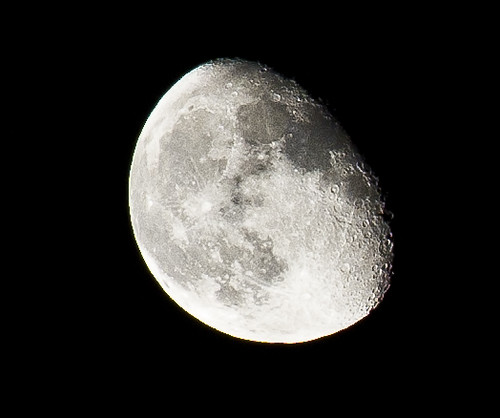
I took this moon shot back in October one day after full with my Canon SX50 HS in auto mode. Just a little sharpening in PSP X3 and I'm happy with the results.
 

Attachments

  • $October moon.webp
    $October moon.webp
    54.3 KB · Views: 143
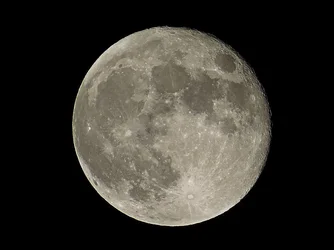
Here is one I took over the summer. I had my shutter speed too low apparently but I still like it.

IMG_9250e by jkschalo, on Flickr

F11 1/40 ISO100
 
Keep in mind that the moon is lit by direct Sunlight, so exposures will be fairly close to daytime settings. Also, the moon is moving, pretty quickly too - just over 1000 m/s. So it wouldn't take much to start to see motion blur.

Yes sir, I think this is what throws most of us off who are new to photographing the moon. We see some giant object hovering above and set up for a stationary object. We fail to understand that object is actually moving around 22,000 mph and is lit up by the sun. Thats what happened to me and why I showed a lot of blur. This time around I set the camera to F11 and 1/500s. Anyhow, It was a cloudy night but the pictures seem to turn out a lot better than my previous attempts.
This.

I wouldn't shoot less than 1/250.

Here's my take.

11474005276_2395eff880.jpg


f/11, 1/250, ISO 1600 (300mm Tamron f/4)

I really like this one!
 
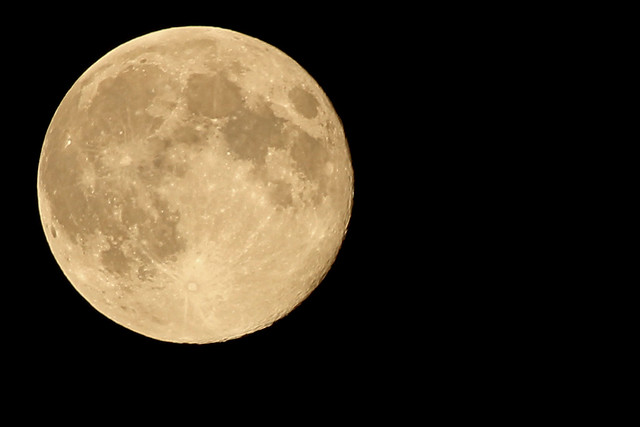
Here is my latest attempt at the moon and shot with my new D800

F/11
1/250
ISO 200

D800
70-200mm 2.8 VR II
TC 1.7


Create an account or login to comment

You must be a member in order to leave a comment

Create account

Create an account on our community. It's easy!

Log in

Already have an account? Log in here.

Back
Top Bottom