What's new

Big lenses

Your 300mm normal lens for [approx] 200x250mm [aka 8x10 inch, and thats ignoring the fact you probably have a lot more room than that for the camera movements] is probably f/5.6, that "nifty fifty" is f/1.8 and its a lens for DSLRs, which means a lot of things change (no need for a central shutter, need for the ability to focus, autofocus motor, etc).

Plus of course the 50mm f1.8, at least on my Nikon, is a VERY small lens. Much smaller than its housing.

My lens also includes it's own shutter though, remove the shutter and it's even smaller ;)
Re-read my posting. I already said that large format lenses need a central shutter. You even QUOTED it. I made it RED, BOLD and UNDERLINED so its not possible to miss it.


That was my point.
My point was that this comparison was completely invalid. And again - the actual optics of a 50mm f1.8 for DSLRs are quite a lot smaller compared to the size of the whole lens. Something you gleefully ignored AGAIN.

Step back a moment and think about this LOGICALLY instead of trying to come up with flawed comparisons.

1. Lets take two sensors of any size, but one is twice as tall as the other, with any but an identical aspect ratio, so the image circle is exactly twice as large in diameter (or radius) as well. Each of the two sensors also have a lens which should give them the same focal length equivalent, at the same aperture. Question: does the larger sensor need a different lens formula, because its larger ? Answer is no, of course not. Especially the optics of the bigger sensor do not suddenly magically get smaller. They grow the same as the sensor.

2. So how heavy are the two optics ? Thats easy too: the bigger sensor is twice as tall/has twice the diameter of the image circle (1 dimension), thus the sensor area is 4 times as large (2 dimension) AND THE OPTICS WEIGHT 8 TIMES AS MUCH (since that grows in 3 dimensions).

There. Thats why, if you do the SAME optics, the weight of the optics increase. In fact, they increase at quite large speed indeed.
 
Your 300mm normal lens for [approx] 200x250mm [aka 8x10 inch, and thats ignoring the fact you probably have a lot more room than that for the camera movements] is probably f/5.6, that "nifty fifty" is f/1.8 and its a lens for DSLRs, which means a lot of things change (no need for a central shutter, need for the ability to focus, autofocus motor, etc).

Plus of course the 50mm f1.8, at least on my Nikon, is a VERY small lens. Much smaller than its housing.

My lens also includes it's own shutter though, remove the shutter and it's even smaller ;)
Re-read my posting. I already said that large format lenses need a central shutter. You even QUOTED it. I made it RED, BOLD and UNDERLINED so its not possible to miss it.


That was my point.
My point was that this comparison was completely invalid. And again - the actual optics of a 50mm f1.8 for DSLRs are quite a lot smaller compared to the size of the whole lens. Something you gleefully ignored AGAIN.

Step back a moment and think about this LOGICALLY instead of trying to come up with flawed comparisons.

1. Lets take two sensors of any size, but one is twice as tall as the other, with any but an identical aspect ratio, so the image circle is exactly twice as large in diameter (or radius) as well. Each of the two sensors also have a lens which should give them the same focal length equivalent, at the same aperture. Question: does the larger sensor need a different lens formula, because its larger ? Answer is no, of course not. Especially the optics of the bigger sensor do not suddenly magically get smaller. They grow the same as the sensor.

2. So how heavy are the two optics ? Thats easy too: the bigger sensor is twice as tall/has twice the diameter of the image circle (1 dimension), thus the sensor area is 4 times as large (2 dimension) AND THE OPTICS WEIGHT 8 TIMES AS MUCH (since that grows in 3 dimensions).

There. Thats why, if you do the SAME optics, the weight of the optics increase. In fact, they increase at quite large speed indeed.

I'm using the tapatalk app, there's no bold or underlined or colored showing, just text.

Secondly, simmer down.

In a perfect world, we would only have the best, sharpest, lightest, smallest lens design... But in the real world we have choices.

I don't have enough info on lens design to comment further, but I doubt the actual design of the 50mm 1.8 is the same as the element design of the 300mm I mentioned.

What I can tell you is that your example is slightly off. If you double one side in length, you are using less of the total IC that would cover that area. You need to extend both sides equally to make your example fully work in terms of lens coverage and surface area.

But anyway, don't get so mad man, this is a forum discussion not a competition, and with the exception of the 50mm 1.8, almost none of the 50mm are super light.

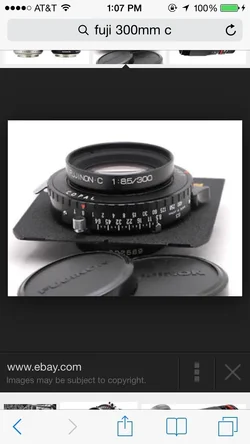
Most 300mm lenses for 35mm can't touch the small size of the 300mm C I have, but then most of the 300mm large format lenses can't either. Why is this lens design so much smaller? Because they found a way to make it work optically, and it's a good lens, that's all.

My point again was that not all focal lengths of a given size will all be the same. They very based on design factors. The larger 35mm ones for example are large because for one they are telephoto lenses, the 300mm C is not, and also they must compress the image detail down to that tiny 35mm area and do it well in high detail. The 300mm doesn't have to compress the info much, and with such a large image surface, the optical detail doesn't have to be quite as strict and perfect. That said it's still darn good.
 
My point again was that not all focal lengths of a given size will all be the same. They very based on design factors. The larger 35mm ones for example are large because for one they are telephoto lenses, the 300mm C is not, and also they must compress the image detail down to that tiny 35mm area and do it well in high detail. The 300mm doesn't have to compress the info much, and with such a large image surface, the optical detail doesn't have to be quite as strict and perfect. That said it's still darn good.

Actually being a telephoto makes a lens smaller. The true definition of a telephoto lens is one where it's physical length is less than it's focal length. Many people assume (wrongly) that telephoto means long focal length lens. This is not the case but telephoto designs are usually used for long focal length lenses specifically to make them smaller.
Wide angle lenses on the other hand often have to be retrofocus, where the rear flange distance is greater than the focal length, this is to give the required clearance at the back of the lens.
 
My point again was that not all focal lengths of a given size will all be the same. They very based on design factors. The larger 35mm ones for example are large because for one they are telephoto lenses, the 300mm C is not, and also they must compress the image detail down to that tiny 35mm area and do it well in high detail. The 300mm doesn't have to compress the info much, and with such a large image surface, the optical detail doesn't have to be quite as strict and perfect. That said it's still darn good.

Actually being a telephoto makes a lens smaller. The true definition of a telephoto lens is one where it's physical length is less than it's focal length. Many people assume (wrongly) that telephoto means long focal length lens. This is not the case but telephoto designs are usually used for long focal length lenses specifically to make them smaller.
Wide angle lenses on the other hand often have to be retrofocus, where the rear flange distance is greater than the focal length, this is to give the required clearance at the back of the lens.

This is slightly wrong,

A telephoto lens, is one where the length from the rear focal node to the film plain is less than the focal length. So in large format photography, the telephoto lens itself is generally bigger and heavier than a non-telephoto, but you need less bellows draw so that's the trade off.

In 35mm/MF photography where the lens is the focussing mechanism instead of the bellows system the interior of the lens elements will shift to accommodate the fixed lens to focal length position.

This is why most telephoto lenses are heavy, because the lens elements make up for the distance to film plane issue.

So not all telephoto lenses are smaller than their non-telephoto counterparts, but in 35mm systems that would mostly be true.

Don't believe everything Wikipedia says ;)

Don't believe everything you read on the internet either (including my posts) sometimes it's a matter of perspective...
 
Example...

300mm C (non telephoto)

$ImageUploadedByTapatalk1398704902.876853.webp

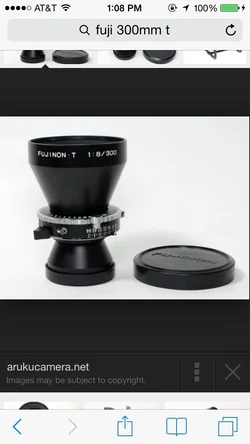
300mm T (telephoto)

$ImageUploadedByTapatalk1398704925.817183.webp


Which is bigger?
 

Create an account or login to comment

You must be a member in order to leave a comment

Create account

Create an account on our community. It's easy!

Log in

Already have an account? Log in here.

Back
Top Bottom