What's new

Brand brand new to photography

raffile

TPF Noob!
Joined
Sep 5, 2011
Messages
45
Reaction score
1
Location
Missouri
I have always wanted to get into photography, not as a career, but as a hobby. I think that the market is a bit saturated to get into this as a career. So anyway I bought a nikon D7000 16.2 mega pixels. It takes awesome photos! Every photo, even the bad ones, look like they were taken professionally.But anyway to get to my question... As a beginner I really don't know where to start. This is just something I wanted to get into as a hobby... Nothing more. Should I just take scenic pictures? Family photos? Either way I am going to have fun with it but maybe you could give me some ideas where you started... What kind of photos you started off taking... Did you ever photoshop photos for different effects? All in all just give me some beginning tips an I would really appreciate it.Thanks in advanced!
 
Take photos of anything you find interesting. Anything. Everything. What I did was walked around the house and neighborhood trying to put a creative spin on every-day objects. This was the first shot I took that I was actually proud of. And it's just my kitchen chair.

Read your manual from front to back (a bit hypocritical of me as I have not done it myself, but it really is important in learning all the features and functions of your camera)
Study the rule of thirds. Not so much a rule as it is a guideline, but important to learn as you're starting out.
Read Understanding Exposure
Plan some ideas out in your head of things you want to shoot and try to form a visual and see how close you can get to achieving it using your camera.
Pick up a nifty fifty. It's one of the best, most versatile lenses you can buy, and it's also one of the cheapest you'll find (around $100 bucks). You'll eventually probably get one anyway, might as well get it now so you have a quality lens to work with.

Your camera doesn't take good pictures, you do. All you're seeing is that your DSLR has a better quality sensor and better quality optics than a point-and-shoot that you're used to. I guarantee most of the shots you take right now, being inexperienced, are crap. You'll start seeing that as you get more practice. Also, megapixels don't really matter until you start sending photos off to have large prints made, and even then, resolution is highly dependent on sensor size. Megapixels have turned into not much more than a marketing gimmick... so don't get your head too wrapped around that, it doesn't matter for the time being.
 
Last edited:
You are right about learning all the ins and outs of this camera. It does way more than I expected. Are there any features you recommend me to get used to? I hope to get familiar with everything but right now it's a bit overwhelming. I normally don't take b/w photos because it's easier to just photoshop them and it leaves me the freedom of bringing out certain colors
 
Are there any features you recommend me to get used to?

Yes. As you start out, keep your camera in full manual mode (marked with an M on the mode wheel on top of your camera) as often as possible. This means you have to manually set the aperture, shutter speed, and ISO yourself for every shot. This is by far the best way to familiarize yourself with how each of those three properties interact with one another.

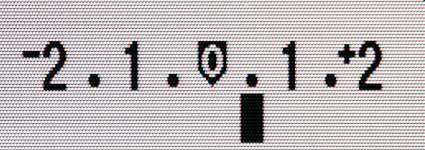
When you look inside your viewfinder, you'll see something that looks like this:

hT9br.jpg


It's an exposure meter. When working in manual (M) mode, that will help to guide you in getting a properly exposed shot (working best in well-lit scenes). When the bar hits 0, that means your camera thinks you'll have a properly exposed shot at the settings you have set. Give it a try. Put your camera into manual mode (ISO should be at 200 by default, just leave that). Go outside, and point your camera somewhere, and start turning the aperture/shutter speed wheels on your camera and watch how the bar in your viewfinder moves around. Take a shot below 0 (underexposed, dark), a shot above 0 (overexposed, bright/washed out), and a shot at 0 (correctly exposed, even colors/brightness).

Again, read the understanding exposure book. Really. It will help you immensely at understanding the relationship between aperture/iso/shutter speed and will show you what each one really means and how it affects your photos. You can probably borrow a copy from your local library.
 
Last edited:
^ +1

Also, 0 on the meter isn't always correct, it's just 0. Use the meter to adjust your settings to match the light in the scene, but only as a guide. Sometimes 0 is what you want, sometimes -1 or +2 looks best. Experiment and see! Read about the different metering modes in your camera's manual so you can get the meter to behave optimally in various conditions.
 
Allow me to offer a different approach. I don't suggest you immediately set your camera to manual. Instead put your camera on the 'P' (programed auto) and take a few photos of inane things around your house. Familiarize yourself with how your pop-up flash works. Figure out hoe to download your pictures and how to reformat your memory cards. Once you're comfortable holding the camera steady and pushing the shutter release without jerking the camera it's time to delve a little deeper in the book that came with it. Get your battery charged up and give yourself about an hour or two each day to learn your camera. Every time the book introduces a feature try it out a few times, change that setting back and forth a few times and pay attention to how your pictures change when you change the particular setting. Your camera book will eventually touch on every operating mode including the infamous 'M' (manual) mode. By using a systematic approach you will soon be very comfortable with every feature of your camera, including all of the varying exposure modes. Putting your camera on manual exclusively does not make you a better photographer nor does it tag you as being knowledgeable. A great deal of research and technology has gone into the operating systems of your camera as well as the various metering and exposure modes, and you have paid a good price for it when you purchased your camera. Learn what everything does and thereby you will know why and when to use the various features.

Don't worry about taking award winning photos right from the start. Learn your camera, develop an eye for images, and soon you'll be the one giving advice to newbies.

Don't worry about buying books and instructional dvd's just yet. Worry about just being able to take a decently exposed photo for now and you'll soon figure out what it is you need a bit of help with. Books, dvd's and forums are only really helpful when it is you know what you want to ask about.

Have fun, it's an interesting and rewarding hobby.
 

Create an account or login to comment

You must be a member in order to leave a comment

Create account

Create an account on our community. It's easy!

Log in

Already have an account? Log in here.

New Topics

Back
Top Bottom