What's new

Can you look at this pic and give me some (technical) pointers??

Sammie_Lou

TPF Noob!
Joined
Jun 15, 2011
Messages
394
Reaction score
59
Location
Farmington Hills, MI
Can others edit my Photos
Photos OK to edit
I went out on my porch with my tripod (a cheap crappy one that I got for my P&S) late at night to try to practice with low light. I'm not looking for C&C for this, as I wasn't trying to "capture" anything at all. I was just testing out settings to see what I could get. This is my neighbor's house. It was about 10 pm and completely dark outside. I just pointed the camera towards their house because their porch lights were on. A couple questions...#1, once I buy myself a remote for the shutter, will the porch lights look more realistic (i.e. smaller) and less like big blobs of light?? And #2, what's with the random green reflection-type things in the middle of the image?? I'm throwing in another one that I took during this same little experiment just because I think it looks sweet. =) I probably looked like a total creep, sitting on my porch in the dark with a tripod pointed at the neighbor's house. lol I'm glad nobody called the cops on me!

Also, was the exposure too long/was the f-stop okay?? I'm wondering if it looks too bright when it's supposed to be a "night shot". Thanks in advance!

#1 (the one I'm asking for help on)
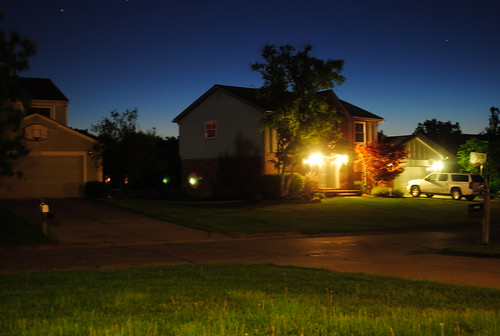
DSC_0350 by SHerren88, on Flickr

#2 (has the same issues...I just like the streaks from the car that drove past)
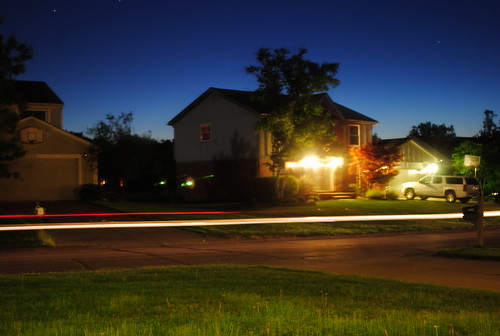
DSC_0349 by SHerren88, on Flickr
 
Different lenses give you different sun stars as they say for the lights. Stop it down to at f11 use a longer exposure I think will bring out the sun stars better. But also get a better tripod...The photos are blurry.
 
The scene you are shooting has too much dynamic range for your camera, so the bright stuff is blown out, and the dark shadows are... well, black. Within the same exposure, you can either expose for the highlights, and get blocked shadows (ie, no detail), or expose for the shadows, and get blown highlights, or go for the middle, and get some blown highlights and some blocked shadows, but more stuff with some detail. The other way is to shoot a series of bracketed shots and assemble them together with a HDR program. As the photographer, you have to decide where you want the detail and expose accordingly. If you want night shots to look like night, then expose for the lights, and everything else will be in darkness. If you want to see what's in the shadows, expose for them, and accept the fact that all the lights will be blown.
 
I'm probably not going to be doing a ton of night photography so I'm going to hold off on a better tripod for now. I'm just trying to learn the manual settings of the camera and how they work together. =) I tried reading a bunch of stuff but the terms are hard for me to understand so it's in one ear and out the other (in one eye and out the other? Hmm...). I'm trying to learn more hands-on, I guess. Thanks for the replies!
 
Cameras see light like it really is, whereas our eyes are a mix of rods and cones (rods are for night vision), and the rods are near colorblind and can't see red light. To make a night photograph look like you see it you have to post process.
 
Until you get the heavy duty tripod and remote trigger, you can try using the self time to minimize vibrations you create
 
The 'random green reflection-type things' is lens flare from the neighbors' lights.
 
...I tried reading a bunch of stuff but the terms are hard for me to understand.... I'm trying to learn more hands-on, I guess. Thanks for the replies!
That is also known as the trial-and-error method, and dooms you to repeating most of the mistakes so many others before you have already made.

Studies have shown most people have to be exposed to a concept about 6 times before they begin to understand it, so don't give up to quick.

How can others offer you help and advice if you don't understand the terminology they use to try and help you? It seems kind of disingenuous to ask for technical pointers and then beg off because you don't understand the technical terms.

If you make the effort to look up any terms you don't understand, you'll not only then know what they mean, you'll discover other information you didn't know you would want to know, and will learn a lot quicker.

If you haven't already, check out some of these short tutorials: Digital Photography Tutorials
 
I went to the library and got "Digital SLR Photography for Dummies". lol Hopefully it helps! I also got 4 other books about DSLR's...once I get the hang of the technical terms and all that, I'll move on to the books that teach more technique/composition. My library card is going to get a workout this summer!
 
One bit of advice I'll offer is to get setup much sooner. Take the shot while there is still some light being reflected after the sun has dipped below the horizon, but dark enough for exterior lights to be needed. There is a golden window of opportunity to make great night shots. You'll need to be ready when it arrives because it doesn't last long. Don't belive me? How about Bryan Peterson then........


YouTube - ‪Taking Pictures after Sunset with Bryan Peterson‬‏
 
I'm diggin' his hairstyle. Might be sporting that look myself, pretty soon... lol Seriously, though, thanks for the video! His book is one that I have on reserve at the library...just waiting for someone to bring it back (and a couple more people to check it out that were on the list ahead of me...).
 

Create an account or login to comment

You must be a member in order to leave a comment

Create account

Create an account on our community. It's easy!

Log in

Already have an account? Log in here.

New Topics

Back
Top Bottom