AfroKen
TPF Noob!
- Joined
- Aug 11, 2009
- Messages
- 166
- Reaction score
- 4
- Location
- Los Angeles, CA
- Can others edit my Photos
- Photos OK to edit
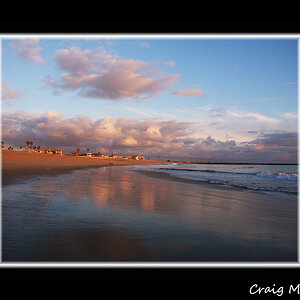
I was taking photos at the beach before and during sunrise in a fairly cool, windy area in Northern California, with a strong off-shore wind. After at least 45 minutes of photographing the surf while doing long-exposures between 10-30 seconds, I started getting visible droplets on the photos when reviewing the photos in the LCD, something I hadn't seen through the viewfinder (maybe I just couldn't see this?). The lens/photos/filters did not appear to be foggy, however.
Since I saw water droplets rather than a specific fog, I assumed that somehow, my exterior filter was being splattered even though it was an off-shore wind. The next morning, I tried it again, being extremely vigilant with covering the filter and wiping it periodically even though I didn't see anything on the exterior filter. And again, after 45 minutes or so, the same thing began occurring.
The strange part is that when I took the camera back to the hotel to wipe down the filter and lens, I didn't see any evidence of water droplets anywhere on either the two ND filters or the lens. ????
Also, I was using a Nikkor 18-200mm VR lens and had two Tiffen 0.9 ND filters attached, the first of which, as it turned out, seems to have a loose filter (the actual glass revolves when I clean it, and if I shake the filter, it noticeably rattles).
I suppose I have at least a couple of questions here:
1. Could the loose filter somehow create condensation?
2. Regardless of the filter, how can I prevent this when on extended shoots at the beach, particularly when doing long-exposure photography? What techniques or equipment do pros use in situations like this?
Now, I do know that you are supposed to keep the camera at a temperature similar to the temperature that you are going to be shooting at, which I thought I did, although I did keep it in the camera bag. But would this account for the water droplets appearing in the photos at least 45 minutes after I had begun shooting? Wouldn't the condensation occur almost immediately?
Equipment (just in case it matters):
Nikkor 18-200mm VR lens
2 Tiffen 0.9 ND filters attached to the above lens
Nikon D90 camera
Feisol tripod
Thank you very much for your time in answering this. I do realize that this is sort of a long description and is somewhat confusing since it has a few different components to it. But I would love to do more long-exposure photography on the beach, but would love to resolve this problem first.
Last edited: