What's new

Confusing White Balance Experiment !! Explanation Please :)

Samerr9

TPF Noob!
Joined
Jan 15, 2011
Messages
683
Reaction score
46
Location
Abu Dhabi,UAE
Can others edit my Photos
Photos OK to edit
Hi all

Lately I am really into nailing the WB after some comments on getting green tints in my photos. The first thing I did to get over this is that I calibrated my monitor with spyder3. Second I decided to use the grey card on every photoshoot. But again I didn't really like the results (just a feeling) so I decided to do the experiment below.

First excuse me if my room is messy but I was doing this for me only and now I am sharing..

Well, I am in my room and it has one tungsten light with no diffusers, so I set my camera to tungsten. Every thing was over warm, so it is time to use a grey card. I have two WB balancing tools. A grey card and a WB traget reflector. I put them all in the same frame and shooted RAW while the camera is on tungsten. In lightroom I used the WB dropper on the red Xs below and the result is as follow:
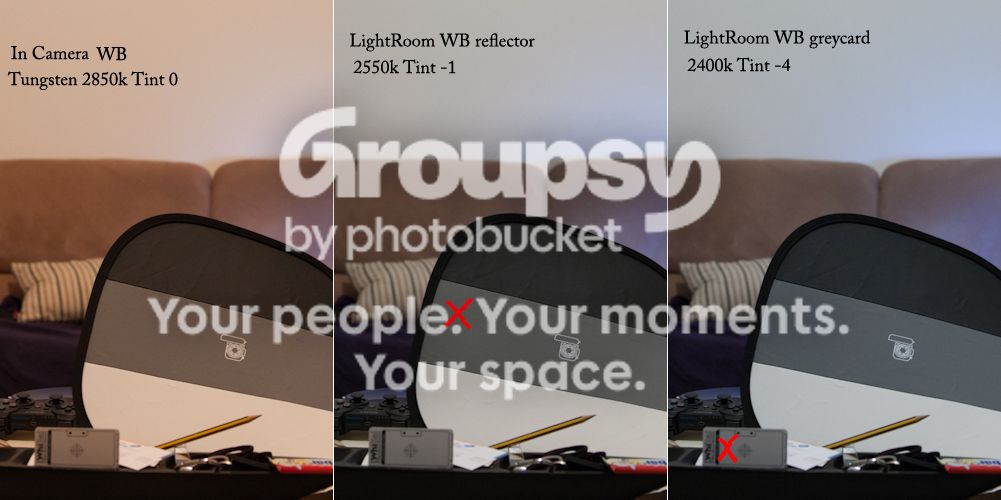
WB.jpg


I don't want to analyse what I am seeing because it is obvious. But is there an explanation?
 
Your in-camera indoor white balance is poor under tungsten light? That's almost par for the course...
 
Your in-camera indoor white balance is poor under tungsten light? That's almost par for the course...
I *think* his bigger question is why when using two different grey cards, he gets two different white balances on the same image.
 
He has at least two light sources in the room. I think there's a TV on.

The light falling on the two cards is slightly different, most likely, so he's getting a slightly different correction to render each one neutral.
 
Your in-camera indoor white balance is poor under tungsten light? That's almost par for the course...

I agree, 5dmii :(

Your in-camera indoor white balance is poor under tungsten light? That's almost par for the course...
I *think* his bigger question is why when using two different grey cards, he gets two different white balances on the same image.

True also, why each is showing different k reading and different tint!
 
He has at least two light sources in the room. I think there's a TV on.

The light falling on the two cards is slightly different, most likely, so he's getting a slightly different correction to render each one neutral.

No it is only one light in the ceiling, the TV was behing me and turned off.. The laptop was facing the coach. I don't think it was reaching and of the cards.
 
Ah, that's the laptop I see illuminating the couch, not a TV? Try closing it up, or cover it with a towel. See if the results get closer together.

Also, try exchanging the positions of the grey cards, to see if any changes follow the CARD or the POSITION.
 
What color is the floor, walls and ceiling in that room? And the ceiling is white?
Notice the reflector is slightly leaned back and up. No reflection from floor. Definitely possibly reflection from walls/ceiling.
The card is striaght up and down. Reflection from floor is possible, but less so from walls and ceiling
 
What color is the floor, walls and ceiling in that room? And the ceiling is white?
Notice the reflector is slightly leaned back and up. No reflection from floor. Definitely possibly reflection from walls/ceiling.
The card is striaght up and down. Reflection from floor is possible, but less so from walls and ceiling

The walls are white and the floor is light biege..

I have a better idea now, give me 10 mintes and ill post it and I hope the issue is resolved :)
 
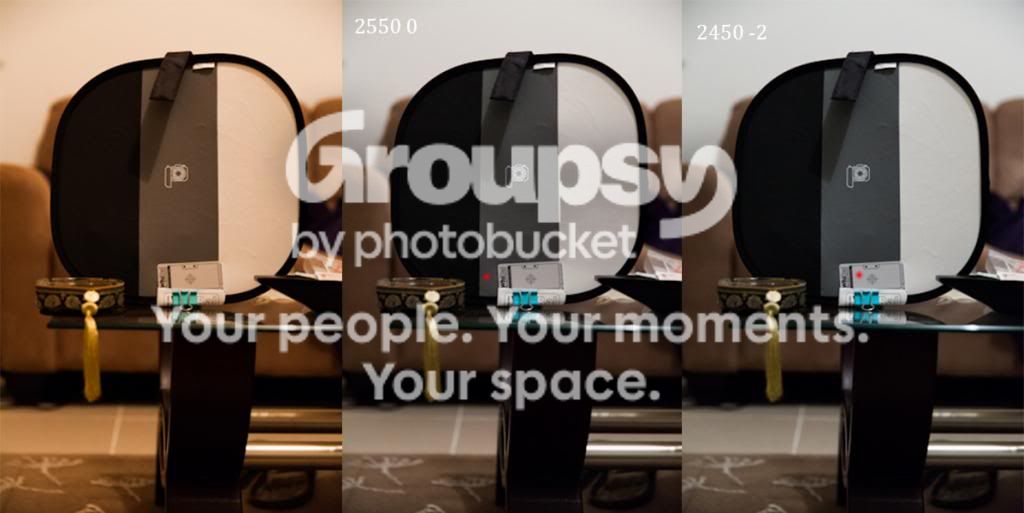
wb22.jpg


I have placed them on the same plain and level also selected the WB from the same plain.. No laptop light..

PS: I used ISO 3200 on porpose as in these situation it is more confusing for me, so it will be great if it is resolved:)
 
If it's an incandescent lamp the colour temperature will depend a lot on the wattage and the type. 2850 K is just an average value. Plenty of household lamps will have a lower CT.

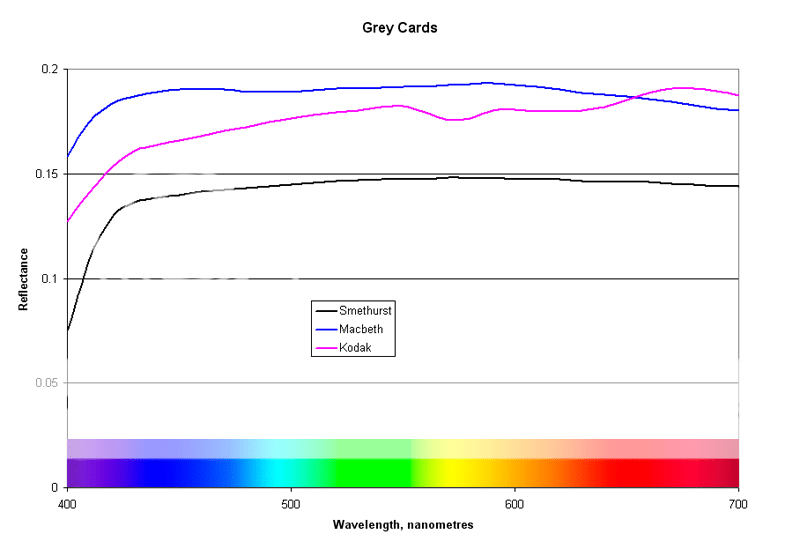
Apart from differences in illumination (eg reflections from adjacent coloured materials, which can have a surprisingly significant effect) there are variations between the 'neutrality' of different grey cards:

Greycards2.png


Put the small card on the larger target to make sure they are in the same light.

Edit: I see that you did that while I was writing my response. As I said, different grey cards can be different 'greys'.
 
hence why I prefer an expo disc for WB. They cost a little more, but you don't really have to worry about these sorts of issues.
 
I don't know what to tell you. I like the middle one best. I can see the difference in the small white balance card in the two samples. It's entirely possible that one of them is not 100% neutral. There isn't a whole lot of difference between the two when you look at the numbers.
wb22.jpg


I have placed them on the same plain and level also selected the WB from the same plain.. No laptop light..

PS: I used ISO 3200 on porpose as in these situation it is more confusing for me, so it will be great if it is resolved:)
 
If it's an incandescent lamp the colour temperature will depend a lot on the wattage and the type. 2850 K is just an average value. Plenty of household lamps will have a lower CT.

Apart from differences in illumination (eg reflections from adjacent coloured materials, which can have a surprisingly significant effect) there are variations between the 'neutrality' of different grey cards:

Put the small card on the larger target to make sure they are in the same light.

Edit: I see that you did that while I was writing my response. As I said, different grey cards can be different 'greys'.

Thank you Helen, that explains it very well..

Now the big question, which one to use?
 

Create an account or login to comment

You must be a member in order to leave a comment

Create account

Create an account on our community. It's easy!

Log in

Already have an account? Log in here.

New Topics

Back
Top Bottom