What's new

Crop vs Full Frame - DoF

Who am I to shatter your strong beliefs, Dao, when even the visual examples weren't able to do that ?
 
Buy a FF and take pictures.

Buy a DX and take pictures.

Buy a cell phone and take pictures.

Lets just take some pictures.
 
I took the pictures and I also posted them here. What else ?
 
Who am I to shatter your strong beliefs, Dao, when even the visual examples weren't able to do that ?
When I first came across with the term Circle of Confusion in 2008, I did a great deal of reading about it as well as DoF. And all the articles, opinions from other sites make me believe that is the correct.

So I have no reason to believe you when you said "CoC is a characteristic of the lens". Sorry.

Unless, Bob Atkin was wrong, information I read from Wikipedia was wrong, Nikon USA post wrong information, dpreview.com post wrong definition about CoC

Since you are the only one I found (so far) said CoC (of DoF) has nothing to do with sensor size (recording medium) and it is a characteristic of the lens, so I will stay with what I believe.
 
Let me rephrase it:
Don't mind me, look at the pictures !
 
May I repeat what Helen said "Sorry, but I have the impression that you don't understand this issue."
 
You perfectly understand the sensor to print process and how a CoC is determined, but you don't get the optics ! After the CoC is established, the lens is built to reach that value. CoC is a characteristic of the lens. It represents the maximum spot diameter of the projected image of a focused point onto the surface of the film/sensor. It's actually the diameter of the spot of light. And it DOES affect the DoF !!! I will give the examples at the end of this post.

You have got mixed up between the minimum CoC a lens is capable of (the smallest blur area the lens makes for an object point in focus – which is a property of the individual lens design, but which has nothing to do with DoF); and the maximum acceptable CoC that is created by out-of focus objects before they appear to be out of focus in the image at its intended viewing size. This is not part of the lens design, but it is what determines DoF.

Once and for all, the Circle of Confusion is a LENS parameter. When a lens is built, it's built for a specific camera format. It's calculated so for a fixed size photo it produces the same clarity. So, if it's built for a FF camera the CoF is ~0.03 and if it's built for a APS-C camera the CoF is ~0.02.

Have you thought about this? You are insistent on it being true, but it is complete nonsense. 0.03 mm is 30 microns. The pixel pitch of the D3 (which isn’t a leader in terms of pixel density) is 8.45 microns. Are you really suggesting that FX lenses are designed to produce a CoC that is 3.5 pixels wide on a D3? That’s crazy.


You are talking about DoF from the perspective of the final print but take into consideration that a lot of cropping can be done in between taking the photo and printing. You cannot say that for every different crop you may have a different DoF. If I print the two photos from the previous post at a 4x6 format they will look the same. They will have the same depth of field.

4x6 is not very good for the consideration of DoF because the criterion is quite relaxed at that size. Different crops of the same original image do indeed show different DoFs when they are enlarged to the same size. This is easy to imagine and easy to see. It all depends on the degree of magnification between the originally-recorded image and the final print. The more you enlarge a slightly blurred detail, the more it is likely to be visible as a blurred detail and not perceived as a point. What is so hard about understanding that?


Let me give you another example. The DX crop of a D3x 24.5MP photo is a 10.5MP photo and a D80 photo has 10.1MP. The D3x DX cropped photo and D80 photo would have the same size and roughly the same pixel density, therefore you can print them at the same paper size. Where is the difference now ?

I’ve already covered this and said that there is no difference, so why do you bring it up as a point of argument? Don't you understand what I have written?


Now let's get back to the last part of your statement: "Lenses are indeed designed for optimum performance and coverage for a particular format, but this has more effect on their maximum resolution and may have no effect on DoF, simply because DoF is all about objects that are not in perfect focus."

Now let me show a couple of pictures and then you tell me if the different DoF has anything to do with the different lenses:
Same camera Nikon D80, same distance (not measured but I didn't move the tripod nor changed camera angle or elevation), same focal length 135mm, same aperture f/8, same photographer ( :D ).

I’m afraid that these examples show nothing other than your lack of understanding. You are trying to show a depth of field comparison. To do that you need to show:
-the exact point that is in perfect focus (that is not the same as focusing on the same point – there must be no errors)
-the transition from objects that appear to be in focus to those that appear to be out of focus. DoF is about objects that are not in the plane of focus, but still appear to be in focus. It is not about objects that appear to be out of focus.


Best,
Helen
 
No wonder they call it circle of "confusion". I am confused as heck!
 
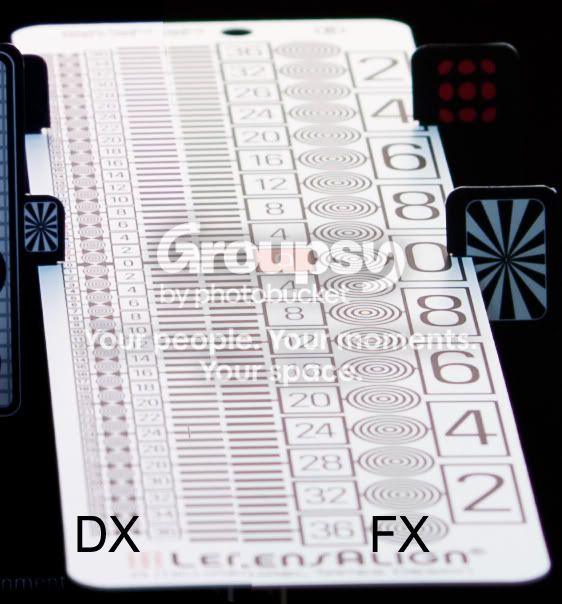
For my own amusement I compared a couple of zooms I have - one old FX for my D3 and one DX for my D40x, both on the D3. Set to ~60 mm. f/5.6, 1.2 m distance, tethered, focused using Live View in Camera Control 2 and focus checked in Capture NX2 at 100%, DX lens carefully adjusted until it matched the FX lens in terms of focal length (actually image size on the sensor). The split between the two images occurs between the two sets of bars:

D3-Aug1-1392-v2.jpg


The lenses have very slightly different resolutions (the older FX lens has slightly higher resolution than the DX lens). Apart from that there isn't a significant difference in the steady defocusing away from the focus point, I think.

Best,
Helen
 
Last edited:
Those of you that think sensor size doesn't affect dof should try shooting 8x10 film--you'd be blown away how small the dof is at f8.

There are only three things that affect dof:

1) aperture (wider narrows dof)
2) focal length (longer narrows dof)
3) distance to the subject (closer narrows dof)

When shooting with a smaller sensor/film you have to either increase distance or shorten focal length, both of which will widen your dof.

A "normal" lens on a crop sensor is 35mm which has a wider dof then a 50mm (normal for fx) at the same aperture and focus distance.

A "normal" lens for an 8x10" film camera is a whopping 300mm! Which means your dof will be very narrow even at higher apertures.
 
Last edited:
I don't know if it makes any difference, but I was doing a comparison between Fuji and Noritsu scanners, and at the same time medium format vs. 35mm for DOF. Take a look at this in regards to DOF (don't mind the scanning):

The LEFT is the Mamiya 645AFD @ 80mm, f/2.8. The RIGHT is an F100 @ 50mm, f/1.4
5988872524_bcf7a6de0c_b.jpg


Look at how strikingly similar the background looks(aside from the crappy noritsu scanning). One was shot on medium format film, the other 35mm. Exposures were equivalent to each other.
 

Create an account or login to comment

You must be a member in order to leave a comment

Create account

Create an account on our community. It's easy!

Log in

Already have an account? Log in here.

Back
Top Bottom